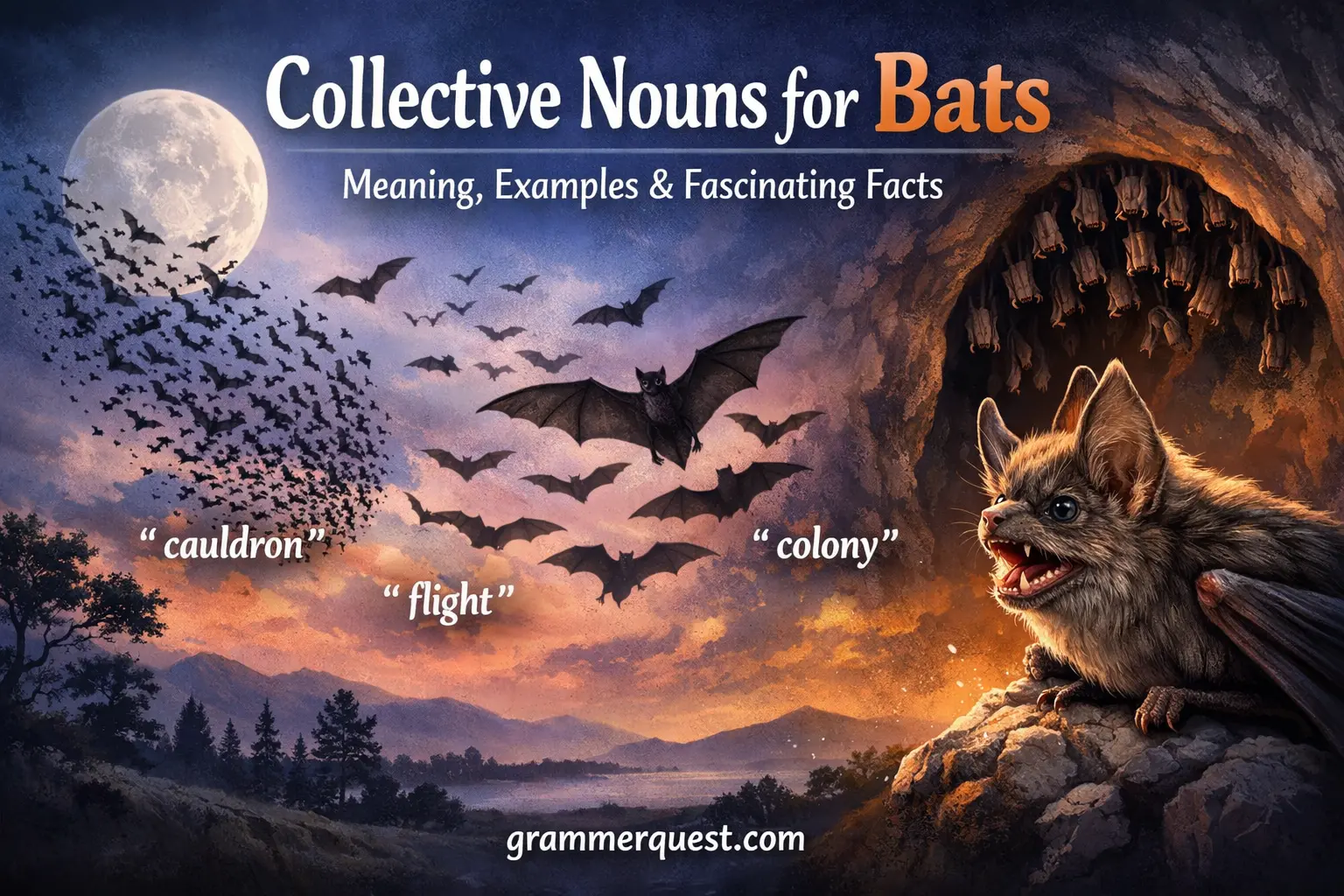
Collective nouns for bats feel special, playful, and joyful, shaping how English language words describe a group as a single unit, making meaning vivid and engaging. When it comes to wildlife, collective nouns often reflect behavior and characteristics, and in the case of bats, this is especially interesting because these highly social creatures live and move in groups, improving understanding, vocabulary, and insight into fascinating mammals and how they behave in nature.
I was inspired by a book by Chloe Rhodes, An Unkindness of Ravens, a Book many readers usually draw ideas from when writing a post—do check the cover, it’s goth AF, y’all, and that influence stayed with me long after I read it.
why we use Collective Nouns for Bats
We use collective nouns for bats to describe a group of bats in a clear and meaningful way.Bats often live together in large groups, especially in caves or trees. Instead of saying “many bats,” we use specific terms like a “colony of bats” or a “cloud of bats.” These collective nouns make the description more vivid, precise, and easier to understand.
They also help in writing and speaking, especially in wildlife studies and storytelling. For example, saying “a colony of bats hung from the cave ceiling” gives a stronger image than just saying “bats.” So, collective nouns help us describe how bats live, move, and behave in groups more effectively.
Collective Nouns for Bats
Below is a simple table to help you understand the most commonly used collective nouns for bats.
Table: Types of Collective Nouns for Bats
| Type | Example |
| Colony | A colony of bats in the cave |
| Cloud | A cloud of bats at sunset |
| Camp | A camp of bats hanging in trees |
| Swarm | A swarm of bats flying together |
| Cauldron | A cauldron of bats in the sky |
Examples of Collective Nouns for Bats
1. Colony of Bats
A colony is the most common term used for bats, especially when they are resting or living together.
Examples:
- A colony of bats lives inside the dark cave.
- We saw a colony of bats hanging from the ceiling.
- The colony of bats grows larger every year.
- A colony of bats rested quietly during the day.
- The colony of bats left the cave at dusk.
- Scientists studied a colony of bats in the forest.
- A colony of bats can include thousands of individuals.
- The colony of bats returned before sunrise.
- Farmers protect a colony of bats for pest control.
- A colony of bats prefers dark and quiet places.
2. Cloud of Bats
This term is used when bats are seen flying together in large numbers, especially at dusk.
Examples:
- A cloud of bats filled the evening sky.
- We watched a cloud of bats emerge from the cave.
- A cloud of bats flew over the river.
- The cloud of bats looked like smoke in the air.
- A cloud of bats circled above the trees.
- The sunset made the cloud of bats look magical.
- A cloud of bats moved swiftly through the sky.
- Tourists gathered to see a cloud of bats.
- The cloud of bats disappeared into the night.
- A cloud of bats created a stunning दृश्य.
3. Camp of Bats
A camp refers to bats resting together, often hanging from trees or cave ceilings.
Examples:
- A camp of bats hung quietly in the forest.
- We spotted a camp of bats in the old tree.
- A camp of bats slept during the daytime.
- The camp of bats stayed hidden from predators.
- A camp of bats clung tightly to the branches.
- The camp of bats made soft noises.
- A camp of bats prefers safe resting spots.
- The camp of bats woke up at dusk.
- A camp of bats can be found in tropical regions.
- The camp of bats remained undisturbed.
4. Swarm of Bats
A swarm highlights their movement when flying actively in large groups.
Examples:
- A swarm of bats flew out at night.
- We saw a swarm of bats hunting insects.
- The swarm of bats moved quickly.
- A swarm of bats filled the sky.
- The swarm of bats followed the river.
- A swarm of bats chased their prey.
- The swarm of bats looked chaotic but organized.
- A swarm of bats flew above the trees.
- The swarm of bats disappeared into darkness.
- A swarm of bats is a common sight at dusk.
5. Cauldron of Bats
This is a more poetic and less common term, often used in literature.
Examples:
- A cauldron of bats rose from the cave.
- The sky darkened with a cauldron of bats.
- A cauldron of bats created a spooky scene.
- We admired a cauldron of bats at sunset.
- The cauldron of bats swirled in the air.
- A cauldron of bats looked like a storm.
- The cauldron of bats amazed the visitors.
- A cauldron of bats formed a dark cloud.
- The cauldron of bats vanished into the night.
- A cauldron of bats is a rare expression.
Also Read This: Collective Nouns for Deer: Meaning, Usage, and Fascinating Facts
Interesting Facts About Bats
1. Longevity (Long Life)
Bats are surprisingly long-lived for their size. Some species can live over 30 years, which is rare among small mammals. This long lifespan helps them adapt and survive in different environments.
2. Unique Physiological Features
- Bats are the only mammals capable of true flight.
- They use echolocation, a system where they send out sound waves and listen to echoes to navigate and hunt in the dark.
- Their wings are made of a thin membrane stretched over elongated fingers, making them highly flexible fliers.
3. Diverse Diet
Bats have a wide variety of diets depending on the species:
- Many bats eat insects, helping control pests.
- Some feed on fruit and nectar, playing a key role in pollination.
- A few species even consume small animals or fish.
4. Environmental Importance
Bats are extremely important for ecosystems. They help:
- Reduce insect populations
- Pollinate plants
- Spread seeds
FAQs
1. What is a collective noun for bats?
A collective noun for bats is a special word used to describe bats when they are together as one group.
2. What is the most common collective noun for bats?
The most common collective noun for bats is a colony, because bats often live together in large groups.
3. Why do bats have collective nouns?
Bats have collective nouns to make language more precise and vivid when describing their group behavior.
4. Are collective nouns for bats different from other animals?
Yes, collective nouns for bats often reflect their social nature, movement, or living habits, which makes them unique.
5. Do bats always live in groups?
Most bats are highly social and live in groups, though some species may live alone for short periods.
6. How do collective nouns help in understanding bats?
They help us understand how bats behave, move, and interact with each other in nature.
7. Are collective nouns only used for animals like bats?
No, collective nouns are also used for people and things, such as a team of players or a bunch of keys.
8. Why are collective nouns considered playful or joyful?
They are often creative and imaginative, making the language more fun and engaging to use.
9. Do collective nouns improve vocabulary?
Yes, learning collective nouns expands vocabulary and improves how clearly we communicate.
10. Why are collective nouns for bats interesting to readers?
They combine language, nature, and behavior, which makes them fascinating for readers who enjoy wildlife and words.
Conclusion
In the end, learning about collective nouns for bats shows how language and nature connect in simple but meaningful ways. These special terms help us describe bats more clearly, reflect their social behavior, and make our words more vivid and engaging.
By understanding and using collective nouns, we not only improve our vocabulary but also gain a deeper appreciation for how these fascinating mammals live and move together in the natural world.