I enjoy exploring Collective Nouns for Camels in the English language, where fun quirks make words sound the same yet mean different things.
When I began learning, it felt challenging but also exciting to know that even lesser-known animals have creative names. For example, ants form an army, lions show pride, and some truly bizarre ones include an opera of canaries, a whoop of chimpanzees, a roll of armadillos, and an orchestra of crickets. Each noun shares a small story, and this pattern helped me better understand naming across different creatures through simple example and imagination.
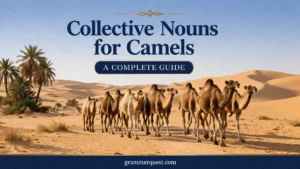
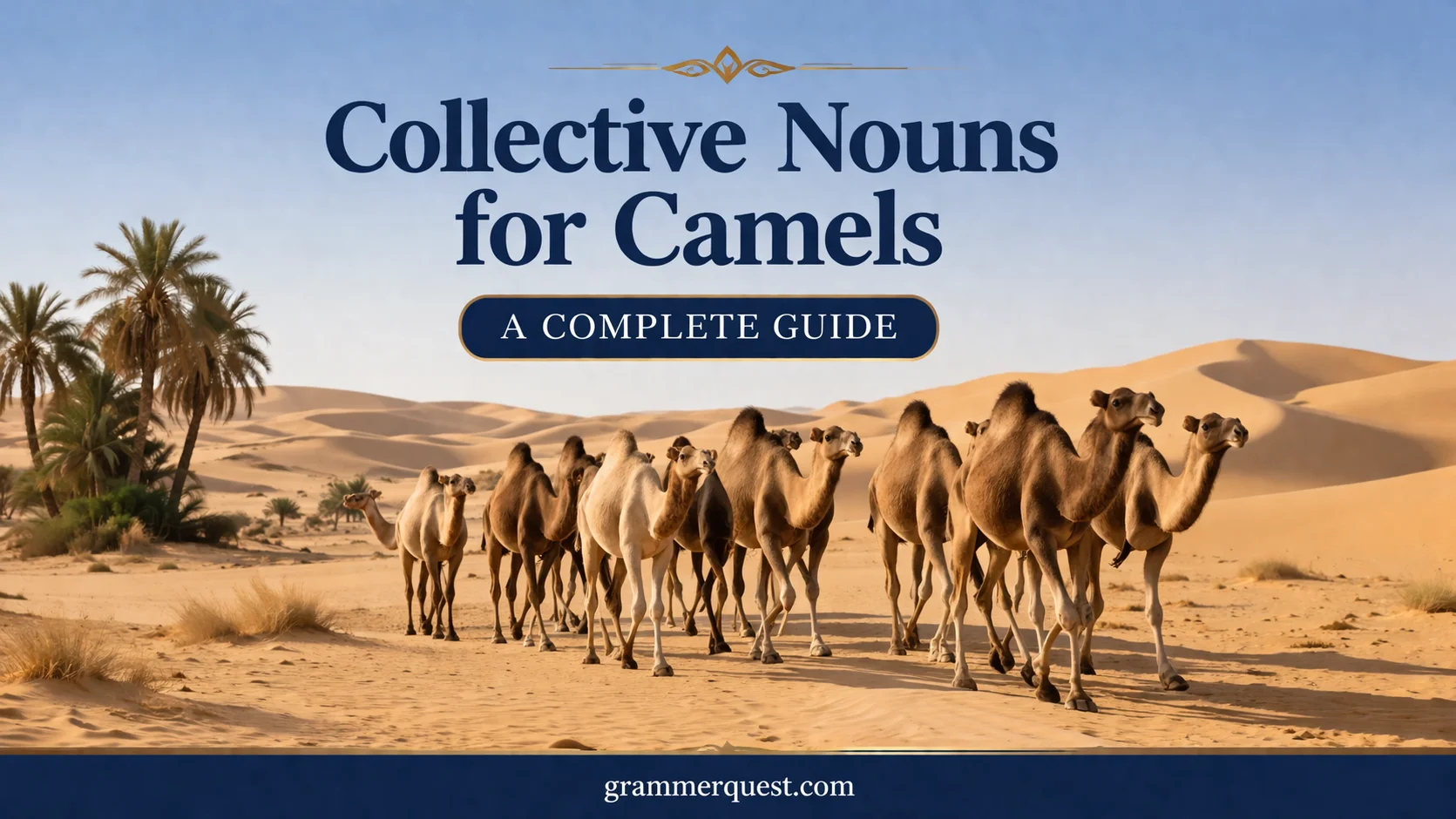
Focusing again on camels, their collective nouns feel very natural once you see them in action. A caravan or train shows them travelling in a line, while a flock or herd describes a large group often guided by a leader. In rare cases, a scorn reflects a more hostile manner. Watching them move together across deserts made me realize these terms truly reflect their behavior, movement, and social structure in a real way.
Why We Use Collective Nouns for Camels
We use collective nouns for camels because they help us communicate more clearly, efficiently, and descriptively. Instead of using long phrases, a single word like “herd” instantly conveys the idea of multiple camels moving or living together.
These nouns also reflect the natural behavior of camels. Since camels often travel in groups for protection, resource sharing, and navigation across deserts, using a collective noun highlights their social structure. Additionally, collective nouns enrich our language by adding variety and making descriptions more interesting and vivid.
How to Use These Collective Nouns of Camels
Using collective nouns for camels is simple once you understand their context. You typically use them as a singular noun representing a group. For example, instead of saying “many camels,” you can say a “herd of camels.”
It’s important to match the noun with the correct verb form depending on whether you treat the group as a single unit or as individuals. For instance, “The herd is moving” (as one unit) versus “The herd are spreading out” (emphasizing individuals, more common in British English). Using these nouns properly makes your writing more natural, fluent, and grammatically accurate.
Collective Nouns for Camels
| Collective Noun | Simple Example |
| Herd | A herd of camels is walking in the desert. |
| Caravan | A caravan of camels crossed the dunes. |
| Train | A train of camels carried goods across the desert. |
Examples of Collective Nouns for Camels
Herd of Camels
Examples:
- A herd of camels is resting under the sun.
- The herd of camels walks slowly across the sand.
- We saw a herd of camels near the oasis.
- The herd of camels drinks water together.
- A herd of camels moves in a line.
- The herd of camels looks calm and quiet.
- A herd of camels travels long distances.
- The herd of camels stays close at night.
- A herd of camels follows its leader.
- The herd of camels crosses the desert safely.
Caravan of Camels
Examples:
- A caravan of camels carries goods across the desert.
- The caravan of camels moves in a long line.
- We followed a caravan of camels during our trip.
- The caravan of camels travels at night.
- A caravan of camels stops near the village.
- The caravan of camels looks impressive.
- A caravan of camels walks slowly through the dunes.
- The caravan of camels reaches the market.
- A caravan of camels brings supplies to the town.
- The caravan of camels rests after a long journey.
Train of Camels
Examples:
- A train of camels carries heavy सामान across the desert.
- The train of camels walks in a straight line.
- We saw a train of camels near the road.
- The train of camels moves together.
- A train of camels follows its guide.
- The train of camels travels far distances.
- A train of camels crosses the hot desert.
- The train of camels stops for rest.
- A train of camels looks very organized.
- The train of camels reaches its destination.
Also Read This: Collective Nouns for Guinea Pigs: A Detailed Guide
Interesting Facts About Camels
Camels are fascinating animals with unique features that help them survive in harsh desert environments.
Longevity
Camels can live for 40 to 50 years, making them long-lived animals compared to many other mammals. Their ability to endure tough conditions contributes to their extended lifespan.
Unique Physiological Features
Camels are known for their incredible adaptations:
- They can go weeks without water.
- Their humps store fat, not water, which provides energy.
- They have thick eyelashes and closable nostrils to protect against sand.
- Their wide feet help them walk easily on soft sand.
Dietary Habits
Camels are not picky eaters. They consume:
- Dry grasses
- Desert plants
- Even thorny shrubs that other animals avoid
Their tough mouths allow them to eat rough vegetation without injury.
FAQs :
1. What are Collective Nouns for Camels?
Collective Nouns for Camels are special words used to describe a group of camels, such as caravan, herd, or train.
2. Why are collective nouns important in English?
They make language more descriptive and help us clearly talk about groups of animals or things.
3. What is the most common collective noun for camels?
The most common term is “caravan,” especially when camels travel long distances together.
4. Can camels have more than one collective noun?
Yes, camels can be called a caravan, herd, train, flock, or even scorn depending on context.
5. What does a “train” of camels mean?
It refers to camels walking in a line, often one behind the other.
6. What is a “scorn” of camels?
It is a less common term used to describe camels in a more hostile or aggressive group.
7. Are collective nouns the same for all animals?
No, each animal can have unique collective nouns, like pride for lions or army for ants.
8. How can I learn collective nouns easily?
By reading, practicing examples, and connecting words with real-life images or stories.
9. Do collective nouns change based on situation?
Sometimes yes, depending on how the animals behave or move as a group.
10. Are collective nouns used in daily conversation?
Some are common in daily use, while others are more creative and used in writing or learning.
Conclusion :
Collective Nouns for Camels show how rich and creative the English language can be. These terms not only describe groups but also reflect movement, behaviour, and culture. Learning them adds depth to communication and makes language more engaging and expressive.

Emma Brooke is a passionate language enthusiast and the voice behind GrammarQuest.com. With a sharp eye for detail and a love for clear communication, she simplifies complex grammar rules into easy, practical lessons. Her goal is to help you write with confidence, clarity, and style—whether you’re a student, professional, or everyday writer.