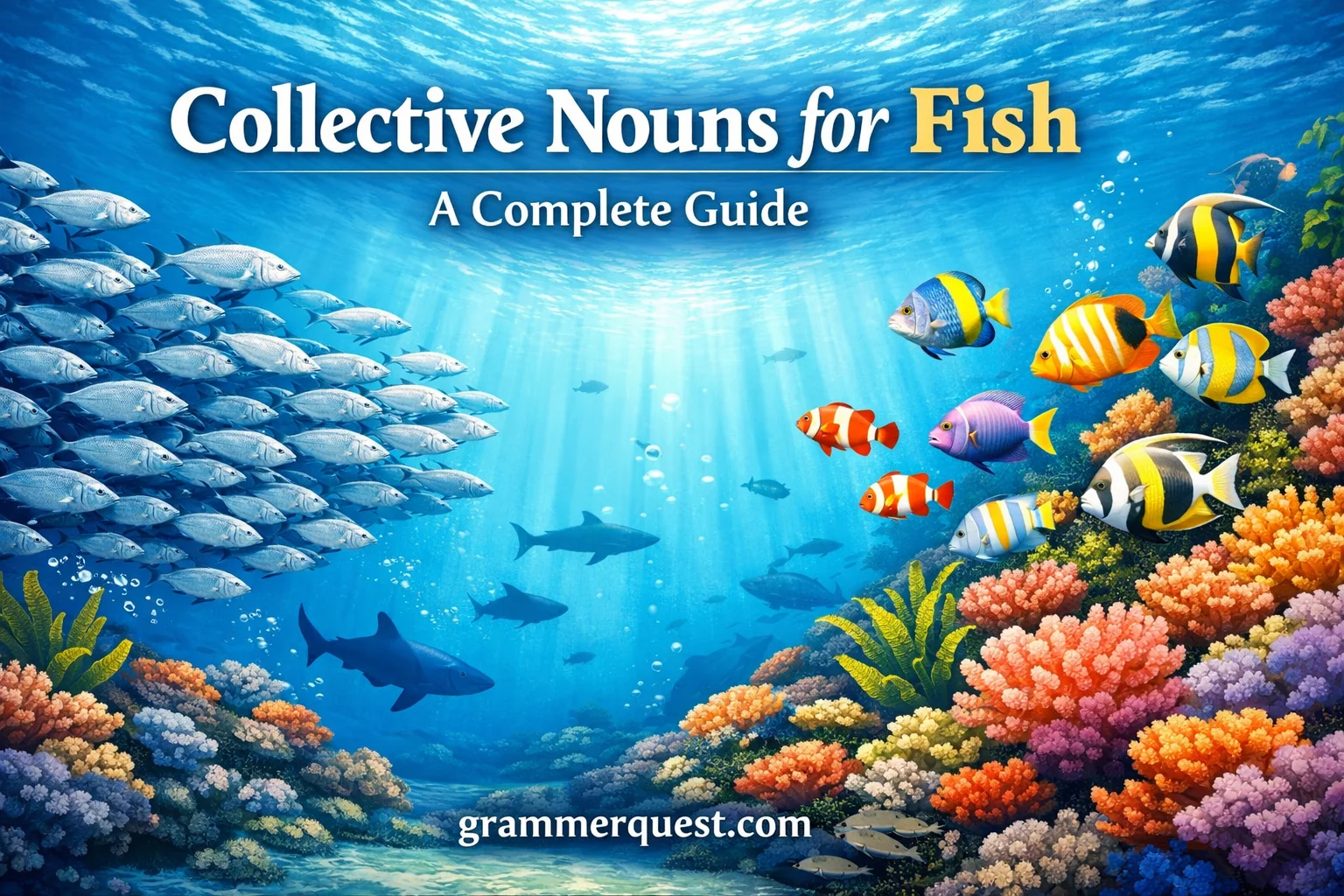
When we talk about Collective Nouns for Fish: A Complete Guide, we refer to a word that describes a group swimming together. This common school, shoal, or pod understanding helps us communicate clearly about animals. In my blog, I explore the meaning of terms, provide exercises to test knowledge, and share synonyms related so learners can learn to use them effectively. This list allows us to add, amend, or comment to expand the guide.
The concept of collective nouns has a long history and was developed from sources that include lists of birds and animals as technical hunting terms. Though sometimes fanciful in origin, hunters found a few doubtful terms that eventually become standard in English vocabulary. Scholars across the century have been diligent in reproducing these with accuracy, and today they are still known as proper names for a stated animal or bird, even in limited domain.
In real life, ordinarily, simpler terms are used: flock instead of congregation, murmuration, or parliament, including plovers, starlings, or owls. The list includes examples like a pod of whales, pack of dogs, clowder of cats, and descension of woodpeckers. Groupings such as colony of bats or ants are widely used in spoken and written language, improving clarity and supporting learning. Collective nouns connect human relationships with nature, and multiple shared examples show the use across groups of mammals and animals, both common and uncommon in usage.
Common Collective Nouns for Fish
Below is a simple table to help you understand the most commonly used collective nouns for fish:
Collective NounTypeExample UsageSchoolStandardA school of fish swims togetherShoalGeneralA shoal of fish gathers near the reefDraftRareA draft of fish moves downstreamRunSeasonalA run of fish heads upstreamCatchFishingA catch of fish fills the net
Detailed Examples of Each Collective Noun
1. School of Fish
A “school” is the most common term used to describe a group of fish swimming together in a coordinated way.
Examples:
- A school of fish moved quickly to avoid the predator.
- We saw a large school of fish near the coral reef.
- The school of fish shimmered under the sunlight.
- A school of fish swam in perfect harmony.
- The diver followed a colorful school of fish.
2. Shoal of Fish
“Shoal” is similar to “school,” but it can refer to fish grouped loosely, not always swimming in a coordinated way.
Examples:
- A shoal of fish rested near the shallow waters.
- The shoal of fish spread out across the lagoon.
- We noticed a shoal of fish near the rocks.
- The shoal of fish slowly drifted apart.
- A shoal of fish gathered near the shore.
3. Draft of Fish
This is a rare and less commonly used term for a group of fish.
Examples:
- A draft of fish moved silently through the river.
- The fisherman spotted a draft of fish below.
- A draft of fish passed under the boat.
- The draft of fish disappeared into deeper water.
- We observed a small draft of fish swimming together.
4. Run of Fish
“Run” is often used when fish migrate, especially during breeding seasons.
Examples:
- A run of fish traveled upstream to spawn.
- The river was full of a run of fish.
- Fishermen waited for the run of fish each year.
- The run of fish attracted many predators.
- We watched a run of fish moving against the current.
5. Catch of Fish
“Catch” refers to fish that have been caught, usually by fishermen.
Examples:
- The fisherman proudly showed his catch of fish.
- A large catch of fish filled the baskets.
- Their catch of fish was enough for the market.
- The catch of fish included many different species.
- We cooked the fresh catch of fish for dinner.
Also Read This: Collective Nouns for Foxes: A Complete Guide
Interesting Facts About Fish
- Fish have been on Earth for over 500 million years.
- There are more than 30,000 species of fish worldwide.
- Many fish swim in groups to protect themselves from predators.
- Some fish can change color to blend into their surroundings.
- Fish use gills to extract oxygen from water.
- Certain species of fish can generate electric shocks.
- Fish communicate with each other through movements and signals.
- Some fish travel thousands of kilometers during migration.
FAQs:
1. What are collective nouns for fish?
They are words that describe a group of fish swimming together, such as school, shoal, or pod, used in common English language for better communication and clarity.
2. Why are collective nouns important?
They help us understand and communicate more clearly about animals, improving our knowledge and making language more effective in both spoken and written forms.
3. What is the most common collective noun for fish?
The most common term is school, which is widely used to describe fish moving together in a group.
4. Are there other terms besides school?
Yes, other terms like shoal and pod are also related and used depending on context and grouping of fish.
5. Where did collective nouns come from?
They have a history and were developed from sources in medieval times, often linked to technical hunting terms.
6. Are all collective nouns still used today?
Not all; some are standard and known in English, while others are rare, limited, or even virtually non-existent in daily usage.
7. Do collective nouns only apply to fish?
No, they also apply to animals, birds, and mammals, showing how groupings are shared across different contexts.
8. Can new collective nouns be created?
Yes, new and similar terms can be coined, like a crash of rhinoceroses, though their existence may be noted but not widely used.
9. Why do some people use simpler terms?
Because in real life, people prefer simple language like flock, which improves clarity and is easier for communication.
10. How can I learn collective nouns effectively?
By using exercises, studying lists, exploring synonyms, and practicing in blog or learning context, which builds knowledge and improves usage.
Conclusion:
Collective nouns are an important part of English vocabulary that helps us describe groups of fish, animals, and other creatures in a clear and structured way. Understanding these terms improves our communication, supports learning, and strengthens our grasp of language and context in both spoken and written forms. Over time, many of these words have been developed through history, sources, and scholars who carefully shaped and preserved them for modern use.
Today, we see a mix of common and uncommon collective nouns, with some widely used like school, while others remain rare or even virtually non-existent in everyday speech. Still, their value lies in how they enhance clarity, reflect human connection with animals, and provide deeper understanding of groupings in nature. Learning these terms not only builds knowledge but also improves overall communication skills and language confidence.

Henry Collins is a passionate grammar expert and the voice behind GrammerQuest.com. With a sharp eye for language and a love for clear communication, he simplifies complex grammar rules into easy, practical lessons.