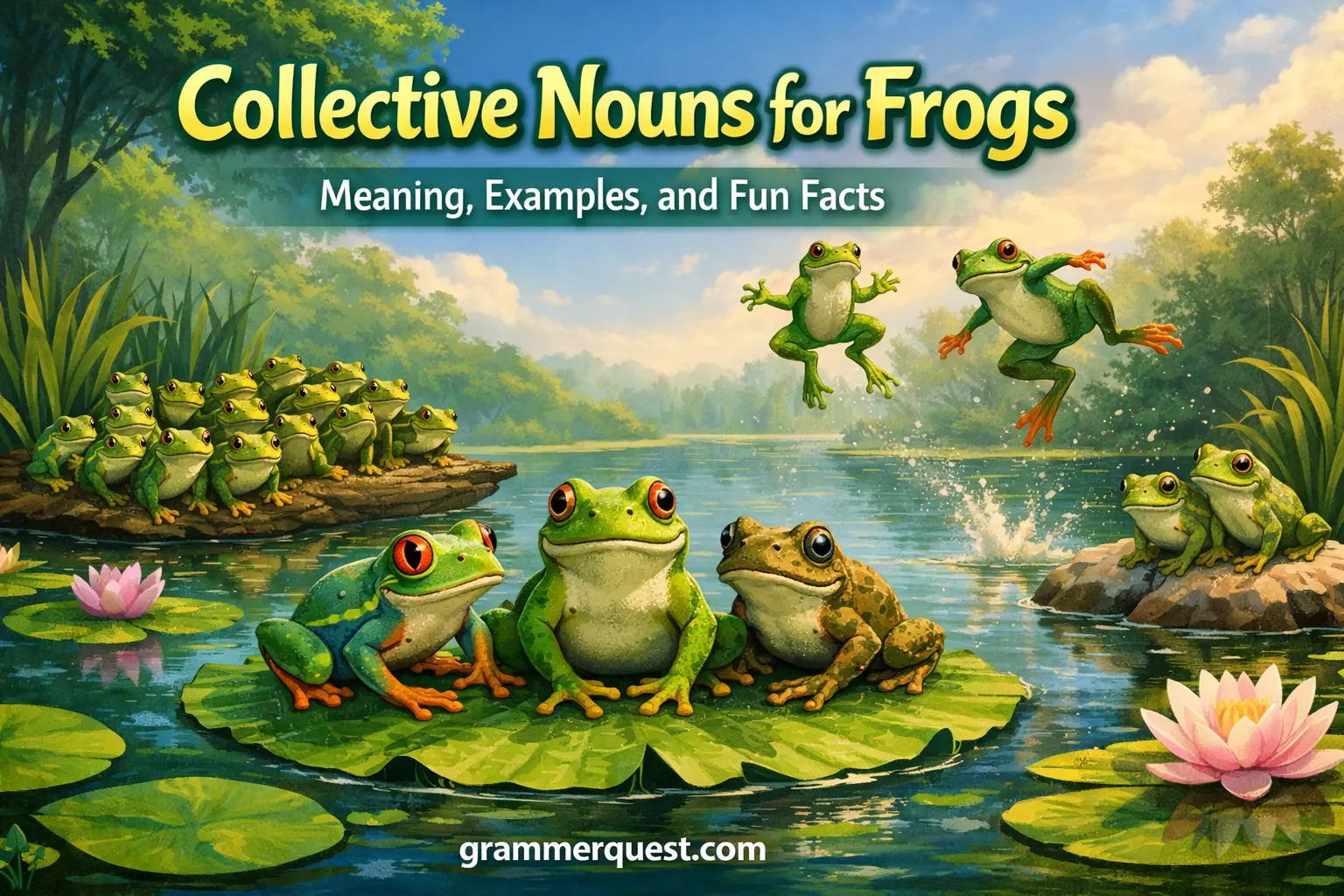
Learning Collective Nouns for Frogs in English makes language more vivid and engaging, using collective nouns as special words. A group of frogs can be described with an interesting term like an army of frogs, a colony of frogs, or a knot of frogs.
These group names are used for animals, people, and things, showing them as a single unit. When I started using these in my own writing, I noticed my sentences felt more creative, and my communication skills improved because the meaning became more clear and easy to follow.
Using such vocabulary words not only makes your content sound better, but also improves communication by making it more natural. Instead of naming each frog separately, these terms simplify how we describe them, while keeping the language engaging and expressive.
Why we use Collective Nouns for Frogs?
Instead of saying “many frogs” or listing them one by one, a term like army of frogs or colony of frogs shows the whole group as a single idea. This makes your sentences easier to understand and more vivid. It also improves your writing and communication because it sounds more natural and descriptive.
How to use this Collective Nouns for Frogs?
You simply place the collective noun before “of frogs” in a sentence. For example, you can say, “I saw an army of frogs near the pond,” or “A colony of frogs gathered after the rain.” In my experience, once you start using these terms in everyday sentences, they quickly become a natural part of how you describe animals and nature.
They’re especially useful when writing stories, school assignments, or anything about wildlife, because they add a creative and engaging touch without making sentences longer.
Collective Nouns for Frogs (Table)
| Collective Noun | Simple Example |
| Army of Frogs | An army of frogs crossed the road. |
| Colony of Frogs | A colony of frogs lived near the pond. |
| Chorus of Frogs | A chorus of frogs croaked at night. |
| Knot of Frogs | A knot of frogs gathered by the water. |
Detailed Examples of Collective Nouns for Frogs
Army of Frogs
The term “army” is often used because frogs can appear in large numbers, especially during rainy seasons.
Examples:
- An army of frogs moved across the wet field.
- We saw an army of frogs near the lake.
- After the rain, an army of frogs appeared suddenly.
- The road was covered by an army of frogs.
- An army of frogs jumped into the pond together.
- The children watched an army of frogs in surprise.
- An army of frogs made the garden lively.
- At night, an army of frogs became very active.
- The farmer noticed an army of frogs in his crops.
- An army of frogs scattered when we approached.
Colony of Frogs
“Colony” is used when frogs live together in one place, especially near water sources.
Examples:
- A colony of frogs lived beside the river.
- We discovered a colony of frogs near the swamp.
- A colony of frogs stayed hidden during the day.
- The pond was home to a colony of frogs.
- A colony of frogs gathered under the leaves.
- The biologist studied a colony of frogs.
- A colony of frogs thrived in the wetland.
- We heard a colony of frogs croaking loudly.
- A colony of frogs rested near the rocks.
- The forest had a large colony of frogs.
Chorus of Frogs
This is one of the most popular terms. It refers to the loud croaking sounds frogs make together, especially at night.
Examples:
- A chorus of frogs sang by the pond.
- At night, a chorus of frogs filled the air.
- We listened to a chorus of frogs in the dark.
- A chorus of frogs echoed through the forest.
- The sound of a chorus of frogs was relaxing.
- A chorus of frogs started after the rain.
- The lake came alive with a chorus of frogs.
- A chorus of frogs could be heard from afar.
- The children enjoyed the chorus of frogs.
- A chorus of frogs welcomed the evening.
Knot of Frogs
“Knot” is used when frogs are closely grouped together in a small space.
Examples:
- A knot of frogs sat near the water’s edge.
- We spotted a knot of frogs under a rock.
- A knot of frogs rested quietly in the shade.
- The boy found a knot of frogs in the grass.
- A knot of frogs jumped away together.
- Near the pond, a knot of frogs stayed hidden.
- A knot of frogs gathered during the rain.
- The camera captured a knot of frogs.
- A knot of frogs remained still for hours.
- The scientist observed a knot of frogs closely.
Interesting Facts About Frogs
Longevity of Frogs
Frogs can live surprisingly long lives depending on their species and environment. Some frogs in the wild live for 5 to 10 years, while others in captivity can live over 15 years. Larger species tend to live longer, especially when protected from predators.
Unique Physiological Features
Frogs have some amazing biological traits:
- They can breathe through their skin, which helps them survive underwater.
- Their powerful hind legs allow them to jump long distances.
- Frogs have sticky tongues that can catch prey in a split second.
- Many frogs can change color slightly to blend into their surroundings.
- Some species even have toxic skin to defend against predators.
Also Read This: Collective Nouns for Bats: Meaning, Examples & Fascinating Facts
Dietary Habits of Frogs
Frogs are mostly carnivorous and play an important role in controlling insect populations.
- They eat insects like flies, mosquitoes, and beetles
- Larger frogs may eat small fish, birds, or even other frogs
- Tadpoles (baby frogs) often eat plants and algae
- Frogs swallow their food whole because they don’t chew
FAQs
What are collective nouns?
Collective nouns are special words used to describe a group of people, animals, or things as a single unit.
What is a group of frogs called?
A group of frogs can be called an army of frogs, colony of frogs, or knot of frogs.
Why are collective nouns important in English?
They make language more vivid, creative, and engaging.
How do collective nouns help in writing?
They improve writing by making it more descriptive and clear.
Do collective nouns improve communication skills?
Yes, they make communication more natural and easier to understand.
Are these vocabulary words useful in daily life?
Yes, they help make everyday language more expressive and interesting.
Can collective nouns be used for other animals?
Yes, they are used for many animals, not just frogs.
Why is naming groups better than listing them separately?
It makes sentences shorter, more clear, and more engaging.
Are these terms used in English grammar rules?
Yes, they are an important part of English grammar.
Do collective nouns make learning language easier?
Yes, they support better vocabulary development and understanding.
Conclusion
Using collective nouns for frogs adds depth to language, making it more vivid, creative, and engaging. Terms like army of frogs, colony of frogs, and knot of frogs help describe a group as a single unit, improving both writing and communication skills. From my experience, learning these vocabulary words makes everyday sentences more clear, natural, and expressive, especially when talking about animals, wildlife, and nature.