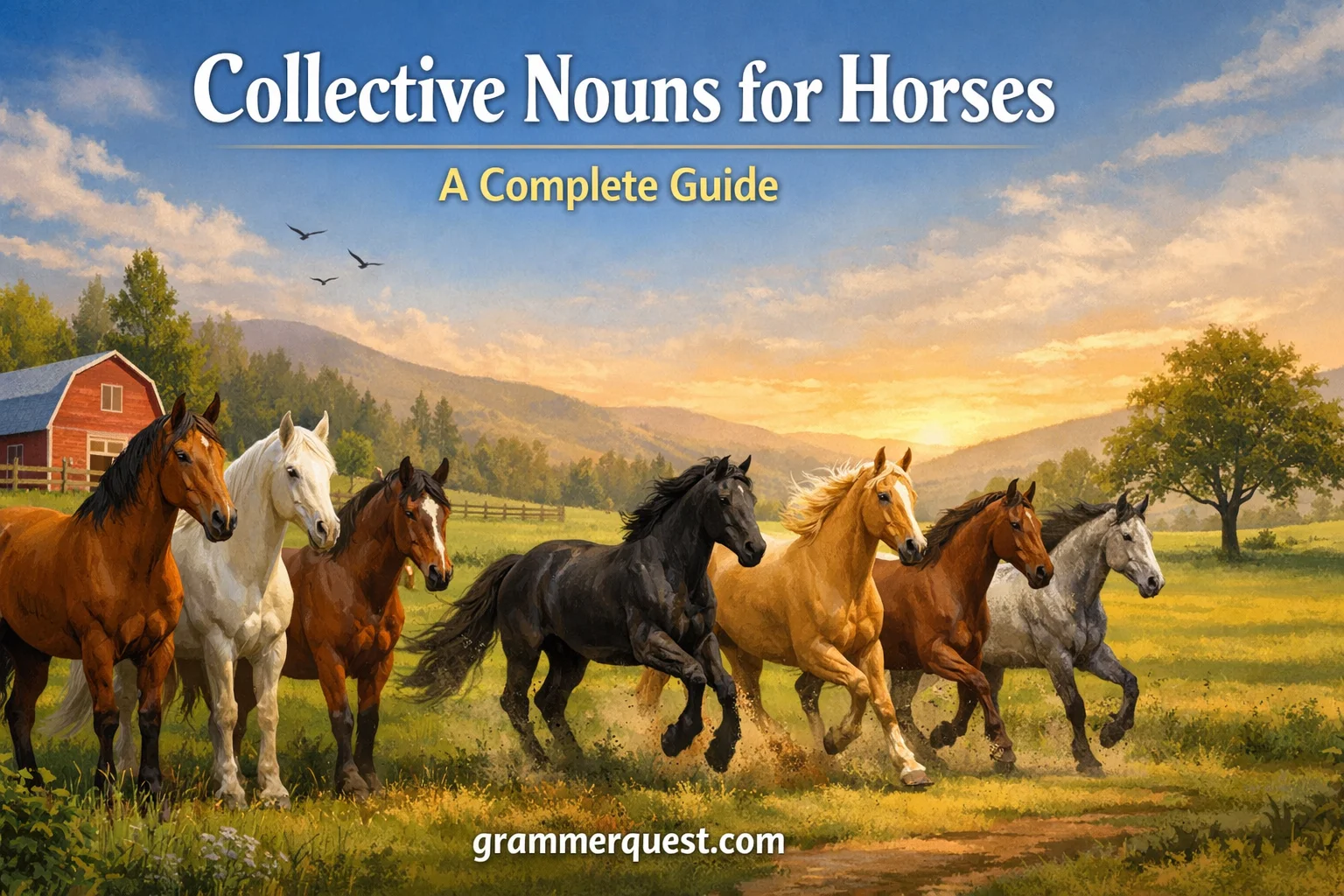
Collective nouns for Horses: a complete guide explains herd as most common group term, drawn from medieval sources and lists using animals, birds, technical hunting terms, still known today.
In my experience, the most common collective noun for horses is a herd, a group term from medieval sources and lists describing animals and birds with purportedly technical hunting terms. Their origin is often fanciful, and many ask whether these terms were ever actually used by hunters, which remains doubtful. Still, a few did end up becoming part of standard English vocabulary. From the 19th century onwards, scholars have been diligent in reproducing medieval lists, though with greater or less accuracy.
Over time, terms arose by imitation of a similar nature, and in recent times new words were coined, like a crash of rhinoceroses. It is noted that, despite the existence of collective nouns, we ordinarily call plovers, starlings, or owls a group or flock in spoken and written English, instead of rare words like congregation, murmuration, or parliament. There is little actual evidence of genuine use, often sketchy or non-existent. The list below includes common standard English terms like a pod of whales and a pack of dogs, and more arcane ones such as a clowder of cats and a descension of woodpeckers.
Why We Use Collective Nouns for Horses
Collective nouns are used to make communication more precise, efficient, and descriptive. Instead of using long phrases, we can express ideas quickly with a single word.
For horses, these nouns are especially useful because they live in organized social groups. Using terms like herd, team, or stable allows us to describe not just a group, but also the context—whether they are wild, working, or housed together.
Additionally, collective nouns add a sense of richness and tradition to language. Many of these terms come from history, where horses played a crucial role in farming, travel, and warfare.
How to Use Collective Nouns of Horses
Using collective nouns correctly is simple once you understand their context and meaning. The key is to match the noun with the situation in which the horses are found.
For example:
- Use herd when talking about horses in the wild.
- Use team when horses are working together.
- Use stable when referring to horses kept in one place.
In sentences, collective nouns are treated as singular nouns, even though they refer to multiple animals. For example:
“The herd is grazing peacefully.”
Always remember to use the correct verb agreement and keep the sentence clear and simple.
Collective Nouns for Horses (With Table)
| Type | Example |
| Herd | A herd of horses grazing in the field |
| Team | A team of horses pulling a carriage |
| Stable | A stable of horses resting inside |
Examples of Collective Nouns for Horses
Herd of Horses
Examples:
- A herd of horses is running across the plains.
- I saw a herd of horses near the river.
- The herd of horses grazes every morning.
- A herd of horses moved together in harmony.
- The herd of horses looked healthy and strong.
- We watched a herd of horses from a distance.
- The herd of horses stayed close for safety.
- A herd of horses crossed the dusty road.
- The herd of horses rested under the trees.
- A herd of horses roamed freely in the valley.
Team of Horses
Examples:
- A team of horses pulled the heavy cart.
- The team of horses worked together perfectly.
- We saw a team of horses in the parade.
- The farmer used a team of horses in the field.
- A team of horses carried supplies up the hill.
- The team of horses was strong and well-trained.
- A team of horses helped transport goods.
- The team of horses moved in perfect rhythm.
- We admired a team of horses at the show.
- A team of horses pulled the wagon through town.
Stable of Horses
Examples:
- A stable of horses was kept clean and organized.
- The stable of horses rested after a long day.
- We visited a stable of horses on the farm.
- A stable of horses needs regular care.
- The stable of horses included different breeds.
- A stable of horses stood quietly at night.
- The owner managed a large stable of horses.
- A stable of horses requires proper feeding.
- The stable of horses was well maintained.
- We saw a beautiful stable of horses near the countryside.
Also Read This: Collective Nouns for Sparrows: A Complete Guide
Interesting Facts About Horses
Longevity
Horses are known for their relatively long lifespan. On average, they live between 25 to 30 years, though some horses have been known to live even longer with proper care. Their longevity depends on diet, environment, and medical attention.
Unique Physiological Features
Horses have several unique biological traits:
- They can sleep both standing up and lying down.
- Their eyes are positioned on the sides of their heads, giving them nearly 360-degree vision.
- Horses have powerful legs designed for speed and endurance, making them one of the fastest land animals.
Dietary Habits
Horses are herbivores, meaning they eat plant-based foods. Their diet mainly includes:
- Grass
- Hay
- Grains
They have a special digestive system designed for continuous grazing, which means they eat small amounts throughout the day rather than large meals.
FAQs:
1. What is the most common collective noun for horses?
The most common collective noun for horses is a herd, which means a group of horses moving together.
2. Are there other collective nouns for horses?
Yes, terms like span (a team of two horses) and string are also used in some contexts.
3. Do people still use these terms today?
Some terms are still known, but many are rarely used and may feel virtually non-existent in everyday language.
4. Where do these collective nouns come from?
Many come from medieval sources and lists, often linked to technical hunting terms and old traditions.
5. Are these terms actually used by hunters?
It is doubtful whether they were ever actually used; many are considered fanciful in origin.
6. Why are medieval lists important?
Scholars from the 19th century onwards have diligently reproduced these lists, making them part of standard English vocabulary.
7. Why do some collective nouns sound unusual?
Many terms were created in imitation of old styles or in recent times, making them sound arcane or unusual.
8. What is the most commonly used term in English?
In everyday spoken and written English, a group of animals is usually called a flock, rather than rare terms like murmuration or parliament.
9. Are collective nouns only used for horses?
No, they are used for many animals and birds, such as a pack of dogs or a pod of whales.
10. Can collective nouns be useful in learning?
Yes, using a worksheet with writing, spelling, and colouring activities helps pupils learn and enjoy the topic.
Conclusion:
Collective nouns for horses, especially herd, remain an important part of English grammar. While many terms come from medieval sources and may seem fanciful or rarely used, they still form a valuable part of standard English vocabulary. Over time, scholars have preserved these lists, even if their genuine use is often limited. Learning these terms through simple activities helps pupils understand language better and makes the topic more engaging and enjoyable.

Henry Collins is a passionate grammar expert and the voice behind GrammerQuest.com. With a sharp eye for language and a love for clear communication, he simplifies complex grammar rules into easy, practical lessons.