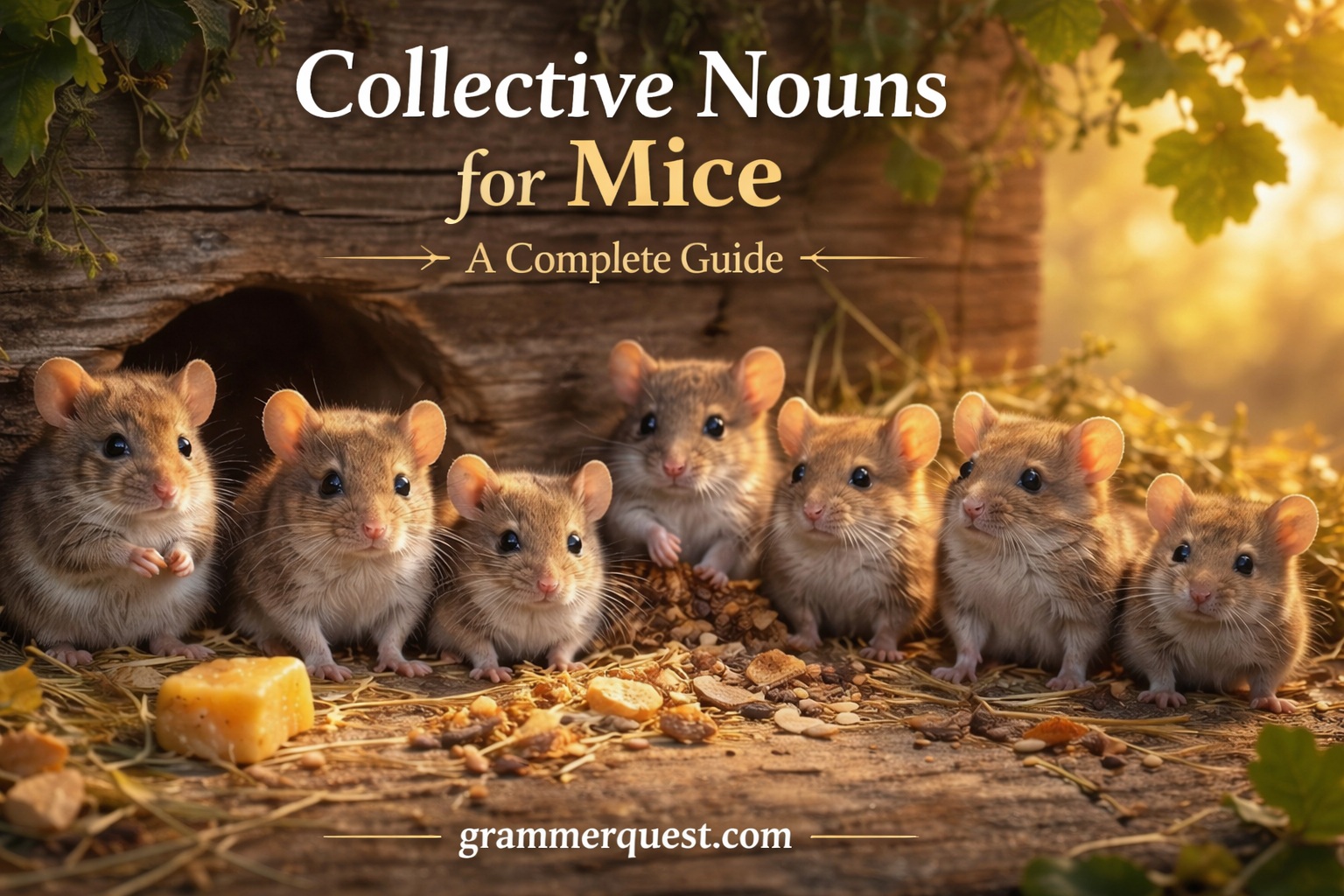
When learning about Collective Nouns for Mice: A Complete Guide, it is important to learn simple phrases in everyday life, adapt words easily, and understand rules in the English language for better semantic meaning in content.
These small rodents like the mouse have the ability to enter tight places such as the kitchen, garage, or shed. A common species, widely regarded as a pest, often invades homes searching for food and shelter. Social animals have a high breeding rate, rarely live alone, and their hierarchy shows how they communicate and reproduce.
The commonly fitting names for a group of mice are a mischief or a nest. In real-life experience, they chew electrical wires, damage furnishings, make holes in wood, and cause trouble. A family cluster with female and infants is literally a nest where they raise and care for their young, connecting expertise with content meaningfully.
Why We Use Collective Nouns for Mice
Collective nouns are used to describe a group as a single unit, making communication more efficient and expressive. Instead of saying “a group of mice,” we can use a more descriptive and vivid term like a mischief of mice.
For mice specifically, these nouns often reflect their behavior, movement, or characteristics. For example, mice are known for being curious, sneaky, and active, which is why terms like mischief are used.
Using collective nouns:
- Adds color and creativity to language
- Helps in clear and concise communication
- Reflects the nature and traits of animals
How to Use These Collective Nouns of Mice
Using collective nouns correctly is simple once you understand their structure. Typically, they are used in the format:
Collective noun + of + animal
For example:
- A mischief of mice scurried across the floor.
When using these terms, remember:
- Treat the group as a single entity in most sentences
- Use context to make your sentence more meaningful
- Choose the noun that best fits the situation or tone
By applying these rules, your writing becomes more engaging and precise.
Collective Nouns for Mice
Below is a simple table to help you understand the most common collective nouns used for mice:
| Type | Example |
| Mischief of mice | A mischief of mice hid behind the wall. |
| Nest of mice | A nest of mice was found in the attic. |
| Horde of mice | A horde of mice ran through the field. |
| Colony of mice | A colony of mice lived underground. |
Examples of Collective Nouns for Mice
Mischief of Mice – Example Sentences
- A mischief of mice ran across the kitchen floor.
- We spotted a mischief of mice near the grain storage.
- A mischief of mice nibbled on the scattered crumbs.
- The farmer chased away a mischief of mice.
- A mischief of mice gathered near the old barn.
- At night, a mischief of mice became very active.
- A mischief of mice explored every corner of the room.
- The cat watched a mischief of mice quietly.
- A mischief of mice chewed through the bag.
- A mischief of mice disappeared into the hole.
Nest of Mice – Example Sentences
- A nest of mice was hidden under the floorboards.
- We found a nest of mice in the cupboard.
- A nest of mice slept during the day.
- The attic contained a nest of mice.
- A nest of mice was built with soft materials.
- The farmer removed a nest of mice carefully.
- A nest of mice stayed warm in winter.
- We heard sounds from a nest of mice.
- A nest of mice grew quickly in number.
- A nest of mice remained hidden for weeks.
Horde of Mice – Example Sentences
- A horde of mice rushed through the field.
- The house was invaded by a horde of mice.
- A horde of mice searched for food.
- The farmer feared a horde of mice.
- A horde of mice moved together بسرعة.
- We saw a horde of mice near the crops.
- A horde of mice damaged the harvest.
- The barn echoed with a horde of mice.
- A horde of mice scattered quickly.
- A horde of mice hid when disturbed.
Colony of Mice – Example Sentences
- A colony of mice lived under the ground.
- Scientists studied a colony of mice.
- A colony of mice worked together.
- The lab kept a colony of mice for research.
- A colony of mice shared resources.
- We observed a colony of mice in the wild.
- A colony of mice survived harsh conditions.
- The field supported a colony of mice.
- A colony of mice reproduced rapidly.
- A colony of mice stayed organized.
Also Read This: Collective Nouns for Owls: A Detailed Guide
Interesting Facts About Mice
Mice may be small, but they are incredibly fascinating creatures with unique traits.
Longevity
- Mice typically live for 1 to 3 years in the wild
- In controlled environments, they can live slightly longer
- Their short lifespan is balanced by rapid reproduction
Unique Physiological Features
- Mice have excellent hearing and sense of smell
- Their teeth never stop growing, so they must constantly gnaw
- They can squeeze through very tiny spaces due to flexible bodies
Dietary Habits
- Mice are omnivores, eating both plant and animal matter
- They prefer grains, seeds, and fruits
- Mice often store food for later use
FAQs:
1. What is a group of mice called?
A group of mice is called a mischief or a nest.
2. Why is the term “mischief” used for mice?
It is used because mice often chew, damage, and create trouble in homes.
3. What does “nest of mice” mean?
It usually refers to a family cluster where a female and infants live together.
4. Do mice live alone or in groups?
Mice are social animals and rarely live alone.
5. Why do mice enter homes?
They enter homes to search for food and shelter.
6. Are mice considered pests?
Yes, many common species of mice are widely regarded as pests due to their behavior.
7. How do mice reproduce?
Mice have a high breeding rate, so they reproduce often.
8. What places do mice usually enter?
They often enter the kitchen, garage, shed, or any house area.
9. What is the behavior of mice in groups?
They follow a hierarchy, communicate, and live in organized groups.
10. Why is learning collective nouns important?
It helps improve English language skills, enhances semantic meaning, and supports better use of words in everyday life.
Conclusion:
Understanding collective nouns for mice helps us better describe how these small rodents live and behave in groups. Terms like mischief and nest are not just words—they reflect the social nature, communication, and breeding patterns of mice. Learning these terms also improves our grasp of the English language, helping us use phrases more accurately in everyday life.

Henry Collins is a passionate grammar expert and the voice behind GrammerQuest.com. With a sharp eye for language and a love for clear communication, he simplifies complex grammar rules into easy, practical lessons.