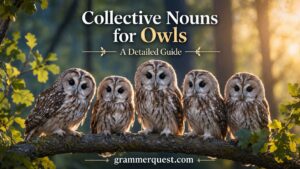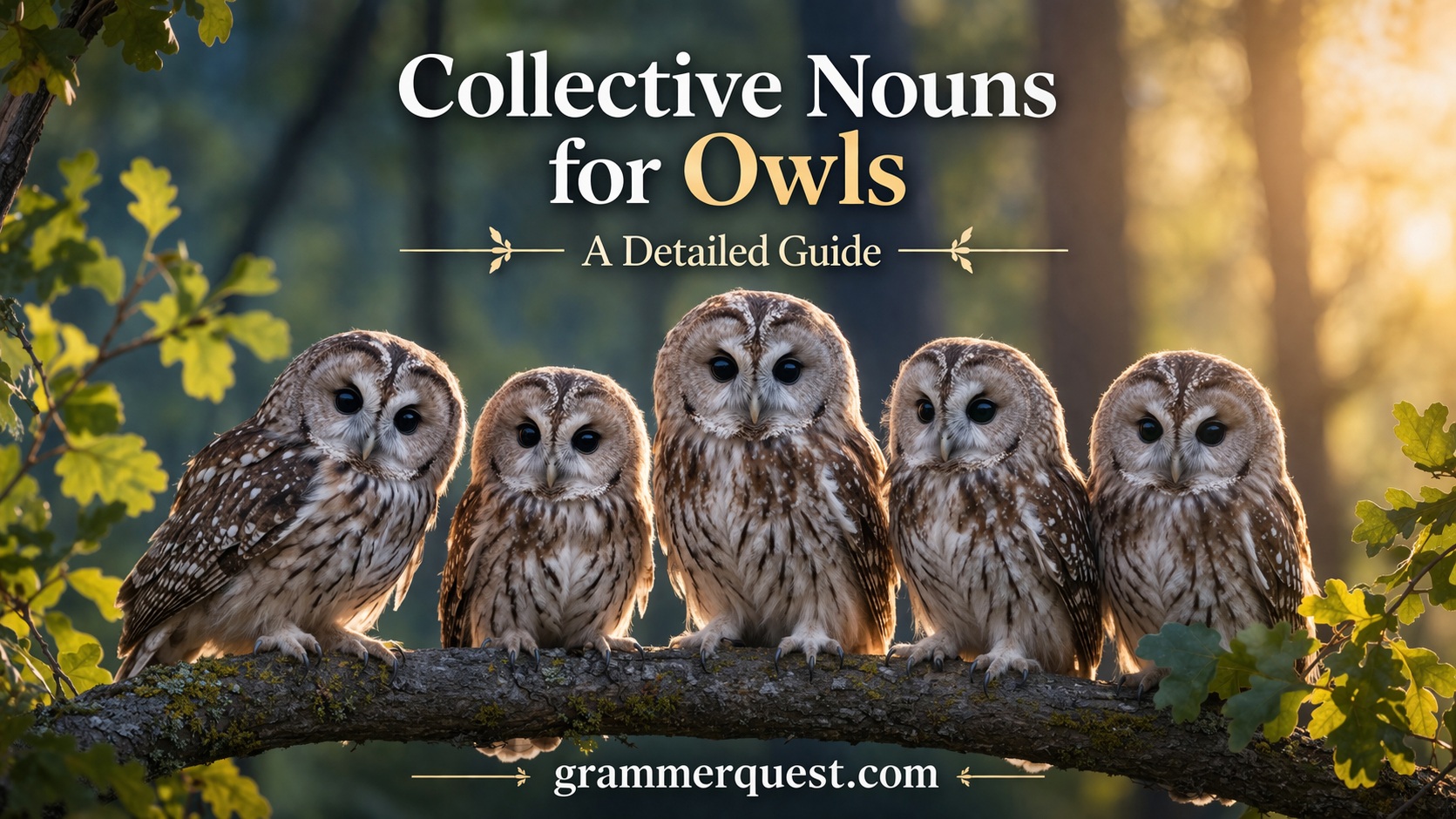
Collective Nouns for Owls: A Detailed Guide explores medieval sources and lists of collective nouns for animals and birds, showing how these terms became part of standard English. I’ve noticed that while a few were actually used by hunters, many feel fanciful and non-existent in real life, even though scholars since the 19th century worked hard to preserve them with accuracy.
Over time, people created imitation forms and new words of similar nature, like a crash of rhinoceroses. Even despite their existence, we still ordinarily call a group of owls a flock in spoken and written English. Words like congregation, murmuration, and parliament sound beautiful, but their actual use feels sketchy, though common examples like pack of dogs or pod of whales remain easy to remember.
In the kingdom of nature, there is a large number of such names, and almost every animal on Earth has one. I once spotted birds in my garden, filling feeders, and it helped me identify them correctly. If you’re lucky enough to see an owl in the wild, it is usually alone, as seeing more is rare. Names like wisdom, congress, hooting, or stare come alive in flight, sometimes called silence because of their quiet movement, making them excellent hunters, and these terms still vary depending on the world or country you’re from.
Why We Use Collective Nouns for Owls
Collective nouns help make communication more vivid, concise, and engaging. Instead of using plain phrases, these special words add personality and depth to language.
For owls, collective nouns are especially meaningful because they are often linked with wisdom, mystery, and quiet observation. The term parliament, for example, reflects the idea of owls being thoughtful and wise.
Using collective nouns for owls:
- Enhances creative writing
- Helps create clear mental images
- Preserves the rich traditions of English vocabulary
How to Use These Collective Nouns of Owls
Using collective nouns is straightforward. Place the collective noun before the animal name, followed by “of owls.”
Examples:
- “A parliament of owls sat in the trees.”
- “We heard a stare of owls at night.”
Keep in mind:
- Use singular verbs when the group acts as one
- Choose the noun based on the context or tone
- Keep sentences simple and natural
With practice, these expressions will make your language more colorful and precise.
Collective Nouns for Owls (Table)
| Collective Noun | Example |
| Parliament | A parliament of owls sat silently. |
| Stare | A stare of owls watched us. |
| Wisdom | A wisdom of owls rested nearby. |
| Bazaar | A bazaar of owls gathered in the trees. |
| Congress | A congress of owls perched quietly. |
Detailed Examples of Collective Nouns for Owls
Parliament of Owls
Examples:
- A parliament of owls sat in the forest.
- We spotted a parliament of owls at dusk.
- A parliament of owls watched silently.
- The parliament of owls rested on branches.
- A parliament of owls gathered at night.
- The parliament of owls looked calm.
- A parliament of owls stayed hidden in trees.
- The parliament of owls observed quietly.
- A parliament of owls perched together.
- Visitors admired a parliament of owls.
Stare of Owls
Examples:
- A stare of owls watched us closely.
- We saw a stare of owls at night.
- A stare of owls sat on branches.
- The stare of owls looked intense.
- A stare of owls remained still.
- The stare of owls followed our movement.
- A stare of owls stayed quiet.
- The stare of owls perched high above.
- A stare of owls observed silently.
- People noticed a stare of owls nearby.
Wisdom of Owls
Examples:
- A wisdom of owls gathered in the woods.
- We admired a wisdom of owls.
- A wisdom of owls perched quietly.
- The wisdom of owls looked peaceful.
- A wisdom of owls stayed together.
- The wisdom of owls rested at night.
- A wisdom of owls watched silently.
- The wisdom of owls remained hidden.
- A wisdom of owls sat on branches.
- Tourists saw a wisdom of owls.
Bazaar of Owls
Examples:
- A bazaar of owls gathered in the forest.
- We noticed a bazaar of owls at dusk.
- A bazaar of owls perched together.
- The bazaar of owls looked unusual.
- A bazaar of owls stayed quiet.
- The bazaar of owls rested in trees.
- A bazaar of owls watched silently.
- The bazaar of owls moved slightly.
- A bazaar of owls stayed hidden.
- Visitors observed a bazaar of owls.
Congress of Owls
Examples:
- A congress of owls perched quietly.
- We saw a congress of owls at night.
- A congress of owls stayed in the trees.
- The congress of owls looked calm.
- A congress of owls gathered silently.
- The congress of owls rested together.
- A congress of owls observed the area.
- The congress of owls stayed still.
- A congress of owls perched nearby.
- People admired a congress of owls.
Read This: Collective Nouns for Swans: A Detailed Guide
Interesting Facts About Owls
Owls are not just linguistically interesting—they are also biologically unique.
Longevity
- Many owls live between 10 to 25 years in the wild
- Larger species tend to live longer
- Some captive owls can live even beyond 30 years
Unique Physiological Features
- Owls can rotate their heads up to 270 degrees
- They have excellent night vision
- Their feathers allow for silent flight, making them skilled hunters
Dietary Habits
- Owls are carnivores
- They eat small mammals, insects, and birds
- Some species also consume fish
FAQs:
1. What is the most common collective noun for owls?
The most common term is a parliament, often used to describe a group of owls in English.
2. Why is the term “parliament” used for owls?
It is believed to relate to owls’ wise appearance, linking them with decision-making and wisdom.
3. Are there other collective nouns for owls?
Yes, terms like wisdom, congress, stare, and hooting are also used.
4. Do owls usually live in groups?
No, owls are generally solitary and are rarely seen in groups in the wild.
5. What collective noun is used when owls are flying?
A group of owls in flight is sometimes called a silence, due to their quiet movement.
6. Is the term “flock” correct for owls?
Yes, flock is the most commonly used general term for groups of birds, including owls, in everyday English.
7. Are these collective nouns officially used everywhere?
No, their use varies by region, and many are more poetic than commonly used in real speech.
8. Where did these collective nouns come from?
Many originated from medieval sources and were later preserved by scholars.
9. Are collective nouns for owls used in modern language?
Some are used, but many remain rare or virtually non-existent in daily conversation.
10. Can collective nouns differ depending on location?
Yes, usage can vary depending on the world or country you’re from.
Conclusion:
Collective nouns for owls show how rich and creative the English language can be. Terms like parliament, wisdom, and congress add a poetic touch, even if owls are usually solitary in nature. While some words come from medieval sources, others are modern and imitation forms. In real life, people often use simple terms like flock, but learning these unique names helps us better appreciate language, nature, and the history behind how we describe groups of animals.

Emma Brooke is a passionate language enthusiast and the voice behind GrammarQuest.com. With a sharp eye for detail and a love for clear communication, she simplifies complex grammar rules into easy, practical lessons. Her goal is to help you write with confidence, clarity, and style—whether you’re a student, professional, or everyday writer.