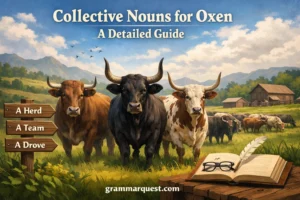
Collective Nouns for Oxen are special words used to describe a group of animals. For example, a pride of lions, a pack of dogs, or a flock of birds. These terms are part of English vocabulary and are often found in standard language used by scholars since the 19th century. Some are more common, while others are lesser-known and even seem bizarre. Words like a pod of whales or a clowder of cats show how creative and fascinating this language can be. I personally find these terms interesting because they evoke feelings and make learning more fun.
Many of these collective nouns come from medieval sources and were once used in hunting terms by hunters, although some are now considered doubtful in everyday use. Still, they remain part of English vocabulary and are sometimes listed in lists for learning. Terms like a murmuration of starlings or a parliament of owls are widely known, even if they are rarely used in real life. Some words like a crash of rhinoceroses or a shimmer of hummingbirds feel fanciful and imaginative. These technical terms help us describe animals in a more creative and interesting way, showing the richness of language.
Why We Use Collective Nouns for Oxen
We use collective nouns to make communication more efficient, descriptive, and engaging. Instead of using long phrases, a single term can describe a group clearly and creatively.
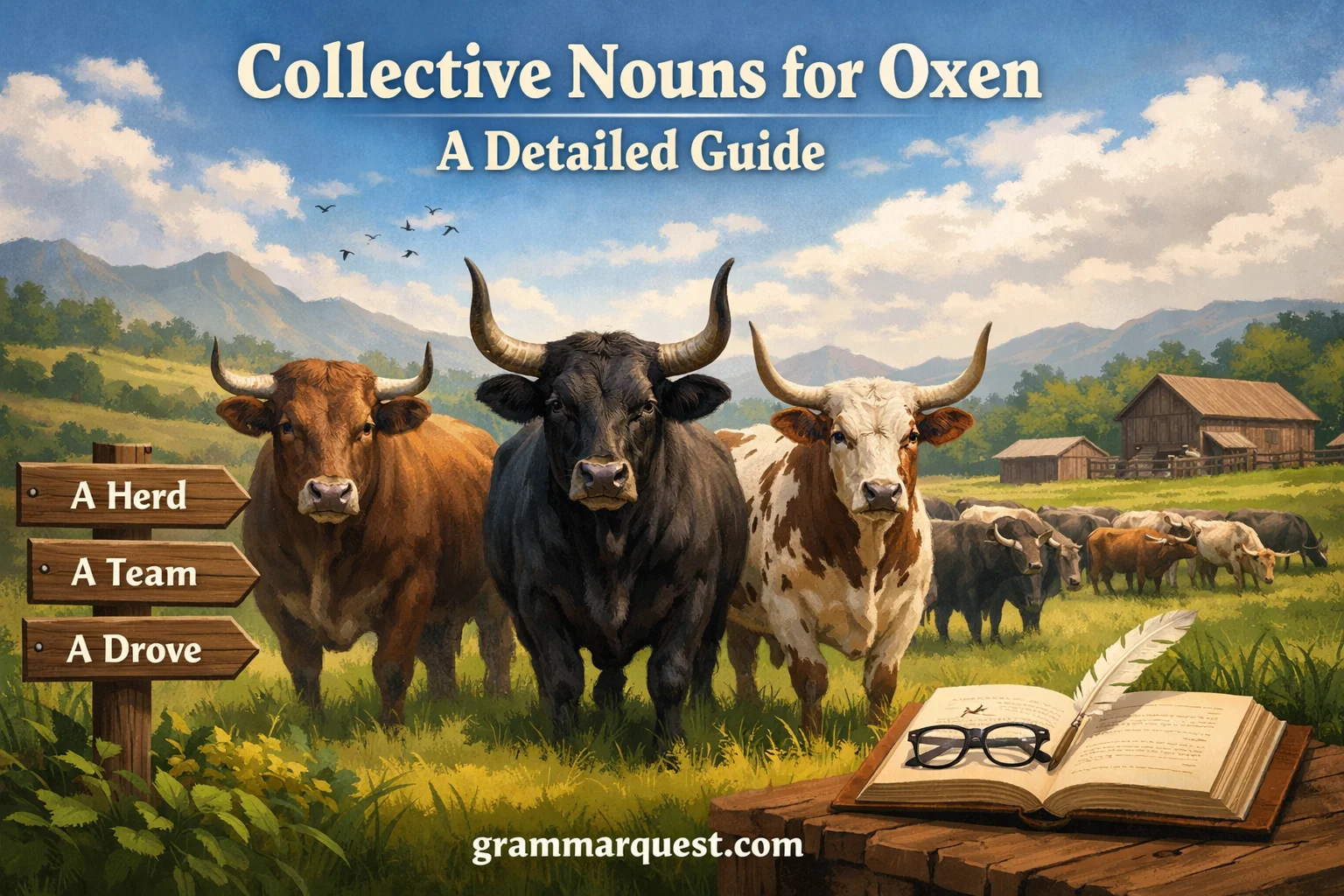
For oxen, collective nouns help highlight their cooperative nature, as these animals often work together in pairs or groups. Using such terms also adds richness and variety to language, making writing and speech more appealing. Additionally, these nouns can reflect cultural and historical contexts, especially since oxen have played an important role in farming societies.
How to Use These Collective Nouns of Oxen
Using collective nouns correctly is simple once you understand the context. These terms are generally treated as singular nouns, even though they refer to a group.
For example, you might say, “A team of oxen is pulling the cart.” Here, “team” represents multiple animals but is treated as a single unit performing one action. It’s important to match the verb accordingly and use the noun in situations where the group is acting together.
You can also use these nouns in both formal and informal writing, storytelling, or educational content. They are especially useful when you want to make your language more colorful and precise.
Collective Nouns for Oxen
| Type | Example |
| Team | A team of oxen pulled the heavy wagon. |
| Yoke | A yoke of oxen worked together in the field. |
| Span | A span of oxen crossed the muddy road. |
| Pair | A pair of oxen stood quietly near the barn. |
Examples of Collective Nouns for Oxen
Team of Oxen – Examples
- A team of oxen is pulling the farmer’s plow.
- The team of oxen moves slowly but steadily.
- We watched a team of oxen carry heavy logs.
- The team of oxen works best in cool weather.
- A strong team of oxen helped build the road.
- The farmer trained his team of oxen carefully.
- A team of oxen stood ready at sunrise.
- The team of oxen dragged the cart uphill.
- Children admired the powerful team of oxen.
- The team of oxen rested after hours of work.
Yoke of Oxen – Examples
- A yoke of oxen is tied together with a wooden beam.
- The yoke of oxen plows the land efficiently.
- Farmers rely on a yoke of oxen for heavy tasks.
- The yoke of oxen walked in perfect rhythm.
- A yoke of oxen stood calmly in the field.
- The yoke of oxen carried supplies across the farm.
- He guided the yoke of oxen with gentle commands.
- The yoke of oxen worked from dawn till dusk.
- A yoke of oxen pulled the cart through mud.
- The yoke of oxen rested under the tree.
Span of Oxen – Examples
- A span of oxen pulled the wagon across the field.
- The span of oxen moved in perfect harmony.
- A span of oxen helped transport goods.
- The farmer owned a strong span of oxen.
- A span of oxen stood near the barn door.
- The span of oxen worked together smoothly.
- A span of oxen crossed the riverbank.
- The span of oxen was trained for farm work.
- A span of oxen rested after a long day.
- The span of oxen pulled heavy equipment.
Pair of Oxen – Examples
- A pair of oxen is grazing in the meadow.
- The pair of oxen pulled a wooden cart.
- A pair of oxen stood quietly in the shade.
- The farmer uses a pair of oxen daily.
- A pair of oxen worked side by side.
- The pair of oxen moved slowly along the road.
- A pair of oxen helped plow the field.
- The pair of oxen rested near the fence.
- A pair of oxen walked through the village.
- The pair of oxen carried supplies home.
Read This: Collective Nouns for Leopards: A Detailed Guide
Interesting Facts About Oxen
Oxen are truly remarkable animals with unique traits that make them valuable to humans and fascinating to study.
Longevity
Oxen can live for 15 to 20 years or more, depending on their care and environment. Their long lifespan allows them to serve farmers for many productive years.
Physiological Features
Oxen are known for their incredible strength and endurance. They have strong muscles, sturdy hooves, and a calm temperament, which makes them ideal for heavy labor. Unlike horses, oxen are less likely to panic, making them more reliable in difficult conditions.
Dietary Habits
Oxen are herbivores, primarily feeding on grass, hay, and grains. Their four-chambered stomach allows them to digest tough plant material efficiently, making them well-suited for agricultural environments.
Teamwork Ability
One of the most interesting facts about oxen is their ability to work in perfect coordination, especially when trained as a pair or team. This teamwork is one reason why collective nouns like “team” and “yoke” are so fitting.
FAQs :
1. What are collective nouns?
Collective nouns are words used to describe a group of animals, like a pack of dogs or a flock of birds.
2. Why are collective nouns important?
They make language more fascinating, creative, and help us describe animals in a clear and interesting way.
3. Are all collective nouns commonly used?
No, some are common while others are lesser-known or even fanciful and rarely used in daily English vocabulary.
4. Where do collective nouns come from?
Many come from medieval sources and were used as hunting terms by hunters.
5. What is a collective noun for lions?
A group of lions is called a pride, which is a widely known and standard term.
6. What is a group of birds called?
A group of birds is often called a flock, which is a common collective noun.
7. Are collective nouns still used today?
Yes, many are still part of standard English, although some are virtually non-existent in daily use.
8. Can collective nouns be creative?
Yes, some like a shimmer of hummingbirds or murmuration of starlings are very creative and fascinating.
9. Do collective nouns follow rules?
No strict rules exist; many terms are based on imitation, tradition, and imagination.
10. Why are some collective nouns unusual?
Because they were created from fanciful ideas and not always based on doubtful or real-world evidence.
Conclusion :
Collective nouns make the English language more interesting and creative. They help us describe a group of animals in a fun and meaningful way, whether it is a pride of lions or a pack of dogs. Although some terms come from medieval sources and may seem doubtful, they still add richness to our vocabulary. Learning these words can pique interest and make language learning more enjoyable, especially for children and language lovers.

George Whitaker is the voice behind GrammarQuest, dedicated to making grammar simple, engaging, and easy to understand. He helps learners turn confusion into confidence with clear explanations and real-world examples.