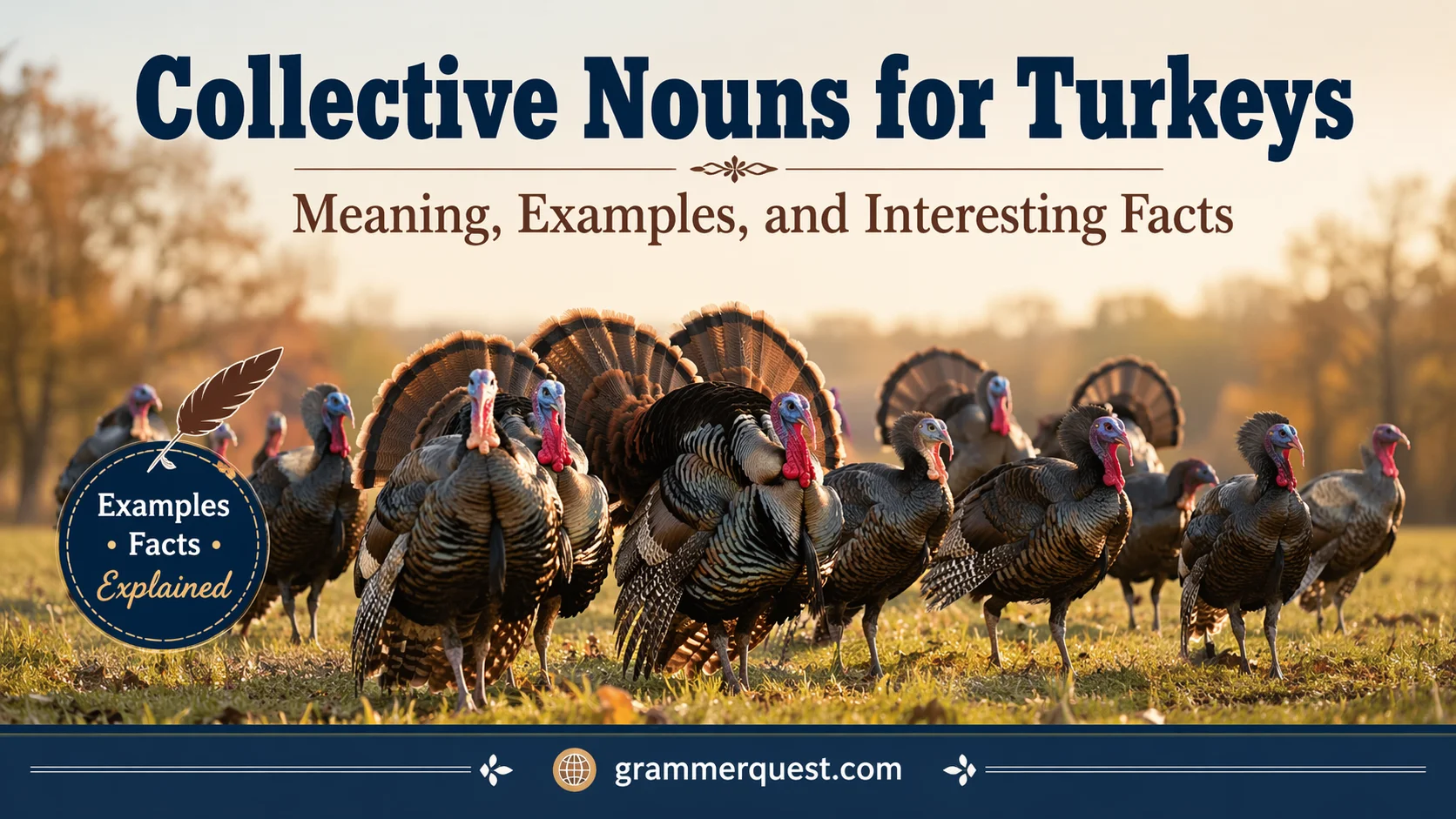
Collective Nouns for Turkeys: Meaning, Examples, and Interesting Facts explains how turkey groups are called a rafter, showing their social nature and collective behavior.
Turkeys are intelligent, curious, and very social creatures. I have seen a lot of turkeys in a barnyard, where they form strong bonds with owners. Their ability to remember human faces is truly surprising, and a group helps them function better within a community. Watching them strutting in a field or pecking around always makes me wonder about their behavior.
In the animal kingdom, many collective nouns exist for animals on Earth. These birds gather not in a flock or herd, but a rafter, which is quite interesting. It helps us identify groups correctly, whether in a garden, near bird feeders, or on TV. Using a comprehensive list, it becomes easier to recognize and appreciate how these creatures interact.
Common Collective Nouns for Turkeys
Below is a simple table showing the most commonly used collective nouns for turkeys with easy examples:
| Collective Noun | Simple Example |
| Rafter of turkeys | A rafter of turkeys crossed the field. |
| Flock of turkeys | A flock of turkeys gathered near the barn. |
| Gang of turkeys | A gang of turkeys wandered through the forest. |
Collective Nouns for Turkeys with Example Sentences
1. Rafter of Turkeys
A “rafter” is the most traditional and widely recognized collective noun for turkeys.
Examples:
- A rafter of turkeys moved slowly across the farm.
- We spotted a rafter of turkeys near the barn.
- The rafter of turkeys scattered when the dog barked.
- A large rafter of turkeys blocked the country road.
- The farmer watched a rafter of turkeys feeding in the field.
- A rafter of turkeys roosted in the trees at sunset.
- Children admired a rafter of turkeys in the wild.
- The rafter of turkeys made soft gobbling sounds.
- A rafter of turkeys gathered under the oak tree.
- The forest echoed with a rafter of turkeys calling.
2. Flock of Turkeys
“Flock” is a general term used for many birds, including turkeys.
Examples:
- A flock of turkeys crossed the road early in the morning.
- The flock of turkeys searched for food in the grass.
- We saw a flock of turkeys near the riverbank.
- The flock of turkeys moved together for safety.
- A flock of turkeys rested under the shade of trees.
- The farmer raised a flock of turkeys on his land.
- A flock of turkeys scattered when they heard a noise.
- The flock of turkeys followed each other closely.
- A flock of turkeys gathered around the feeding area.
- The flock of turkeys disappeared into the forest.
3. Gang of Turkeys
“Gang” is a more informal and creative collective noun used in storytelling.
Examples:
- A gang of turkeys roamed freely in the meadow.
- The gang of turkeys explored the backyard.
- A noisy gang of turkeys startled the hikers.
- The gang of turkeys crossed the dusty path.
- A gang of turkeys gathered near the water source.
- The gang of turkeys moved quickly through the bushes.
- A curious gang of turkeys approached the fence.
- The gang of turkeys scattered in different directions.
- We watched a gang of turkeys searching for grains.
- The gang of turkeys rested after a long walk.
Read More: Collective Nouns for Ponies: A Complete Guide
Interesting Facts About Turkeys
Turkeys are fascinating birds with unique biological and behavioral traits. Here are some interesting facts:
1. Longevity
Turkeys can live up to 10 years in the wild and even longer in protected environments. Their lifespan depends on habitat, food availability, and safety from predators.
2. Unique Physical Features
Turkeys are known for their colorful feathers, strong legs, and distinctive “wattle” and “snood” on their heads. Male turkeys (toms) also display impressive tail fanning during mating season.
3. Diet and Feeding Habits
Turkeys are omnivores, meaning they eat both plants and small animals. Their diet includes seeds, berries, insects, and small reptiles, making them highly adaptable feeders.
4. Social Behavior
Turkeys are very social birds that prefer living in groups. This is why collective nouns like rafter and flock are commonly used to describe them.
FAQs:
1. What is a group of turkeys called?
A group of turkeys is called a rafter.
2. Why are collective nouns important?
Collective nouns help us describe groups of animals more correctly.
3. Are turkeys social animals?
Yes, turkeys are very social and live better in a group.
4. Can turkeys recognize humans?
Yes, they have the ability to remember human faces.
5. Where can you usually see turkeys?
You can find them in a field, barnyard, or even near a garden.
6. What do turkeys do in groups?
They strut, peck, and interact while staying within their community.
7. Is “rafter” the only name for turkey groups?
Yes, rafter is the most recognized collective term.
8. How can you identify turkey groups?
You can identify them by watching how they gather and move together.
9. Are turkeys intelligent birds?
Yes, they are very intelligent, curious, and playful creatures.
10. Where can I learn more collective nouns?
You can use a comprehensive list or watch nature shows on TV.
Conclusion:
Understanding Collective Nouns for Turkeys: Meaning, Examples, and Interesting Facts helps you see these birds in a new way. Instead of just thinking of food, you begin to notice their social life, intelligence, and how they function in a group. Learning terms like rafter not only improves language skills but also makes observing nature more meaningful and interesting.

Emma Brooke is a passionate language enthusiast and the voice behind GrammarQuest.com. With a sharp eye for detail and a love for clear communication, she simplifies complex grammar rules into easy, practical lessons. Her goal is to help you write with confidence, clarity, and style—whether you’re a student, professional, or everyday writer.