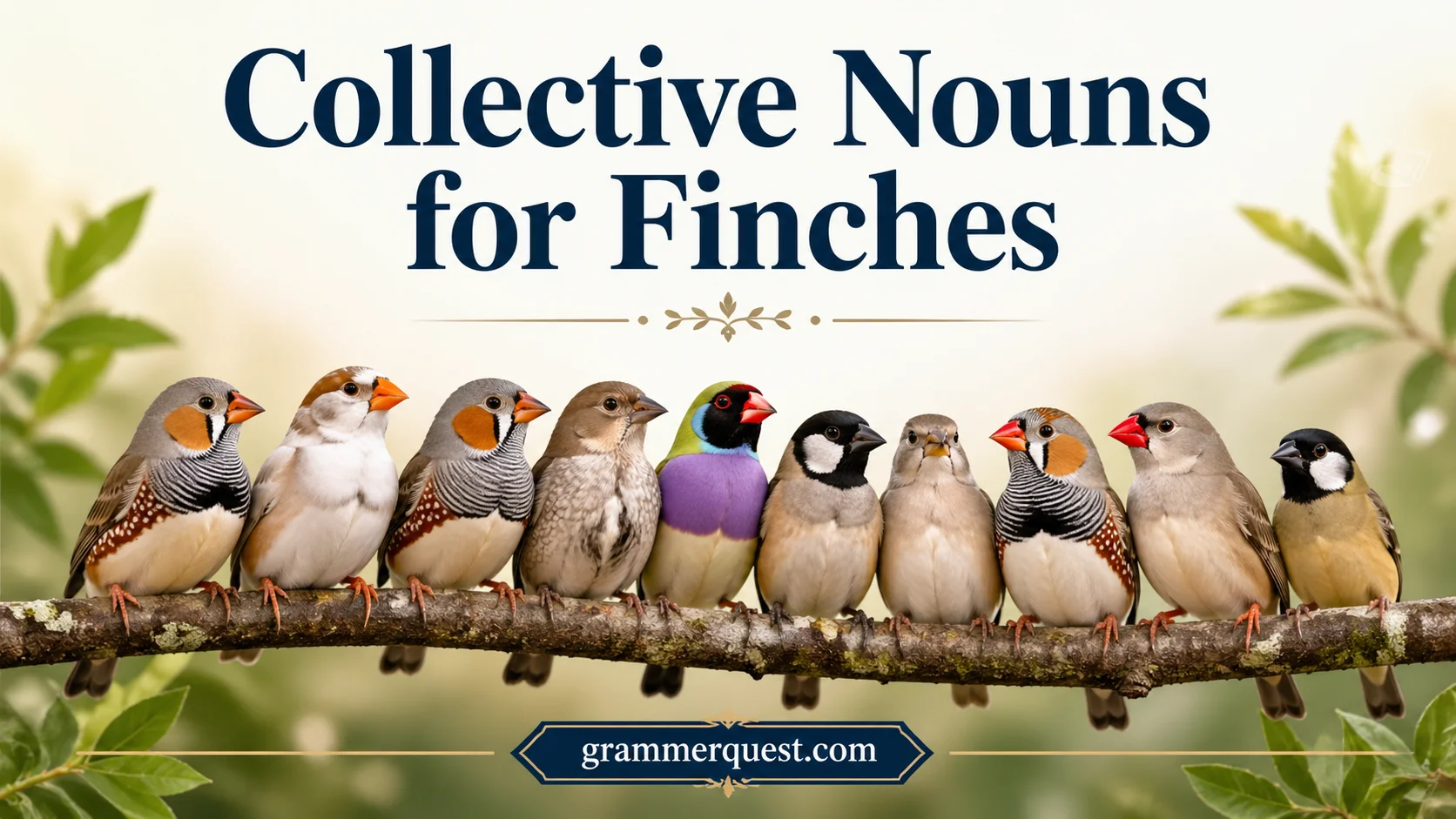
Collective Nouns for Finches shows how group nouns describe birds like finches using the word flock, based on my field observations in nature from experience in gardens and fields observed.
From my field studies, flocks of crows, finches, and geese show how birds stay together in a similar type of group called a flock, often seen in gardens and fields where they create mesmerising wonder and detail in nature. I have observed Goldfinch wings shimmering in sunlight over a stubble field while Ravens appear with deep calls above hills, forming a V shape in the sky that feels like magic.
In language studies I find collective nouns useful for almost every animal in the animal kingdom where each group has a name or term like charm for finches seen in gardens and bird feeders. I have also spotted them on TV and in real life where birds fluttering and chirping show behavior and appearance. This makes study of nature interesting and comprehensive for identifying groups in the wild correctly nature.
Common Collective Nouns for Finches
| Collective Noun | Type | Simple Example |
| Flock | General group of finches | A flock of finches landed on the tree. |
| Charm | Often used for goldfinches | A charm of goldfinches brightened the garden. |
| Band | A small group of birds | A band of finches flew over the field. |
| Flight | Birds moving together in the air | A flight of finches crossed the sky. |
| Company | A gathering of birds | A company of finches gathered near the feeder. |
Flock of Finches
A flock is the most common collective noun for finches. It is used for many birds that travel, rest, or feed together.
Example Sentences
- A flock of finches sat on the fence.
- We saw a flock of finches in the garden.
- A flock of finches flew across the sky.
- The flock of finches chirped loudly in the morning.
- A flock of finches gathered near the bird feeder.
- The flock of finches rested on the branches.
- A flock of finches moved quickly from tree to tree.
- I watched a flock of finches peck at the seeds.
- A flock of finches filled the apple tree.
- The flock of finches disappeared into the woods.
Charm of Finches
A charm is a beautiful collective noun often used for goldfinches and other colorful finches. It gives a lovely image of their bright feathers and graceful movement.
Example Sentences
- A charm of finches rested on the flowers.
- We admired a charm of goldfinches near the road.
- A charm of finches made the garden look lively.
- The charm of finches fluttered between the trees.
- A charm of finches danced in the sunlight.
- The charm of finches fed quietly on seeds.
- A charm of finches flew past the window.
- I spotted a charm of finches in the meadow.
- A charm of finches covered the sunflower patch.
- The charm of finches brought color to the field.
Band of Finches
A band is used for a group of birds that stay close together. It suggests unity and movement, which fits finches well because they often travel in small groups.
Example Sentences
- A band of finches landed on the rooftop.
- We heard a band of finches singing in the yard.
- A band of finches fed near the grass.
- The band of finches flew over the river.
- A band of finches stopped in the orchard.
- The band of finches moved along the hedge.
- A band of finches searched for seeds together.
- I saw a band of finches on the telephone wire.
- The band of finches took off at once.
- A band of finches rested in the tall reeds.
Flight of Finches
A flight describes birds in motion, especially when they are flying together. This collective noun highlights the speed and beauty of finches in the air.
Example Sentences
- A flight of finches passed above the garden.
- We watched a flight of finches circle the field.
- A flight of finches moved quickly through the sky.
- The flight of finches landed near the barn.
- A flight of finches rose from the grass.
- The flight of finches turned toward the forest.
- I saw a flight of finches cross the path.
- A flight of finches fluttered over the lake.
- The flight of finches disappeared behind the hill.
- A flight of finches glided from one tree to another.
Company of Finches
A company is a general collective noun for a group that stays together. It is less common than “flock,” but it works well in descriptive writing.
Example Sentences
- A company of finches gathered near the feeder.
- We found a company of finches in the shrubs.
- A company of finches rested under the tree.
- The company of finches sang softly in the morning.
- A company of finches flew toward the meadow.
- The company of finches shared the sunflower seeds.
- I noticed a company of finches on the rooftop.
- A company of finches hid among the leaves.
- The company of finches moved together along the path.
- A company of finches brightened the winter garden.
Read This: Collective Nouns for Cobras
Interesting Facts About Finches
Finches are fascinating birds with many surprising traits. One interesting fact is that some finches live surprisingly long lives for small birds, especially in safe environments such as zoos or well-protected habitats. Their lifespan can vary by species, but many can live several years when food and shelter are available.
Finches also have unique physical features. Their beaks are short, strong, and specially shaped for cracking seeds. This beak design helps them eat different kinds of food depending on the species and season. Some finches have colorful feathers, while others are more plain-colored to blend into their surroundings.
Their diet is another remarkable trait. Finches mainly eat seeds, but many also enjoy fruits, buds, and small insects. This flexible diet helps them survive in forests, gardens, grasslands, and even urban areas. Their feeding habits also explain why they are often seen in groups around bird feeders.
FAQs:
1. What is the main collective noun for finches?
The most common collective noun for finches is “charm”, used for a group of these small birds.
2. Why are finches called a “charm”?
They are called a charm because their chirping, movement, and behavior feel lively and attractive in nature.
3. Do finches always stay in groups?
Yes, finches are social birds and are often seen in flocks, especially while feeding.
4. Where can we usually see finch groups?
You can often spot them in gardens, woodlands, fields, and near bird feeders.
5. What makes finch groups special?
Their colorful feathers, quick movement, and twittering songs make them very noticeable.
6. Is “flock” also used for finches?
Yes, flock is a general term used for many birds including finches, though “charm” is more specific.
7. What does the word “charm” originally mean?
It comes from an old English word related to song or twittering sound.
8. Are finches found all over the world?
Yes, finches are found in many regions across the Earth, adapting to different habitats.
9. Why do finches gather in groups?
They gather for feeding, protection, and easier survival in natural environments.
10. Can we see finches in cities?
Yes, finches are often seen in urban gardens and near bird feeders.
Conclusion:
Finches are small but highly social birds that often gather in flocks or charms, making their presence lively and noticeable in nature. Their chirping, colorful feathers, and active behavior show why humans gave them special collective nouns to describe their groups. Observing them in gardens or fields makes it easier to understand how language connects deeply with the natural world.

George Whitaker is the voice behind GrammarQuest, dedicated to making grammar simple, engaging, and easy to understand. He helps learners turn confusion into confidence with clear explanations and real-world examples.