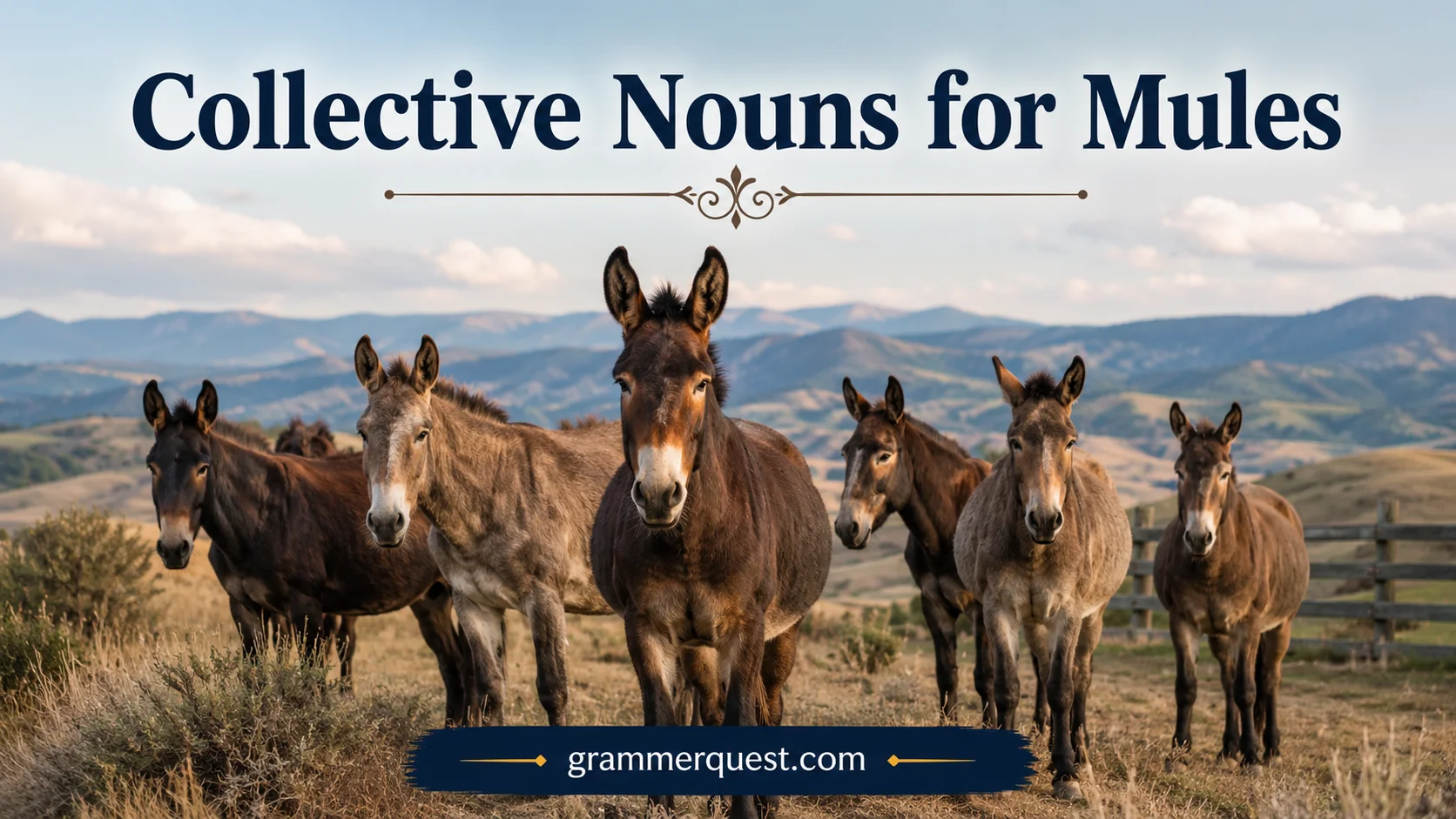
Collective Nouns for Mules are interesting terms used in English vocabulary to describe mule groups. These collective nouns developed through medieval hunting traditions, scholarly studies, and language evolution over centuries.
Collective Nouns for Mules have a rich background in English language history. Medieval scholars and hunters created many collective nouns for animals and birds to make communication more colorful and descriptive. Over time, these terms became part of standard vocabulary and were widely used in books, education, and spoken language. Some names survived for centuries, while others slowly disappeared from everyday use but remained important in grammar and literature studies.
Today, Collective Nouns for Mules and other animal group names still attract language learners and writers. People commonly use terms like flock, pack, pod, and parliament to describe animal groups in conversations and stories. These fascinating expressions help teachers explain grammar concepts with examples and make learning English more exciting. Understanding collective nouns also improves vocabulary, writing skills, and the ability to describe animals, objects, and ideas in a creative and meaningful way.
Common Collective Nouns for Mules (Quick Overview Table)
| Collective Noun Type | Simple Example |
| Herd | A herd of mules grazing in the field |
| Team | A team of mules pulling a cart |
| Pack | A pack of mules carrying goods |
| String | A string of mules walking on a trail |
| Drove | A drove of mules moving together |
Herd of Mules
A herd of mules is commonly used when mules are seen grazing or living together in a natural or open environment.
Example Sentences: Herd of Mules
- A herd of mules was grazing peacefully in the valley.
- We saw a herd of mules near the riverbank.
- The herd of mules moved slowly across the field.
- A herd of mules gathered under the shade of trees.
- The farmer owns a large herd of mules.
- A herd of mules stood quietly in the pasture.
- The herd of mules was protected by a shepherd.
- Children watched a herd of mules from a distance.
- A herd of mules traveled together in the open land.
- The herd of mules scattered when it started raining.
Team of Mules
A team of mules is often used when mules work together, especially for pulling carts or plows.
Example Sentences: Team of Mules
- A team of mules pulled the heavy cart uphill.
- The farmer used a team of mules for plowing.
- A strong team of mules helped transport goods.
- The team of mules worked tirelessly all day.
- A team of mules was trained for mountain travel.
- The driver guided the team of mules carefully.
- A team of mules crossed the bridge slowly.
- The team of mules carried supplies to the village.
- A team of mules made the journey easier.
- The team of mules responded well to commands.
Read More: Collective Nouns for Skunks
Pack of Mules
A pack of mules is used when mules are carrying loads, especially in rugged or mountainous areas.
Example Sentences: Pack of Mules
- A pack of mules carried supplies through the hills.
- The explorers relied on a pack of mules.
- A pack of mules traveled along the narrow path.
- The pack of mules was loaded with food and water.
- A pack of mules helped transport goods to remote areas.
- The pack of mules moved carefully over rocky ground.
- A pack of mules followed the guide closely.
- The travelers used a pack of mules for their journey.
- A pack of mules rested after a long trip.
- The pack of mules crossed the mountain safely.
String of Mules
A string of mules describes mules moving in a line, often guided one after another.
Example Sentences: String of Mules
- A string of mules walked along the narrow trail.
- The string of mules followed the leader.
- A string of mules crossed the desert slowly.
- The guide led a string of mules up the hill.
- A string of mules carried supplies in sequence.
- The string of mules moved carefully through the forest.
- A string of mules was used for transport.
- The string of mules stopped at the river.
- A string of mules made a long journey.
- The string of mules stayed connected on the path.
Drove of Mules
A drove of mules is used when mules are being driven or moved from one place to another, often in large numbers.
Example Sentences: Drove of Mules
- A drove of mules was moved to the market.
- The farmer guided a drove of mules carefully.
- A drove of mules crossed the open field.
- The drove of mules traveled together in formation.
- A drove of mules was sold at the fair.
- The herder managed a large drove of mules.
- A drove of mules blocked the road temporarily.
- The drove of mules was heading to the village.
- A drove of mules moved under the hot sun.
- The drove of mules was counted by the farmer.
Interesting Facts About Mules
Mules are fascinating hybrid animals born from a male donkey and a female horse. They are widely respected for their strength, intelligence, and endurance.
One of the most remarkable features of mules is their longevity. They often live longer than horses and donkeys, sometimes reaching up to 40 years or more with proper care.
Physiologically, mules are incredibly strong and sure-footed, making them ideal for mountainous terrains. They also have a unique combination of traits from both parent species, such as the donkey’s endurance and the horse’s agility.
In terms of diet, mules are herbivores and primarily eat grass, hay, and grains. They require less food compared to horses of similar size, making them highly efficient working animals.
FAQs:
What are collective nouns?
Collective nouns are words used to describe a group of people, animals, or things as one unit, such as flock, pack, or clowder.
Why do we use collective nouns?
We use them to make communication easier and more natural when talking about groups instead of individual items.
Are collective nouns still used today?
Yes, many collective, nouns are still used in modern, English, especially in spoken and written language.
What is a collective noun for mules?
A group of mules is commonly referred to as a pack or sometimes a trip, depending on context and usage.
Are medieval collective nouns real or imaginary?
Many medieval, collective, nouns were fanciful and created by scholars, not always used by real hunters.
Why did scholars create these terms?
Scholars developed these terms to study language, nature, and animal groupings in a more structured way.
What are some examples of animal collective nouns?
Examples include a pack of dogs, a clowder of cats, and a pod of whales.
Do people use words like congregation or murmuration?
Yes, but mostly in literature or formal writing; in daily speech, flock is more common.
Are new collective nouns still created today?
Yes, new collective, nouns are still coined, sometimes in a humorous or creative way.
Why are collective nouns important in English?
They make language more expressive, precise, and help describe groups in a meaningful way.
Conclusion:
Collective nouns are an important part of English, language because they help describe groups in a clear and creative way. From medieval, scholars to modern usage, these terms show how language evolves over time. Even if some words are fanciful, they still enrich communication and make descriptions of animals, mules, and other creatures more interesting and expressive.

Emma Brooke is a passionate language enthusiast and the voice behind GrammarQuest.com. With a sharp eye for detail and a love for clear communication, she simplifies complex grammar rules into easy, practical lessons. Her goal is to help you write with confidence, clarity, and style—whether you’re a student, professional, or everyday writer.