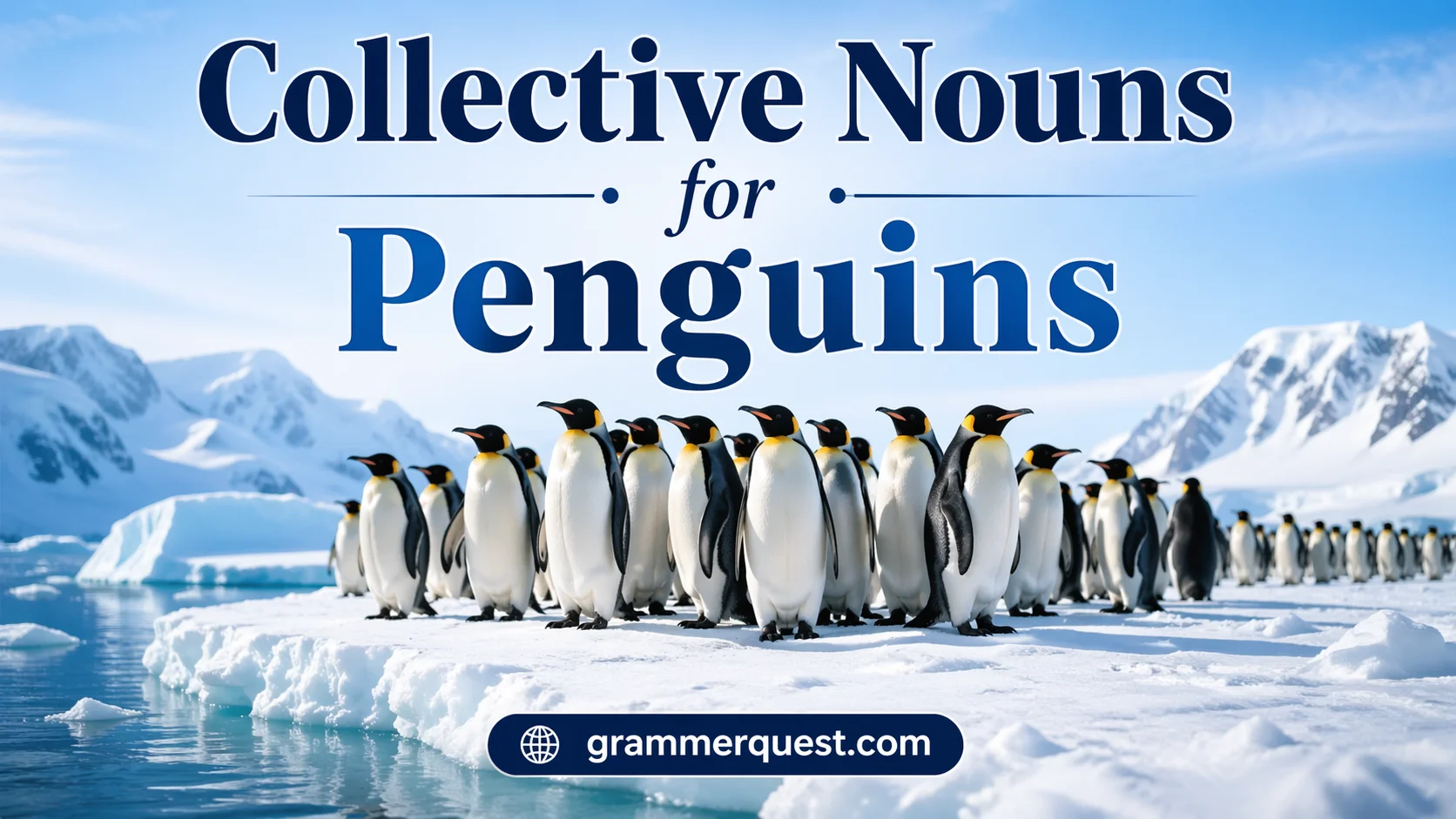
Collective Nouns for Penguins shows penguins are social, gregarious birds, colonial species forming large groups, nesting, travelling and feeding together in cold southern hemisphere environments always found together living colonies.
In wildlife observation, penguins are highly social and live in colonies forming complex societies where thousands and millions move as one group, nesting, travelling, feeding together in cold areas of the southern hemisphere. They are always found with other penguins never alone often seen on TV showing group behavior similar pride lions pod dolphins murder crows wacky naming roots unusual traits in natural observation patterns and animal group naming traditions.
The collective noun often depends on situation and activity. Common forms include colonies, rookeries and huddles, while swimming penguins are called a raft and walking penguins a waddle. In observation, groups move together as one, never alone, and naming changes based on age, location and activity, leading to many terms and questions like what in the world we call a group of penguins in structured naming traditions study field context.
Common Collective Nouns for Penguins (Table Overview)
| Type (Collective Noun) | Simple Example |
| Colony | A colony of penguins is resting on the ice. |
| Rookery | A rookery of penguins is nesting near the shore. |
| Waddle | A waddle of penguins is walking across the snow. |
| Huddle | A huddle of penguins is keeping warm together. |
| Raft | A raft of penguins is floating in the sea. |
Colony of Penguins
What is a Colony?
A colony refers to a large group of penguins living and breeding together, usually on land or ice.
Examples
- A colony of penguins gathered near the rocky shore.
- The colony of penguins protected their young from the cold wind.
- We saw a huge colony of penguins during the expedition.
- The colony of penguins was noisy during feeding time.
- A colony of penguins can contain thousands of birds.
- The colony of penguins moved closer to the sea.
- Scientists studied the colony of penguins for breeding patterns.
- The colony of penguins shared warmth during the storm.
- A large colony of penguins formed on the icy plateau.
- The colony of penguins spread out along the coastline.
Rookery of Penguins
What is a Rookery?
A rookery is a breeding ground where penguins build nests and raise their chicks.
Examples
- A rookery of penguins was active during the breeding season.
- The rookery of penguins was filled with chicks.
- We observed a rookery of penguins from a safe distance.
- The rookery of penguins was protected by adult birds.
- A noisy rookery of penguins echoed across the ice.
- The rookery of penguins was located near the coast.
- Researchers marked each rookery of penguins carefully.
- The rookery of penguins grew larger every year.
- A rookery of penguins helps ensure survival of chicks.
- The rookery of penguins was busy with feeding activity.
Waddle of Penguins
What is a Waddle?
A waddle describes penguins walking together in their characteristic slow, swaying motion.
Examples
- A waddle of penguins crossed the frozen land.
- The waddle of penguins moved slowly toward the water.
- We watched a waddle of penguins marching in a line.
- A waddle of penguins slipped on the icy path.
- The waddle of penguins looked adorable from afar.
- A waddle of penguins followed the leader closely.
- The waddle of penguins headed back to their nests.
- A waddle of penguins stopped to rest on the ice.
- Tourists photographed a waddle of penguins walking by.
- The waddle of penguins moved in perfect rhythm.
Huddle of Penguins
What is a Huddle?
A huddle describes penguins gathering closely together to conserve heat and protect themselves from extreme cold.
Examples
- A huddle of penguins stayed warm during the blizzard.
- The huddle of penguins rotated positions for warmth.
- We saw a huddle of penguins braving the icy wind.
- A huddle of penguins protected the chicks inside.
- The huddle of penguins tightened as the temperature dropped.
- Scientists observed a huddle of penguins for survival studies.
- A huddle of penguins remained still in the freezing night.
- The huddle of penguins shifted constantly for heat balance.
- A huddle of penguins formed naturally in harsh weather.
- The huddle of penguins showed strong group cooperation.
Raft of Penguins
What is a Raft?
A raft refers to a group of penguins floating together in water, often resting or traveling.
Examples
- A raft of penguins floated calmly in the ocean.
- The raft of penguins drifted near the iceberg.
- We spotted a raft of penguins swimming together.
- A raft of penguins dived in search of fish.
- The raft of penguins rested between hunting trips.
- A raft of penguins moved gracefully through cold waters.
- The raft of penguins stayed close for protection.
- A raft of penguins surfaced for air simultaneously.
- The raft of penguins followed the current slowly.
- A large raft of penguins gathered near the shore.
Also Read This: Collective Nouns for Hounds
Interesting Facts About Penguins
penguins are extraordinary birds with many unique traits:
- Longevity: Some penguin species can live up to 15–20 years in the wild, while others may live even longer in protected environments.
- Physiological Adaptations: Penguins have a thick layer of blubber and tightly packed feathers that keep them warm in freezing temperatures. Their bodies are also streamlined for fast swimming.
- Dietary Habits: Penguins mainly eat fish, squid, and krill. They are excellent divers and can hunt deep underwater for food.
- Penguins use their flippers like wings to “fly” underwater, making them powerful swimmers.
- They rely heavily on teamwork, especially during breeding and survival in harsh climates.
FAQs:
1. What is the most common collective noun for penguins?
The most common collective nouns are colonies, rookeries, and huddles, depending on their activity and location.
2. What is a group of swimming penguins called?
A group of swimming penguins is called a raft.
3. What is a group of walking penguins called?
A group of walking penguins is called a waddle.
4. Why do penguins live in colonies?
Penguins live in colonies for safety, warmth, and better survival in harsh cold areas.
5. Are penguins always found alone?
No, penguins are never found alone; they are always with other penguins.
6. Where do penguins usually live?
They live in cold areas of the southern hemisphere, away from people.
7. How many penguins can be in a colony?
A colony can include thousands or even millions of penguins.
8. Do all penguins use the same collective noun?
No, the collective noun depends on what they are doing and where they are situated.
9. What makes penguin groups special?
Their groups act like complex societies, where they do everything together.
10. Are there other animal group names like penguins?
Yes, examples include a pride of lions, a pod of dolphins, and a murder of crows.
Conclusion:
Penguins are highly social birds that live in structured groups known as colonies, huddles, rookeries, rafts, and waddles depending on their behavior. These collective nouns help describe their strong group life, survival habits, and unique way of moving together in harsh cold environments.

George Whitaker is the voice behind GrammarQuest, dedicated to making grammar simple, engaging, and easy to understand. He helps learners turn confusion into confidence with clear explanations and real-world examples.