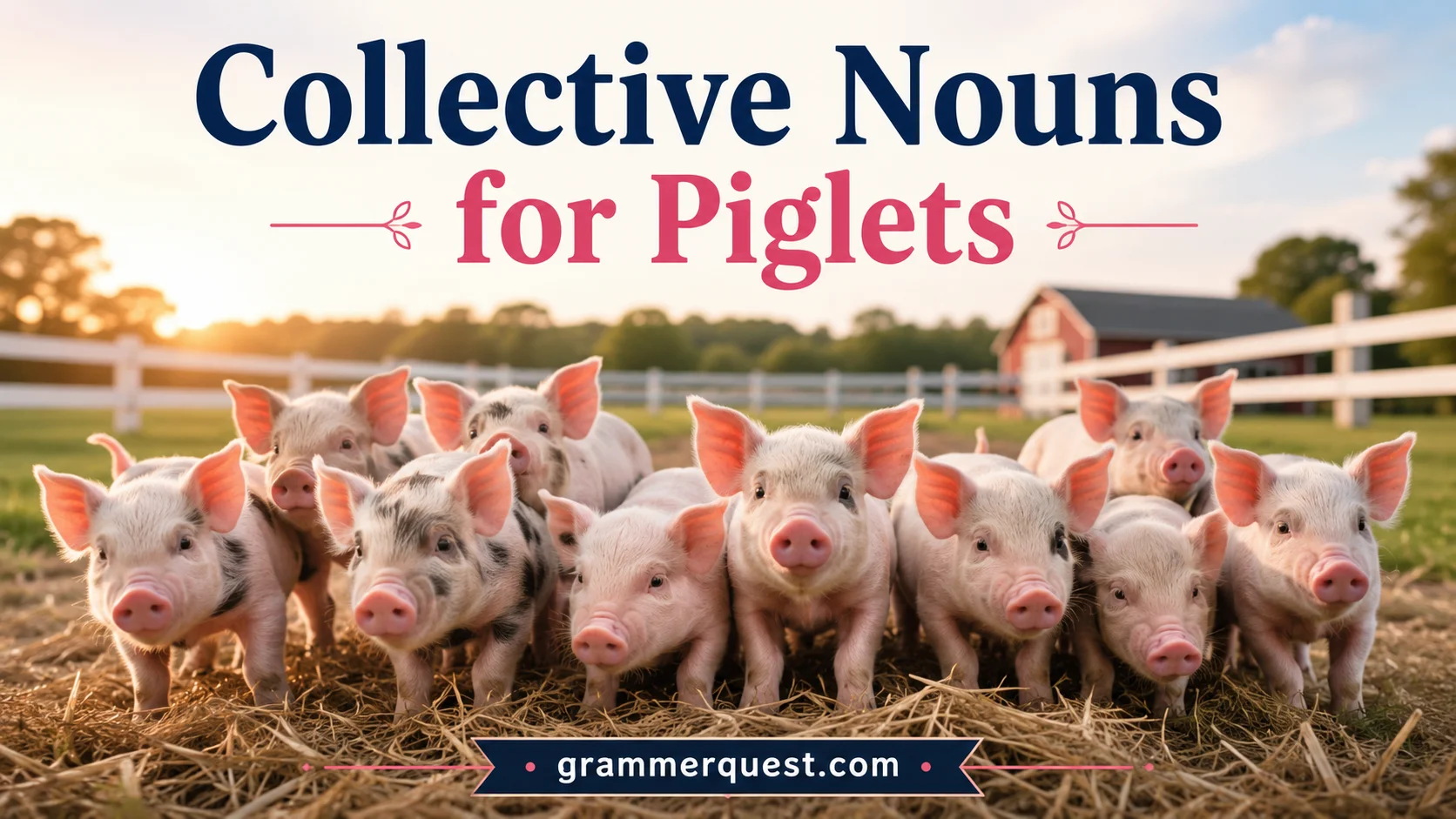
Collective Nouns for Piglets help learners understand collective nouns, group names, and animal vocabulary in simple and fun English daily. While learning English and improving speaking English, I noticed many people easily describe one animal, person, idea, or object, but struggle with groups of things. In kingdom Animalia, writers use special names like sounder for a group of pigs, school of fish, and flock of sheep. These creative terms improve communication, grammar skills, and make conversations more colorful and natural for language learners everywhere.
These interesting names are used for many animals including mammals, birds, fish, amphibians, and insects found in wildlife and nature. A murder of crows, herd of cows, or a glowing group of jellyfish adds fun to the English language and helps improve vocabulary. I personally enjoy learning these collective terms because they make reading and speaking more expressive. From whales and dolphins to sheep and crows, these unique words make animal terminology easier to remember and enjoyable for students and writers alike.
Table: Common Collective Nouns for Piglets
| Collective Noun Type | Simple Example |
| Litter of piglets | A litter of piglets is feeding. |
| Farrow of piglets | A farrow of piglets is sleeping. |
| Sounder of piglets | A sounder of piglets is running. |
| Passel of piglets | A passel of piglets is playing. |
| Team of piglets | A team of piglets is exploring. |
Litter of Piglets
The most common collective noun for piglets is a litter, referring to piglets born from the same mother.
Examples (Litter of Piglets)
- A litter of piglets is resting beside their mother.
- The farmer fed the litter of piglets in the morning.
- A litter of piglets squealed when they saw milk.
- The litter of piglets stayed close together in the barn.
- A litter of piglets followed the sow everywhere.
- The litter of piglets played in the muddy field.
- A litter of piglets slept under the warm straw.
- The litter of piglets ran toward the feeding trough.
- A litter of piglets explored the farmyard curiously.
- The litter of piglets huddled together during the rain.
Farrow of Piglets
A farrow is another traditional term used for a group of piglets, especially at birth.
Examples (Farrow of Piglets)
- A farrow of piglets was born early this morning.
- The farrow of piglets stayed close to the sow.
- A farrow of piglets squeaked loudly in the pen.
- The farmer counted the farrow of piglets carefully.
- A farrow of piglets rested in the warm corner.
- The farrow of piglets drank milk from their mother.
- A farrow of piglets moved slowly across the barn.
- The farrow of piglets played gently in the straw.
- A farrow of piglets followed their mother outside.
- The farrow of piglets grew stronger every day.
Sounder of Piglets
A sounder usually refers to a group of pigs, but it can also include young piglets in the wild.
Examples (Sounder of Piglets)
- A sounder of piglets moved through the forest.
- The sounder of piglets searched for food together.
- A sounder of piglets dug into the soil for roots.
- The sounder of piglets stayed alert in the wild.
- A sounder of piglets followed the leader pig.
- The sounder of piglets crossed the muddy riverbank.
- A sounder of piglets rested under the trees.
- The sounder of piglets scattered when they heard noise.
- A sounder of piglets explored the forest floor.
- The sounder of piglets moved quietly at night.
Passel of Piglets
A passel is an informal and playful term used for a large group of piglets.
Examples (Passel of Piglets)
- A passel of piglets ran around the yard happily.
- The passel of piglets chased each other in circles.
- A passel of piglets rolled in the mud together.
- The passel of piglets made loud squeaking sounds.
- A passel of piglets explored the garden area.
- The passel of piglets played under the sun.
- A passel of piglets followed the farmer eagerly.
- The passel of piglets rested after a long play.
- A passel of piglets climbed over small hills.
- The passel of piglets gathered near the feeding area.
Team of Piglets
A team is a modern, informal way to describe piglets working or moving together.
Examples (Team of Piglets)
- A team of piglets explored the farm together.
- The team of piglets worked through the muddy field.
- A team of piglets followed their mother closely.
- The team of piglets searched for food as one group.
- A team of piglets played in the sunshine.
- The team of piglets crossed the small stream.
- A team of piglets rested under a tree.
- The team of piglets ran toward the barn.
- A team of piglets stayed close in cold weather.
- The team of piglets reacted quickly to sounds.
Read More: Collective Nouns for Antelope
Interesting Facts About Piglets
Piglets are more than just cute farm animals—they are highly intelligent and social creatures with fascinating biology.
- Longevity: Piglets grow quickly into adult pigs, which can live 10–15 years in good conditions.
- Physiology: Piglets are born with limited fat and rely heavily on their mother’s milk for warmth and energy. Their bodies develop rapidly in the first few weeks.
- Dietary Habits: In early life, piglets feed only on milk, but as they grow, they transition to grains, vegetables, and a wide variety of foods.
- Piglets are known for their strong sense of smell, which helps them find food even when it is buried underground.
- They are highly social and form strong bonds with their siblings and mother.
FAQs :
1. What is a collective noun for piglets?
A collective noun for piglets is a special word used to describe a group of piglets together, such as a sounder (for pigs in general).
2. What does “sounder” mean?
A sounder is the collective term used for a group of pigs or piglets moving or feeding together in one place.
3. Are collective nouns only used for animals?
No, collective nouns are used for animals, people, and objects to describe groups in a single word.
4. Why do we use collective nouns?
We use them to make English more clear, natural, and expressive when talking about groups of things.
5. Is “piglets” the same as pigs?
No, piglets are baby pigs, while pigs are fully grown animals, but both can belong to a sounder.
6. Can collective nouns change in different countries?
Yes, some collective terms can vary in usage depending on region and English language style.
7. What are some other animal collective nouns?
Examples include a herd of cows, flock of sheep, school of fish, and murder of crows.
8. Are collective nouns part of grammar?
Yes, they are an important part of English grammar, especially in noun groups and sentence building.
9. Do collective nouns improve vocabulary?
Yes, learning them improves vocabulary, communication, and understanding of language expressions.
10. Where are collective nouns commonly used?
They are used in writing, education, literature, and everyday speaking English conversations.
Conclusion :
Collective nouns for piglets help learners understand how groups of animals are named in a simple and meaningful way. Words like sounder make the English language more expressive and interesting. Learning these collective terms improves grammar, vocabulary, and overall communication skills. Whether in wildlife, nature, or daily conversation, these animal group names make language more colorful and easier to remember for students and writers alike.

Emma Brooke is a passionate language enthusiast and the voice behind GrammarQuest.com. With a sharp eye for detail and a love for clear communication, she simplifies complex grammar rules into easy, practical lessons. Her goal is to help you write with confidence, clarity, and style—whether you’re a student, professional, or everyday writer.