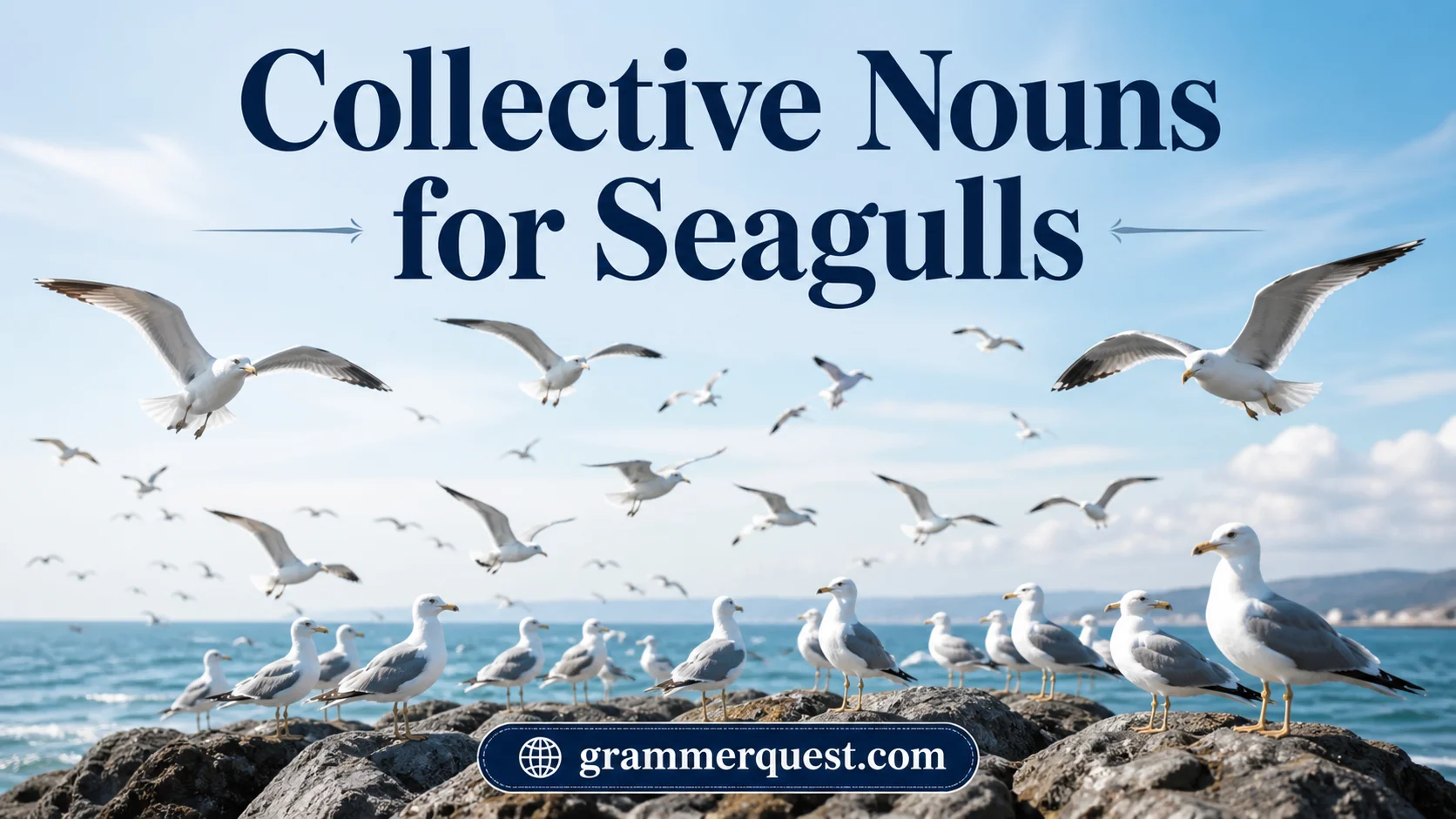
Collective Nouns for Seagulls help us understand how groups of gulls are named in simple English. These birds belong to the family Laridae and are found worldwide near coasts and oceans. The most common terms include colony, flock, and scavenging. Seagulls are social, gregarious, and often seen in large groups around beaches and seaside areas where food is available making them easy to observe and study in natural environments across the world today especially for beginners learning nature clearly explained
They are often misunderstood birds but actually highly intelligent and curious creatures seen in coastal regions. Seagulls show strong flocking behaviour and gather quickly when food is dropped at seaside locations within seconds. They live in colonies on cliffs and islands and adapt well to changing environments across the globe today. They are social, loud, and confident birds interacting closely with humans near beaches, gardens, and feeders showing interesting survival skills and patterns in nature every single day observed worldwide.
Table: Collective Nouns for Seagulls (Simple Overview)
| Type of Collective Noun | Simple Example |
| Flock | A flock of seagulls flying over the sea |
| Colony | A colony of seagulls nesting on cliffs |
| Squabble | A squabble of seagulls fighting over food |
| Flight | A flight of seagulls gliding over waves |
| Scream | A scream of seagulls near the shore |
1. Flock of Seagulls
A flock of seagulls is the most common collective noun used when describing a group of seagulls flying or resting together.
Example Sentences:
- A flock of seagulls flew across the sunset sky.
- We saw a flock of seagulls near the beach today.
- The flock of seagulls followed the fishing boat.
- A large flock of seagulls gathered on the pier.
- The flock of seagulls circled above the ocean.
- Tourists watched a flock of seagulls swooping down.
- The flock of seagulls moved in perfect harmony.
- A flock of seagulls rested on the sandy shore.
- The fisherman fed a flock of seagulls scraps of fish.
- A flock of seagulls took off suddenly into the wind.
2. Colony of Seagulls
A colony of seagulls refers to a group that lives and nests together, usually in coastal breeding areas.
Example Sentences:
- A colony of seagulls built nests on the cliffs.
- The colony of seagulls was noisy at dawn.
- We observed a colony of seagulls raising chicks.
- A colony of seagulls occupied the rocky island.
- The colony of seagulls protected their nesting area.
- Scientists studied a colony of seagulls on the coast.
- A large colony of seagulls gathered near the lighthouse.
- The colony of seagulls returned every spring.
- A colony of seagulls filled the shoreline with sound.
- The colony of seagulls thrived in the protected bay.
3. Squabble of Seagulls
A squabble of seagulls describes their noisy and chaotic fights, often over food.
Example Sentences:
- A squabble of seagulls fought over a piece of bread.
- The squabble of seagulls made loud cries on the beach.
- We watched a squabble of seagulls chase a chip.
- A squabble of seagulls gathered around the fisherman.
- The squabble of seagulls grew louder near the trash bin.
- A squabble of seagulls swooped aggressively at each other.
- The squabble of seagulls disturbed the peaceful shore.
- Tourists laughed at a squabble of seagulls stealing snacks.
- A squabble of seagulls quickly formed near food scraps.
- The squabble of seagulls scattered when a wave crashed.
4. Flight of Seagulls
A flight of seagulls highlights their graceful movement through the air.
Example Sentences:
- A flight of seagulls glided over the ocean waves.
- The flight of seagulls moved toward the horizon.
- We admired a flight of seagulls in the evening sky.
- A flight of seagulls soared above the cliffs.
- The flight of seagulls followed the wind currents.
- A flight of seagulls passed over the fishing boats.
- The flight of seagulls looked beautiful at sunrise.
- A flight of seagulls circled above the lighthouse.
- The flight of seagulls drifted gracefully through clouds.
- A flight of seagulls disappeared into the distance.
5. Scream of Seagulls
A scream of seagulls reflects their loud, sharp calls often heard along coastal areas.
Example Sentences:
- A scream of seagulls filled the morning air.
- The scream of seagulls echoed along the beach.
- We heard a scream of seagulls near the harbor.
- A scream of seagulls startled the resting tourists.
- The scream of seagulls intensified during feeding time.
- A scream of seagulls warned others of danger.
- The scream of seagulls blended with crashing waves.
- A scream of seagulls rose above the fishing boats.
- The scream of seagulls created a wild seaside atmosphere.
- A scream of seagulls marked the arrival of the tide.
Read This: Collective Nouns for Dolphins
Interesting Facts About Seagulls
Seagulls are remarkable coastal birds known for their adaptability and intelligence. They can live for 20 to 30 years, and in some cases even longer in protected environments. Their longevity allows them to develop strong survival skills over time.
Physiologically, seagulls have powerful wings that enable long-distance flight and gliding. Their webbed feet help them swim and walk on slippery surfaces, making them highly versatile in coastal habitats.
Diet-wise, seagulls are opportunistic feeders. They eat fish, insects, small marine creatures, and even human food waste. This adaptability helps them survive in both natural and urban environments.
FAQs :
1. What is the most common collective noun for seagulls?
The most common collective nouns are colony, flock, and scavenging.
2. Why are seagulls called a flock?
Because they move and feed together in large social groups.
3. What does a colony of seagulls mean?
It refers to seagulls living together in nesting areas like cliffs or islands.
4. Why is the word scavenging used for seagulls?
Because they often search for and eat leftover food near humans.
5. Are seagulls social birds?
Yes, they are highly gregarious and prefer living in groups.
6. Where are seagulls usually found?
They are found worldwide near oceans, beaches, and coastal areas.
7. Do seagulls live alone?
Rarely, they are more commonly seen in groups rather than alone.
8. Are seagulls aggressive birds?
They can appear bold, but they are naturally curious and adaptable.
9. Why do seagulls gather near humans?
They gather because food is often available in seaside and coastal areas.
10. What makes seagulls interesting birds?
Their intelligence, survival skills, and social flocking behaviour make them unique.
Conclusion :
Seagulls are social, adaptive, and highly intelligent birds found across the world in coastal environments. Their collective nouns like colony, flock, and scavenging help us understand their group behaviour in simple English. These birds are often seen near beaches, oceans, and even urban areas where they interact closely with humans. Despite being misunderstood at times, seagulls show remarkable survival skills, strong flocking behaviour, and a natural ability to thrive in changing environments, making them an important part of the animal kingdom.

George Whitaker is the voice behind GrammarQuest, dedicated to making grammar simple, engaging, and easy to understand. He helps learners turn confusion into confidence with clear explanations and real-world examples.