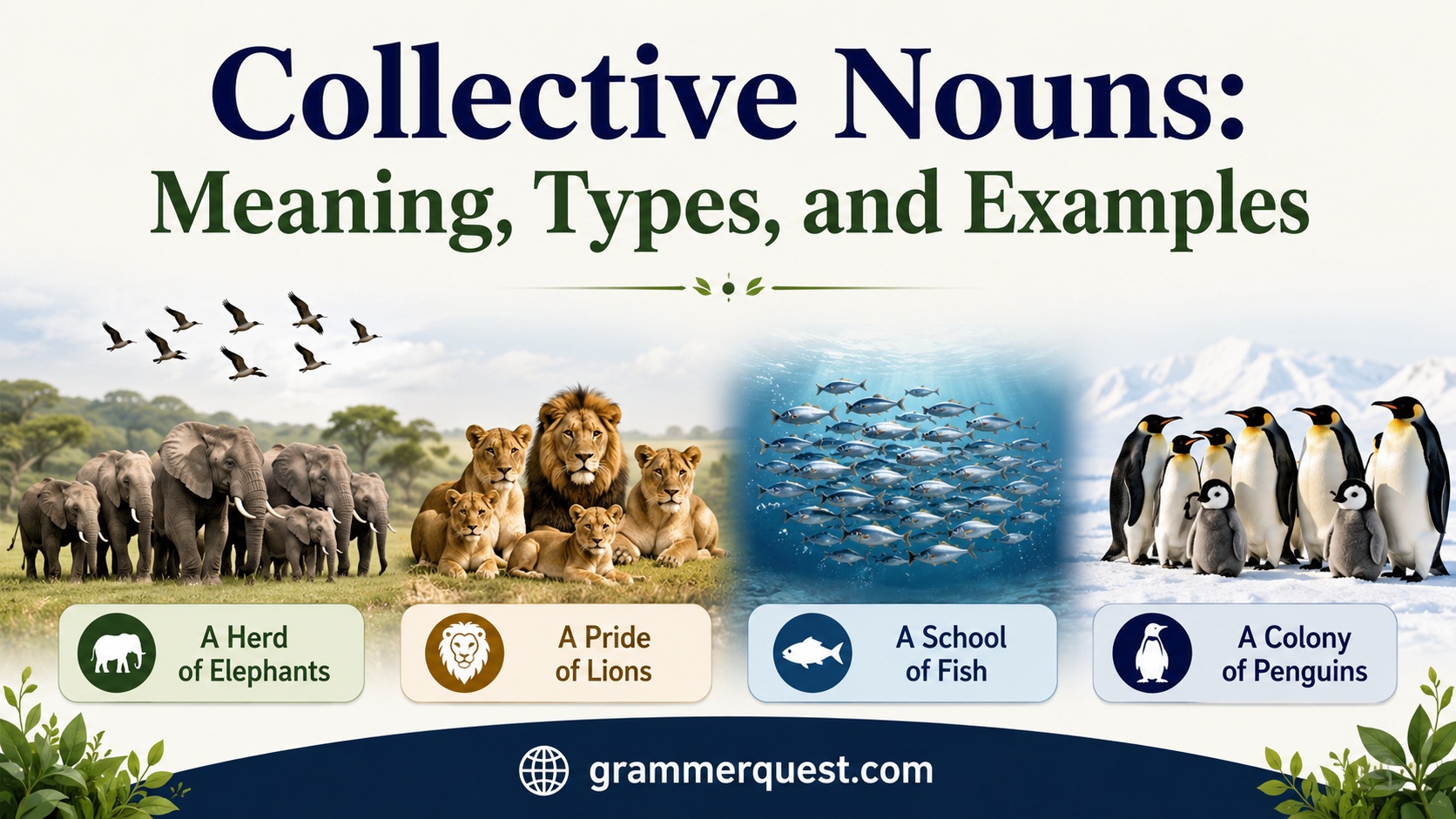
Collective Nouns: Meaning, Types, and Examples help learners understand how a collective noun represents a group of people, animals, or things as a single unit. Common examples like band, fleet, pride, and herd are widely used in the English language for better communication. In my experience of teaching grammar, students easily improve their understanding when they learn these noun examples through real-life context instead of difficult rules. This method also supports stronger vocabulary building and smoother language usage in daily writing and speaking.
A collective noun is an important word in English grammar because it can describe many individuals or items together. These special names make written communication more clear and effective. During language learning, learners often gain a greater understanding by using examples in a natural context. Terms connected with grouped objects, collection, and noun examples also improve sentence structure and overall grammar skills. Learning these words step by step makes communication easier and helps students use English more confidently.
Types of Collective Nouns (Overview Table)
| Type | Collective Noun | Simple Example |
| People | Team | A team of players |
| Animals | Herd | A herd of cows |
| Birds | Flock | A flock of birds |
| Objects | Bundle | A bundle of sticks |
| Insects | Swarm | A swarm of bees |
Collective Nouns for People
Collective nouns for people describe groups involved in similar activities or roles.
Examples:
- A team of players won the match easily.
- A crowd of people gathered in the stadium.
- A choir of singers performed beautifully.
- A jury of judges announced the verdict.
- A class of students is studying hard.
- A band of musicians played at the concert.
- A panel of experts discussed the topic.
- A staff of workers cleaned the building.
- A crew of sailors sailed the ship safely.
- A flock of tourists visited the museum.
Collective Nouns for Animals
Animal groups often have unique and interesting collective nouns.
Examples:
- A herd of cows is grazing in the field.
- A pack of wolves chased the deer.
- A pride of lions rested under the tree.
- A flock of sheep moved across the hill.
- A troop of monkeys climbed the trees.
- A colony of ants built a nest.
- A swarm of bees surrounded the hive.
- A pod of dolphins swam together.
- A litter of puppies played in the yard.
- A gaggle of geese walked near the lake.
Collective Nouns for Birds
Birds also have special collective nouns depending on their behavior.
Examples:
- A flock of birds flew across the sky.
- A murmuration of starlings formed beautiful patterns.
- A parliament of owls sat quietly on trees.
- A colony of penguins lived near the ice.
- A flight of swallows migrated south.
- A kettle of hawks circled above the field.
- A brood of hens protected their chicks.
- A raft of ducks floated on the pond.
- A skein of geese flew in formation.
- A team of swans glided across the lake.
Collective Nouns for Objects
Collective nouns are also used for non-living things.
Examples:
- A pile of books is on the table.
- A bundle of sticks was tied together.
- A stack of plates fell from the shelf.
- A set of tools is missing.
- A collection of coins was displayed.
- A group of islands forms an archipelago.
- A heap of sand was left on the ground.
- A batch of cookies was baked.
- A pack of cards is used for games.
- A series of events changed history.
Collective Nouns for Insects
Insects often appear in large groups with unique collective names.
Examples:
- A swarm of bees attacked the hive.
- A colony of ants built tunnels underground.
- A cloud of locusts destroyed crops.
- A plague of insects spread quickly.
- A horde of mosquitoes filled the air.
- A cluster of beetles gathered on the leaf.
- A nest of termites damaged the wood.
- A flight of butterflies danced in the garden.
- A swarm of flies entered the room.
- A army of ants carried food together.
Read More: Collective Nouns for Fish
Interesting Facts About Collective Nouns
Collective nouns are not just grammar tools—they also reflect how humans observe and interpret group behavior in nature and society.
- Many animal collective nouns date back to medieval English hunting traditions.
- Some are highly poetic, like a “murder of crows” or “murmuration of starlings.”
- Collective nouns help scientists and writers describe group behavior efficiently.
- Some groups behave differently when together, such as safety in numbers for animals like fish and birds.
- English has hundreds of unique collective nouns, many of which are rarely used in daily speech but remain culturally significant.
FAQs :
What are collective nouns?
Collective nouns are words used to name a group of people, animals, or things as one unit. Examples include band, herd, and fleet.
Why are collective nouns important in English grammar?
They improve communication by helping writers and speakers describe many individuals or objects with a single word.
Can collective nouns be singular and plural?
Yes, a collective noun is usually treated as a singular unit, but sometimes it can show plural meaning depending on the sentence context.
What are some common examples of collective nouns?
Common examples include a pride of lions, a band of musicians, a fleet of ships, and a herd of cattle.
How can students learn collective nouns easily?
Students learn faster by using noun examples in real-life sentences and daily language usage instead of memorizing long definitions.
Conclusion :
Understanding collective nouns helps learners improve their English grammar, vocabulary, and sentence structure. These words make communication shorter, clearer, and more effective by describing groups as a single unit. With regular practice and real-life examples, students can use collective nouns confidently in speaking and writing.

Emma Brooke is a passionate language enthusiast and the voice behind GrammarQuest.com. With a sharp eye for detail and a love for clear communication, she simplifies complex grammar rules into easy, practical lessons. Her goal is to help you write with confidence, clarity, and style—whether you’re a student, professional, or everyday writer.