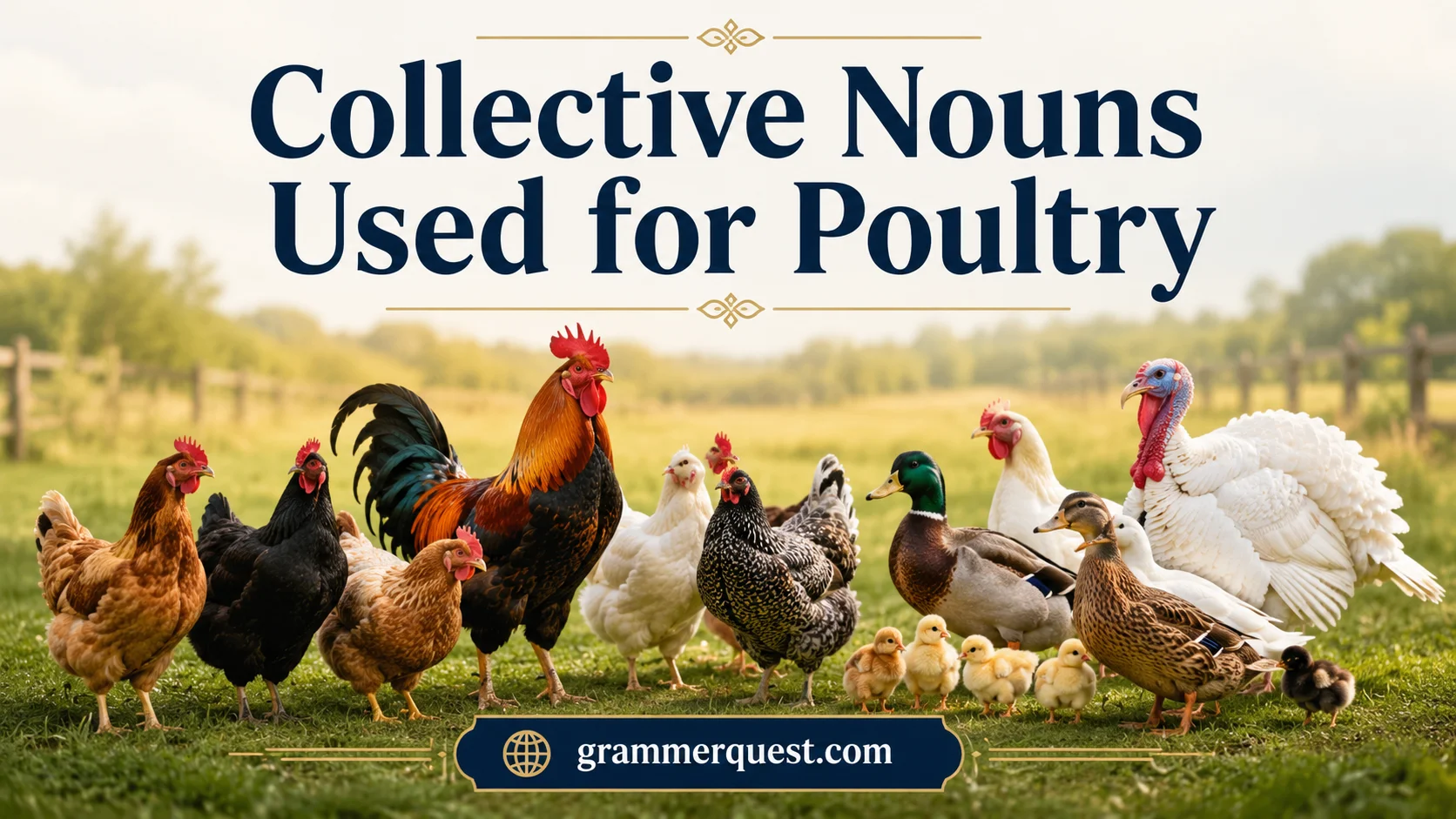
Collective Nouns Used for Poultry explain how a Flock of Chickens or other Poultry birds stay gathered together in one place in simple English Grammar.
In old farming traditions, a brood of chickens described a small family unit with baby chickens and younger chickens making a soft peep sound or gentle quiet chirp. The word Flock became one of the most common Collective Nouns because farmers and villagers often saw birds moving together in large groups. I once visited a local farm where these sounds and movements made the meaning of these terms feel natural and easy to remember.
The origin of chicken naming goes back nearly 5,000 years to the Red junglefowl of South-Eastern Asia. Through human domestication, this shy bird slowly transformed into one of the world’s most recognized domesticated chickens. Old medieval sources and scholars also created unusual names like murmuration, parliament, pack of dogs, and crash of rhinoceroses. Many of these technical hunting terms are still studied today in both spoken English and written English.
Common Collective Nouns for Poultry
| Type of Poultry Group | Collective Noun | Simple Example |
| Chickens | Flock | A flock of chickens |
| Chicks | Brood | A brood of chicks |
| Eggs | Clutch | A clutch of eggs |
| Chickens (young sound) | Peep | A peep of chicks |
| Ducks | Raft | A raft of ducks |
Flock of Poultry
A flock is the most common collective noun for poultry, especially chickens and other farm birds. It describes a group moving, feeding, or resting together.
Example Sentences:
- A flock of chickens is roaming in the yard.
- The farmer feeds the flock of hens every morning.
- A flock of turkeys gathered near the barn.
- We saw a flock of ducks near the pond.
- The flock of poultry moved toward the shelter.
- A flock of chickens followed the farmer.
- The flock of birds scattered when it rained.
- A large flock of hens was resting under the tree.
- The flock of ducks swam across the lake.
- A flock of poultry makes farm life lively.
Brood of Chicks/Hens
A brood refers to young birds (especially chicks) that are cared for by a mother hen. It highlights protection and nurturing behavior.
Example Sentences:
- A brood of chicks stayed close to their mother.
- The hen is guarding her brood carefully.
- A brood of young chickens followed the hen.
- The farmer saw a brood of chicks in the coop.
- A brood of hens and chicks is resting.
- The mother hen warmed her brood under her wings.
- A brood of baby chickens is learning to eat.
- The brood of chicks chirped loudly.
- A brood of poultry was kept safe in the barn.
- The hen protected her brood from danger.
Clutch of Eggs
A clutch is used for a group of eggs laid by a bird at one time, especially chickens or ducks.
Example Sentences:
- A clutch of eggs was found in the nest.
- The hen is sitting on a clutch of eggs.
- A clutch of chicken eggs is ready to hatch.
- The farmer collected a clutch of fresh eggs.
- A clutch of duck eggs is very valuable.
- The hen protects her clutch carefully.
- A clutch of eggs is warming under the hen.
- The nest contains a clutch of five eggs.
- A clutch of poultry eggs was stored safely.
- The hen did not leave her clutch unattended.
Peep of Chicks/Chickens
A peep refers to a small group of young chicks, named after their soft chirping sound.
Example Sentences:
- A peep of chicks is following the hen.
- The farmer heard a peep of chickens.
- A peep of baby chicks is very active.
- The hen guided her peep safely.
- A peep of chicks is eating grains.
- The peep of poultry stayed near the coop.
- A peep of chicks ran across the yard.
- The mother hen called her peep loudly.
- A peep of chickens gathered under the tree.
- The small peep of chicks looked adorable.
Raft of Ducks
A raft is a collective noun specifically used for ducks when they are floating together on water.
Example Sentences:
- A raft of ducks is swimming in the pond.
- The children watched a raft of ducks.
- A raft of ducklings followed their mother.
- The lake had a raft of ducks floating peacefully.
- A raft of ducks moved together in harmony.
- The farmer saw a raft of ducks near the river.
- A raft of ducks crossed the water slowly.
- The raft of poultry ducks gathered at sunset.
- A raft of ducks is feeding in the lake.
- The peaceful raft of ducks floated away.
Read More: Collective Nouns for Swine
Interesting Facts About Poultry
Poultry birds such as chickens, ducks, and turkeys are not only useful for food but also fascinating in behavior and biology.
- Longevity: Chickens can live up to 5–10 years, while ducks may live even longer under good care.
- Unique Physiology: Poultry birds have lightweight bones and strong wings adapted for short flights.
- Dietary Habits: They are mostly omnivores, eating grains, seeds, insects, and small plants.
- Chickens communicate using over 20 different sounds.
- Ducks have waterproof feathers due to natural oil glands.
- Poultry birds are highly social and prefer living in groups for safety.
FAQs:
What are Collective Nouns Used for Poultry?
They are special words used to describe a group of Poultry or Chickens together, such as Flock, brood, and peep.
What is the most common collective noun for chickens?
The most common Collective Noun for Chickens is Flock.
What does a brood of chickens mean?
A brood of chickens usually refers to a family unit with baby chickens and their mother.
Why is a group of young chickens called a peep?
Young chickens often make a soft peep sound, which inspired the term peep of chickens.
Where did chickens originally come from?
Modern chickens descended from the Red junglefowl found in South-Eastern Asia.
How old is chicken domestication history?
The history of human domestication of chickens goes back around 5,000 years.
What are some unusual collective nouns for birds?
Some famous examples are murmuration for starlings and parliament for owls.
Were medieval collective nouns really used by hunters?
Many technical hunting terms from medieval sources had little real or genuine use.
Why are collective nouns important in English Grammar?
They improve vocabulary, make sentences clearer, and help learners understand group names better.
Are collective nouns still used today?
Yes, many Collective Nouns are still common in both spoken English and written English.
Conclusion:
Understanding Collective Nouns Used for Poultry makes learning English Grammar more fun and practical. Words like Flock, brood, and peep not only describe groups of Chickens but also connect us with history, farming traditions, and language development. These terms continue to enrich modern vocabulary and everyday communication.

Emma Brooke is a passionate language enthusiast and the voice behind GrammarQuest.com. With a sharp eye for detail and a love for clear communication, she simplifies complex grammar rules into easy, practical lessons. Her goal is to help you write with confidence, clarity, and style—whether you’re a student, professional, or everyday writer.