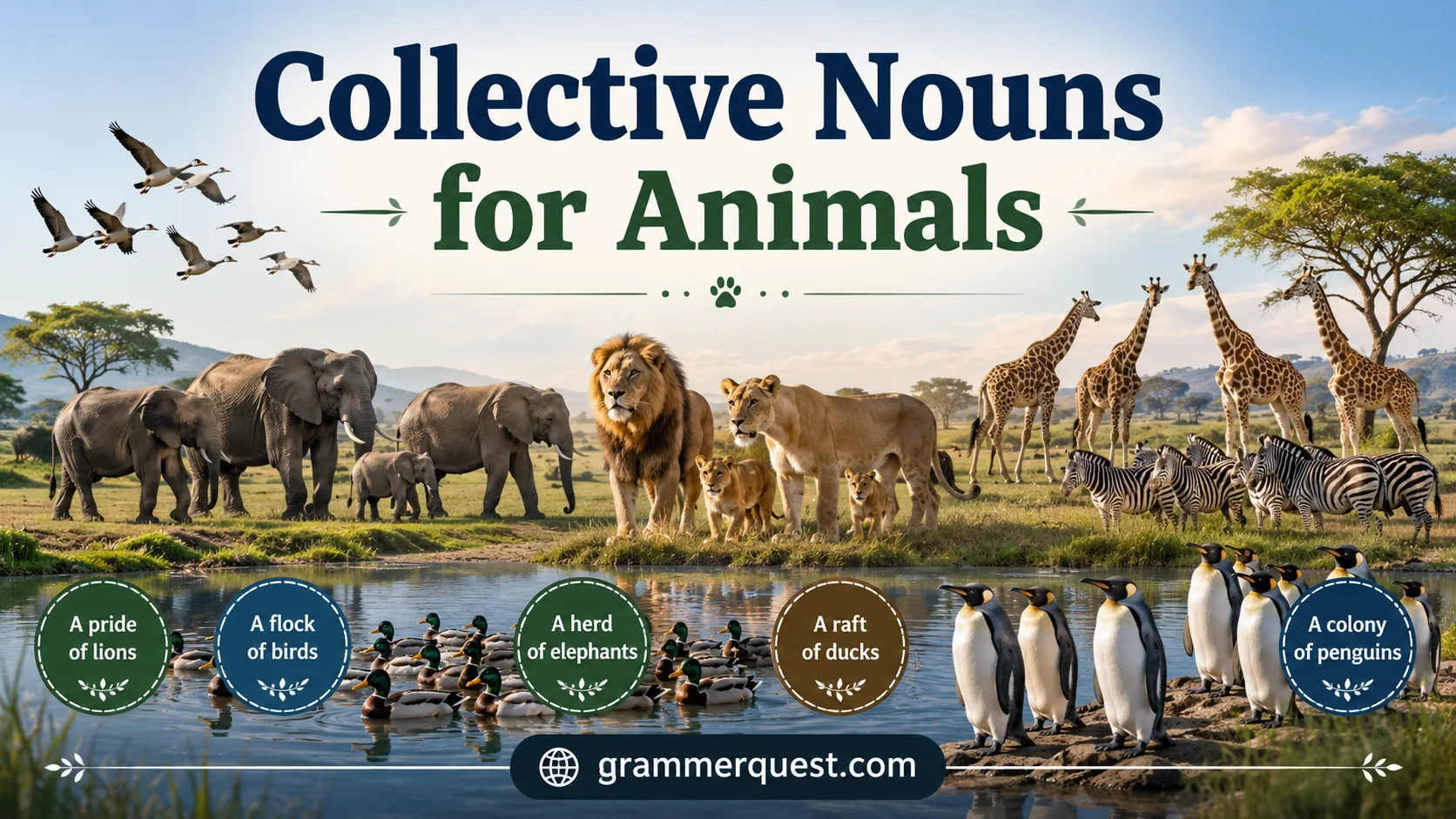
Collective Nouns for Animals are special words used to describe a group of animals, group of birds, or group of insects. A collective word works as a collective reference, making communication easier and more organized. This collective naming system uses naming conventions, group names, and group identification to create clear animal nouns, bird nouns, and insect nouns. These terms are an important part of animal terminology, bird terminology, insect terminology, and wildlife terminology. They are commonly used in both spoken language and written language, helping readers and speakers identify different kinds of animal groups quickly and accurately.
Many proper collective nouns come from medieval sources and medieval lists compiled by scholars. Their origin is often connected to technical hunting terms used by hunters, although some have a fanciful origin. Over time, these words became part of English vocabulary, ranging from common terms to arcane terms. Famous examples include a pack of dogs, pod of whales, flock of birds, parliament of owls, murmuration of starlings, and congregation of plovers. More unusual examples are a clowder of cats, descension of woodpeckers, gathering of flamingos, flamboyance of flamingos, and a crash of rhinoceroses, all of which make collective nouns memorable and interesting.
Common Collective Nouns for Animals
| Collective Noun | Type of Animals | Simple Example |
| Herd | Cattle, elephants, deer | A herd of elephants crossed the river. |
| Pack | Wolves, dogs | A pack of wolves hunted together. |
| Flock | Birds, sheep | A flock of birds flew overhead. |
| School | Fish | A school of fish swam in the sea. |
| Pride | Lions | A pride of lions rested in the grass. |
| Colony | Ants, penguins | A colony of ants worked hard. |
| Troop | Monkeys | A troop of monkeys climbed the trees. |
| Swarm | Bees, insects | A swarm of bees filled the garden. |
| Pod | Dolphins, whales | A pod of dolphins jumped in the water. |
| Team | Horses | A team of horses pulled the wagon. |
Types of Collective Nouns for Animals
Herd of Animals
A herd is commonly used for grazing or large land animals that stay together for protection and survival.
Examples
- A herd of deer ran through the forest.
- The herd of elephants moved slowly.
- We saw a herd of cattle in the field.
- A herd of buffalo crossed the plains.
- The herd stayed close together during the storm.
- Farmers guided the herd into the barn.
- A herd of goats climbed the hill.
- The herd drank water from the river.
- A herd of zebras grazed peacefully.
- The herd traveled across the valley.
Pack of Animals
A pack usually describes wild animals that hunt or travel together, especially wolves and dogs.
Examples
- A pack of wolves howled at night.
- The pack searched for food together.
- We noticed a pack of wild dogs nearby.
- A pack of foxes moved quietly.
- The pack protected its young members.
- Hunters spotted a pack in the forest.
- A pack of coyotes crossed the road.
- The pack rested under the trees.
- A pack of dogs barked loudly.
- The pack followed the leader carefully.
Flock of Animals
A flock is often used for birds and some farm animals like sheep.
Examples
- A flock of birds flew over the lake.
- The flock of sheep grazed calmly.
- We watched a flock of ducks swim.
- A flock of geese migrated south.
- The flock gathered near the farm.
- A flock of pigeons filled the sky.
- The shepherd cared for the flock daily.
- A flock of chickens wandered outside.
- The flock moved together quickly.
- A flock of sparrows sat on the tree.
School of Animals
A school refers mainly to fish swimming together in the same direction.
Examples
- A school of fish swam near the coral reef.
- The school moved quickly in the ocean.
- Divers observed a school of tuna underwater.
- A school of salmon traveled upstream.
- The school changed direction suddenly.
- We saw a school of fish in the aquarium.
- A school of sardines filled the water.
- The school stayed together for safety.
- Fishermen followed the school carefully.
- A school of fish sparkled in sunlight.
Pride of Animals
A pride is the special collective noun used for lions.
Examples
- A pride of lions rested under the tree.
- The pride hunted together at night.
- We saw a pride near the grasslands.
- The pride protected its cubs carefully.
- A pride of lions roared loudly.
- The pride walked across the savannah.
- Tourists photographed the pride from a jeep.
- The pride shared its meal peacefully.
- A strong lion led the pride.
- The pride stayed close during the storm.
Read More: Collective Nouns for Swordfish
Interesting Facts About Animals
Longevity of Animals
Animals have different lifespans depending on their species and environment. Some creatures, like tortoises, can live for more than 100 years, while smaller animals such as mice may only live a few years. Certain birds, whales, and elephants are also known for their long lives. Scientists study animal longevity to better understand aging, survival, and health in nature.
Unique Physiological Features of Animals
Animals possess amazing physical abilities that help them survive. Cheetahs can run at incredible speeds, bats use echolocation to move in darkness, and chameleons can change color to blend into their surroundings. Some animals, like camels, can survive long periods without water, while penguins have thick feathers to protect them from freezing temperatures. These unique features make the animal kingdom diverse and fascinating.
Dietary Habits of Animals
Animals eat different kinds of food based on their needs and habitats. Herbivores such as cows and deer feed on plants, carnivores like lions eat meat, and omnivores such as bears consume both plants and animals. Some creatures have very unusual diets. For example, anteaters mainly eat ants and termites, while pandas prefer bamboo. The dietary habits of animals play an important role in maintaining balance in ecosystems.
FAQs :
What are Collective Nouns for Animals?
Collective Nouns for Animals are special words used to describe a group of animals as a single unit. Examples include a pack of dogs and a pod of whales.
Why are collective nouns important?
They make communication clearer and more interesting by allowing people to refer to animal groups with one specific term instead of a longer description.
Are all collective nouns commonly used today?
No. Some terms, such as pack of dogs or flock of birds, are common, while others like clowder of cats or descension of woodpeckers are rarely used.
Where did many animal collective nouns come from?
Many originated from medieval sources and old hunting traditions, where scholars and hunters recorded unique names for groups of animals and birds.
What is the most famous collective noun for birds?
A flock of birds is the most widely used term, although special names like parliament of owls and murmuration of starlings are also well known.
Conclusion :
Collective Nouns for Animals add color and variety to the English language. From common terms such as a pack of dogs and a pod of whales to unusual expressions like a flamboyance of flamingos or a crash of rhinoceroses, these names make animal groups easier to identify and more enjoyable to discuss. They also provide a fascinating connection to history, language, and wildlife terminology.

Emma Brooke is a passionate language enthusiast and the voice behind GrammarQuest.com. With a sharp eye for detail and a love for clear communication, she simplifies complex grammar rules into easy, practical lessons. Her goal is to help you write with confidence, clarity, and style—whether you’re a student, professional, or everyday writer.