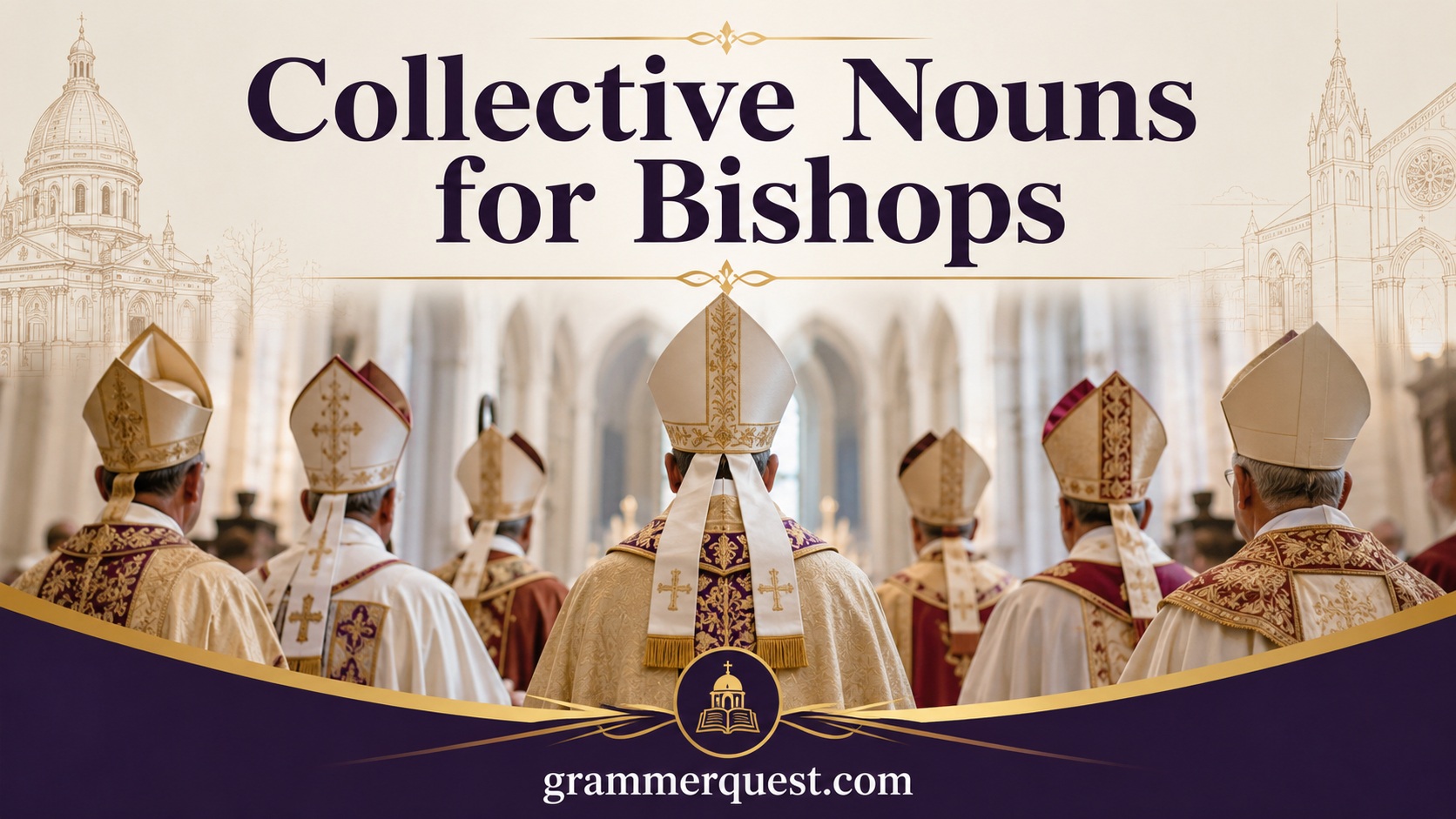
Collective Nouns for Bishops are special terms used to describe a group of bishops in the English language. These collective nouns make communication more interesting and help readers understand religious groups with greater clarity. Many of these expressions have been passed down through history and remain valuable for learning grammar, improving vocabulary, and exploring the traditions of the Christian church in a simple and engaging way.
Learning Collective Nouns for Bishops is useful for students, writers, and anyone interested in English grammar. These unique terms reflect centuries of language development and often carry historical and cultural importance. Understanding collective nouns, their meanings, and their usage can strengthen your writing skills, expand your vocabulary, and make your sentences more natural, accurate, and enjoyable to read.
Collective Nouns for Bishops
| Collective Noun | Type | Simple Example |
| Bench | Clergy | A bench of bishops attended the conference. |
| College | Formal Group | A college of bishops met for an important discussion. |
| Assembly | General Gathering | An assembly of bishops gathered for worship. |
| Council | Official Meeting | A council of bishops approved the proposal. |
What is a Bench of Bishops?
The term bench of bishops is the traditional and most widely accepted collective noun for bishops. It refers to a group of bishops serving together within a church or attending an official gathering.
Example
- A bench of bishops gathered for the annual meeting.
- The bench of bishops discussed church policies.
- We saw a bench of bishops during the ceremony.
- The bench of bishops welcomed the new leader.
- A bench of bishops attended the national conference.
- The bench of bishops offered prayers together.
- Everyone respected the bench of bishops.
- The bench of bishops met inside the cathedral.
- The bench of bishops announced important decisions.
- The bench of bishops worked together to guide the church.
Other Collective Nouns for Bishops
Although bench is the traditional term, several general collective nouns may also describe bishops depending on the situation.
College of Bishops
A college of bishops usually refers to bishops considered as one governing body.
Example
- The college of bishops held a special meeting.
- Every member of the college of bishops voted.
- The college of bishops welcomed new members.
- The college of bishops discussed future plans.
- The college of bishops gathered at the cathedral.
- The college of bishops issued a public statement.
- People listened to the college of bishops carefully.
- The college of bishops supported the proposal.
- The college of bishops prayed together.
- The college of bishops celebrated the special occasion.
Assembly of Bishops
Example
- An assembly of bishops gathered for worship.
- The assembly of bishops welcomed visitors.
- Everyone watched the assembly of bishops arrive.
- The assembly of bishops sang hymns together.
- The assembly of bishops discussed important matters.
- A large assembly of bishops attended the service.
- The assembly of bishops met peacefully.
- The assembly of bishops encouraged unity.
- The assembly of bishops shared their experiences.
- The assembly of bishops ended with a blessing.
Council of Bishops
Example
- The council of bishops met in the cathedral.
- The council of bishops approved the proposal.
- A council of bishops discussed church rules.
- The council of bishops welcomed the guests.
- Everyone respected the council of bishops.
- The council of bishops prayed before the meeting.
- The council of bishops solved many issues.
- The council of bishops made an important decision.
- The council of bishops thanked the volunteers.
- The council of bishops ended the meeting peacefully.
Read More: Collective Nouns for Architects
Interesting Facts About Bishops
Although the word bishop usually refers to a senior Christian church leader rather than a wildlife species, it is interesting to understand their historical role and traditions. Bishops have served as spiritual leaders for nearly two thousand years, overseeing dioceses, ordaining clergy, and preserving church teachings. Their distinctive vestments, including the mitre and pastoral staff, make them easily recognizable during religious ceremonies. Since bishops are people, they do not have biological traits such as longevity as a species, physiological adaptations, or dietary habits in the way animals do. Their lifespan and diet vary from person to person, depending on health, lifestyle, and culture.
Why Learn Collective Nouns for Bishops?
Understanding collective nouns for bishops helps improve both grammar and vocabulary. These unique expressions add precision and richness to writing while reflecting historical traditions within the Christian church. Learning terms such as bench of bishops also helps readers appreciate how English has developed specialized collective nouns for different groups.
FAQs :
1. What are Collective Nouns for Bishops?
Collective nouns for bishops are special words used to describe a group of bishops together, such as a bench of bishops.
2. What is the most common collective noun for bishops?
The most commonly used collective noun is a bench of bishops.
3. Why do bishops have collective nouns?
Collective nouns make the English language more descriptive and help identify groups with a single, meaningful word.
4. Are collective nouns for bishops still used today?
Yes, some terms, especially bench of bishops, are still used in religious and formal contexts.
5. Where did these collective nouns come from?
Many collective nouns originated during the Middle Ages and were recorded in historical books such as the Book of St Albans.
6. Can students use these collective nouns in writing?
Yes. They are useful for improving vocabulary, grammar, and formal writing skills.
7. Are there different collective nouns for bishops?
Yes. While bench is the best-known term, some older or less common expressions appear in historical references.
8. What is a collective noun?
A collective noun is a word that refers to a group of people, animals, or things as a single unit.
9. Why should I learn collective nouns?
Learning collective nouns improves your English vocabulary, writing style, and understanding of grammar.
10. Are collective nouns only used for people?
No. Collective nouns are also used for animals, objects, and many other groups, such as a flock of birds or a pride of lions.
Conclusion :
Collective Nouns for Bishops add depth and richness to the English language by giving a unique name to a group of bishops. Understanding these terms not only improves grammar and vocabulary but also offers insight into the history and traditions of English. Whether you are a student, teacher, or language enthusiast, learning these collective nouns will make your writing more accurate, engaging, and expressive.

George Whitaker is the voice behind GrammarQuest, dedicated to making grammar simple, engaging, and easy to understand. He helps learners turn confusion into confidence with clear explanations and real-world examples.