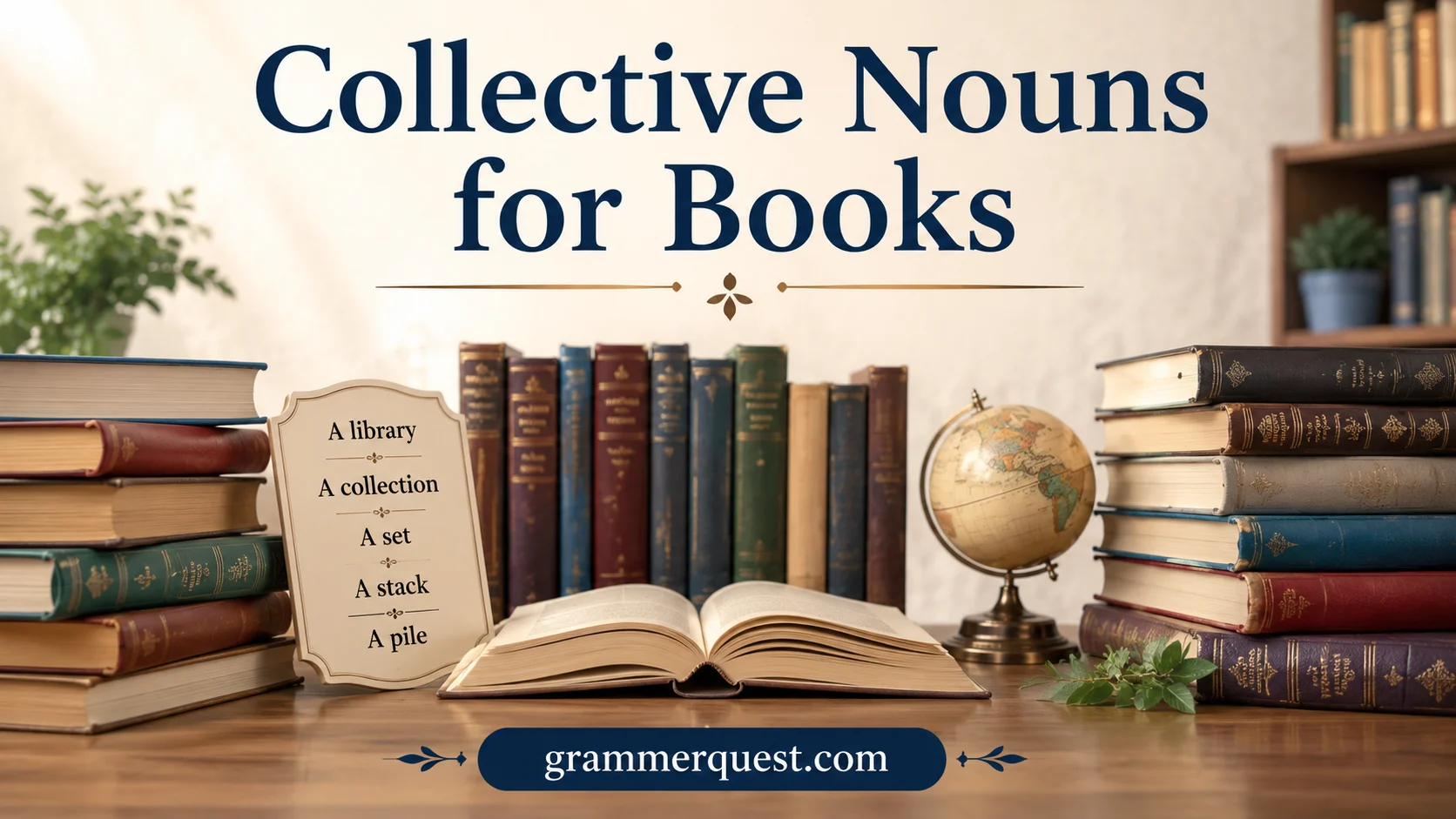
Collective Nouns for Books are useful words that describe a group of books in a clear and interesting way. Whether you see books arranged on a shelf, stacked in a corner, or collected in a large building, different collective nouns can be used to represent them. Common examples include a pile of books, a shelf of books, and a library of books. Learning these terms helps improve vocabulary and makes both writing and speaking more descriptive and engaging for readers.
Books are valuable sources of knowledge, imagination, and entertainment, and understanding their collective nouns adds depth to language skills. Just as English uses special group names for animals and people, it also has collective terms for objects like books. Knowing words such as collection, pile, shelf, and library can make communication more precise and effective. These expressions are especially helpful for students, writers, and anyone interested in expanding their understanding of English grammar and vocabulary.
Table: Common Collective Nouns for Books
| Type (Collective Noun) | Simple Example |
| Library of books | A library of books on history |
| Stack of books | A stack of books on the desk |
| Shelf of books | A shelf of books in the room |
| Pile of books | A pile of books near the chair |
| Collection of books | A collection of novels |
Collective Nouns for Books with Examples
Library of Books
A “library of books” refers to a large organized group of books, often stored for reading or research.
Examples (Library of Books)
- A library of books was arranged by subject.
- She donated a library of books to the school.
- The library of books covers science and history.
- A library of books stood in the quiet hall.
- He explored a library of books on space travel.
- The old house had a library of books upstairs.
- A library of books filled the entire room.
- They built a library of books for the community.
- A library of books was opened for students.
- The digital library of books is growing fast.
Stack of Books
A “stack of books” describes books placed one on top of another.
Examples (Stack of Books)
- A stack of books fell from the table.
- She carried a stack of books to class.
- A stack of books waited for sorting.
- He placed a stack of books near the window.
- The teacher handed out a stack of books.
- A stack of books blocked the door.
- They organized a stack of books neatly.
- A stack of books was on the study desk.
- The student balanced a stack of books carefully.
- A stack of books covered the floor.
Shelf of Books
A “shelf of books” refers to books arranged on a shelf for display or storage.
Examples (Shelf of Books)
- A shelf of books lined the classroom wall.
- She cleaned a shelf of books every weekend.
- A shelf of books displayed old novels.
- He borrowed a shelf of books from the library.
- A shelf of books was filled with poetry.
- They arranged a shelf of books alphabetically.
- A shelf of books decorated the office.
- She reached for a shelf of books on history.
- A shelf of books stood beside the window.
- The library had a shelf of books for kids.
Pile of Books
A “pile of books” refers to books placed loosely on top of each other, often in an unorganized way.
Examples (Pile of Books)
- A pile of books lay on the floor.
- He sorted a pile of books in the corner.
- A pile of books blocked the hallway.
- She cleaned up a pile of books after reading.
- A pile of books was ready for donation.
- They discovered a pile of books in the attic.
- A pile of books fell during cleaning.
- He borrowed a pile of books for research.
- A pile of books covered the study table.
- She organized a pile of books into shelves.
Collection of Books
A “collection of books” refers to a carefully selected group of books gathered for a purpose or theme.
Examples (Collection of Books)
- A collection of books was displayed in the museum.
- She owns a collection of books on art.
- A collection of books was donated to charity.
- He has a collection of books from around the world.
- A collection of books inspired the students.
- They built a collection of books over many years.
- A collection of books filled the bookshelf.
- She sold her collection of books online.
- A collection of books was published together.
- The rare collection of books is valuable.
Read More: Collective Nouns for Strawberries
Interesting Facts About Books
Books are fascinating objects that have existed for centuries, evolving from ancient handwritten manuscripts to modern digital formats. They are known for their incredible longevity, with some ancient texts surviving thousands of years due to careful preservation. Unlike living organisms, books do not have physical biological systems, but they do show “behavior” in a metaphorical sense—such as being organized, collected, and circulated among readers. Books also do not consume food, but they “feed” on human curiosity and knowledge transfer, growing in importance as they are read and shared. Their durability depends on materials like paper, ink, and binding, which determine how long they can survive environmental conditions.
FAQs :
1. What is a collective noun for books?
A collective noun for books is a word used to describe a group of books together, such as a pile, shelf, or library of books.
2. What is the most common collective noun for books?
The most common collective noun is a pile of books, especially when books are stacked together.
3. Can a shelf be a collective noun for books?
Yes, a shelf of books is often used when books are neatly arranged on a bookshelf.
4. Is a library a collective noun for books?
Yes, a library of books refers to a large collection of books kept in one place.
5. Why are collective nouns important?
Collective nouns make writing and speaking more descriptive, organized, and interesting.
6. Are collective nouns only used for animals?
No, collective nouns can be used for people, animals, and objects, including books.
7. What is another word for a group of books?
A collection of books is another common term used for a group of books.
8. How can collective nouns improve vocabulary?
They help learners use more precise and varied language in everyday communication.
9. Are collective nouns for books commonly used in writing?
Yes, writers and educators often use them to make descriptions clearer and more engaging.
10. Can there be more than one collective noun for books?
Yes, books can be referred to as a pile, shelf, collection, or library, depending on the context.
Conclusion :
Understanding Collective Nouns for Books helps make language more expressive and accurate. Words such as pile, shelf, collection, and library allow us to describe groups of books in different situations. By learning and using these collective nouns, you can improve your vocabulary, strengthen your grammar skills, and communicate more effectively in both writing and conversation.

George Whitaker is the voice behind GrammarQuest, dedicated to making grammar simple, engaging, and easy to understand. He helps learners turn confusion into confidence with clear explanations and real-world examples.