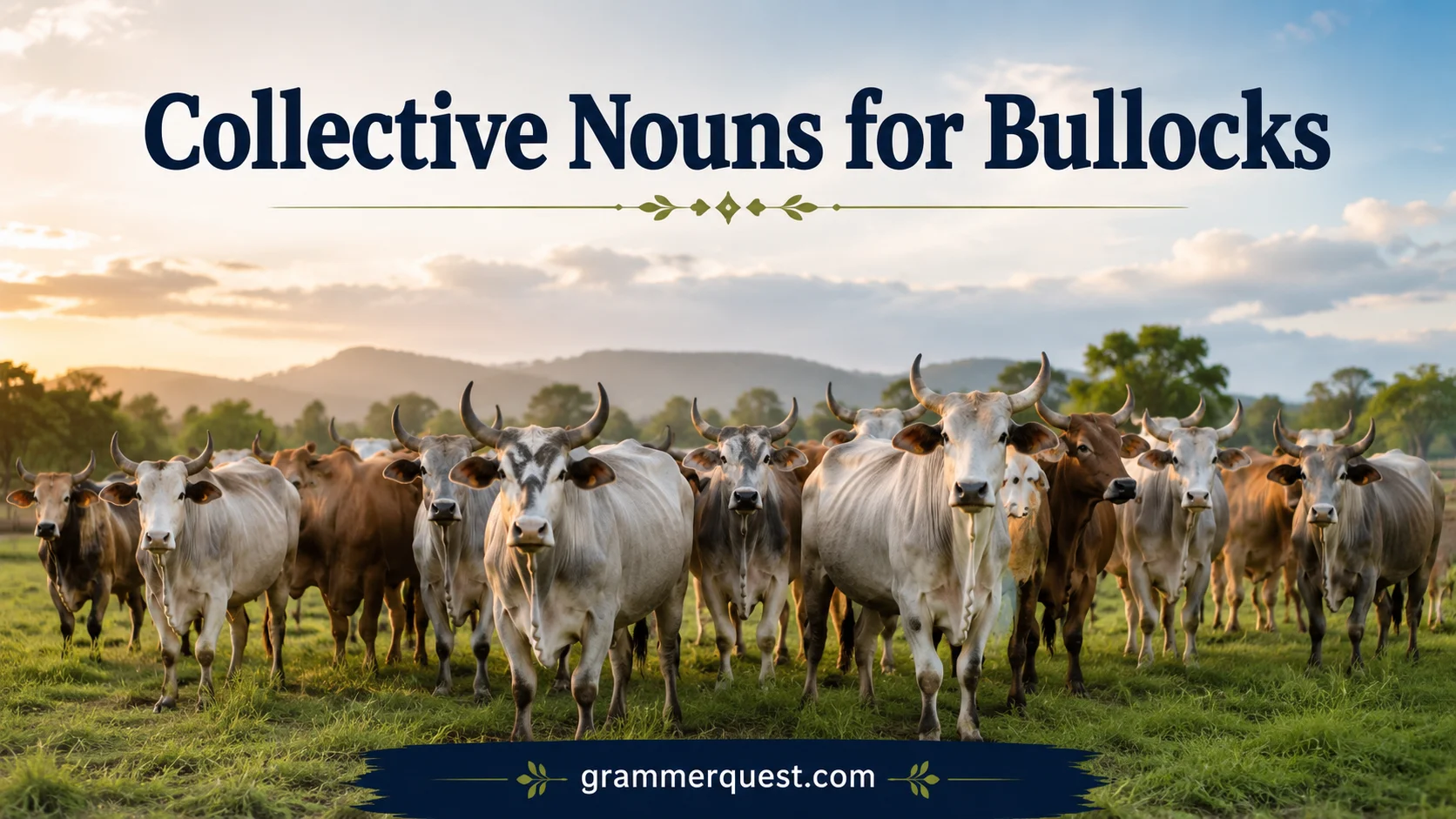
Collective Nouns for Bullocks are an important part of English grammar and make learning more interesting. A collective noun is a word used to describe a group of bullocks or other animals. These special terms help people understand animal groups and improve their knowledge of naming, terminology, classification, and proper usage. When discussing cattle, bovines, livestock, or a herd, collective nouns make communication clearer and more accurate. They are useful for both students and anyone interested in language.
By studying language, vocabulary, expression, and collective expression, learners can better understand how group names work. I have found that this subject becomes easier when exploring species, wildlife, fauna, mammals, creatures, domestic animals, and farm animals. Topics such as zoology and husbandry also use these terms regularly. These connections help students build a stronger understanding of animal-related words while improving their overall grammar and communication skills.
Table: Collective Nouns for Bullocks
| Collective Noun Type | Simple Example |
| Herd of bullocks | A herd grazing in the field |
| Yoke of bullocks | A yoke pulling a plough |
| Team of bullocks | A team used for farming work |
| Drove of bullocks | A drove being moved to market |
| Span of bullocks | A span pulling a cart |
Herd of Bullocks
A herd of bullocks refers to a large group of bullocks grazing or moving together in a field.
Example
- A herd of bullocks was grazing peacefully in the green meadow.
- The farmer guided a herd of bullocks toward the barn.
- We saw a herd of bullocks near the riverbank.
- A herd of bullocks slowly crossed the dusty road.
- The children watched a herd of bullocks from a distance.
- A herd of bullocks rested under the shade of trees.
- The shepherd walked beside a herd of bullocks.
- A herd of bullocks moved together toward the village.
- Farmers depend on a herd of bullocks for agriculture.
- A herd of bullocks created a beautiful countryside scene.
Yoke of Bullocks
A yoke of bullocks usually refers to two bullocks joined together to pull heavy loads or plough fields.
Example Sentences:
- A yoke of bullocks pulled the wooden plough through the field.
- The farmer trained a yoke of bullocks for farming work.
- A strong yoke of bullocks carried the heavy cart uphill.
- We saw a yoke of bullocks working in the rice field.
- A yoke of bullocks rested after a long day’s work.
- The village uses a yoke of bullocks for transportation.
- A yoke of bullocks is essential for traditional farming.
- The old man guided a yoke of bullocks carefully.
- A yoke of bullocks helped in ploughing the muddy land.
- The farmer praised his hardworking yoke of bullocks.
Team of Bullocks
A team of bullocks is a group trained to work together, especially in farming or pulling carts.
Example
- A team of bullocks pulled the loaded cart through the village.
- The farmer owns a strong team of bullocks.
- A team of bullocks worked hard in the field.
- We watched a team of bullocks carrying grains.
- The team of bullocks moved in perfect coordination.
- A team of bullocks was used for ploughing land.
- The village depends on a team of bullocks for farming.
- A team of bullocks rested near the river after work.
- The farmer trained his team of bullocks daily.
- A team of bullocks helped transport heavy goods.
Drove of Bullocks
A drove of bullocks refers to a group of bullocks being driven or moved from one place to another, often to market.
Example
- A drove of bullocks was taken to the cattle market.
- The shepherd guided a drove of bullocks through the road.
- A drove of bullocks blocked the narrow street.
- We saw a drove of bullocks moving slowly toward town.
- A drove of bullocks was resting near the water tank.
- Farmers sold a drove of bullocks at the fair.
- A drove of bullocks traveled long distances together.
- The trader bought a drove of bullocks for farming use.
- A drove of bullocks created dust while walking.
- The village boys followed a drove of bullocks curiously.
H2: Span of Bullocks
A span of bullocks usually refers to a pair of bullocks working together, especially when pulling carts or ploughs.
Example
- A span of bullocks pulled the heavy cart uphill.
- The farmer owns a strong span of bullocks.
- A span of bullocks worked in the wheat field.
- We saw a span of bullocks near the canal.
- A span of bullocks rested under the tree shade.
- The village depends on a span of bullocks for farming.
- A span of bullocks carried goods to the market.
- The farmer fed his span of bullocks in the evening.
- A span of bullocks moved slowly through the muddy path.
- The old cart was pulled by a span of bullocks.
Read This: Collective Nouns for Goshawks
Interesting Facts About Bullocks
Bullocks are known for their incredible strength, endurance, and usefulness in agriculture. They can work for long hours without tiring quickly, making them essential in traditional farming systems. Their lifespan often ranges between 15 to 20 years, depending on care, diet, and working conditions. Physically, bullocks have strong muscular bodies, large hooves for stability, and a powerful skeletal structure that allows them to pull heavy loads efficiently. They are herbivores and mainly feed on grass, hay, grains, and agricultural by-products, which makes them low-cost and sustainable working animals. Interestingly, bullocks are highly social animals and prefer staying in groups, which is why collective nouns like herd, team, or yoke are so meaningful in describing them.
FAQs :
1. What is the collective noun for bullocks?
The most common collective noun for bullocks is a herd.
2. Why are collective nouns important?
Collective nouns help describe a group of animals or people with a single word.
3. Are bullocks considered cattle?
Yes, bullocks are part of cattle and belong to the bovine family.
4. What does the word bullock mean?
A bullock is a domesticated male bovine, often used for farm work.
5. Is a herd the only collective noun for bullocks?
A herd is the most widely used term, though regional expressions may vary.
6. How do collective nouns improve grammar?
They make sentences clearer and help writers avoid repeating long descriptions.
7. What is the difference between a collective noun and a common noun?
A collective noun names a group, while a common noun names a single person, place, animal, or thing.
8. Are collective nouns used only for animals?
No, they are also used for people and objects, such as a team of players or a fleet of ships.
9. Why do animals have unique collective nouns?
Many collective nouns come from history, tradition, and old hunting or farming language.
10. Can learning collective nouns help students?
Yes, learning collective nouns expands vocabulary and improves writing and communication skills.
Conclusion :
Understanding Collective Nouns for Bullocks helps learners use English more accurately and confidently. The term herd is the most common name for a group of bullocks, and learning such expressions improves vocabulary, grammar, and knowledge of animal-related language. These collective nouns also connect language with farming, wildlife, and everyday communication, making them both useful and interesting to study.

George Whitaker is the voice behind GrammarQuest, dedicated to making grammar simple, engaging, and easy to understand. He helps learners turn confusion into confidence with clear explanations and real-world examples.