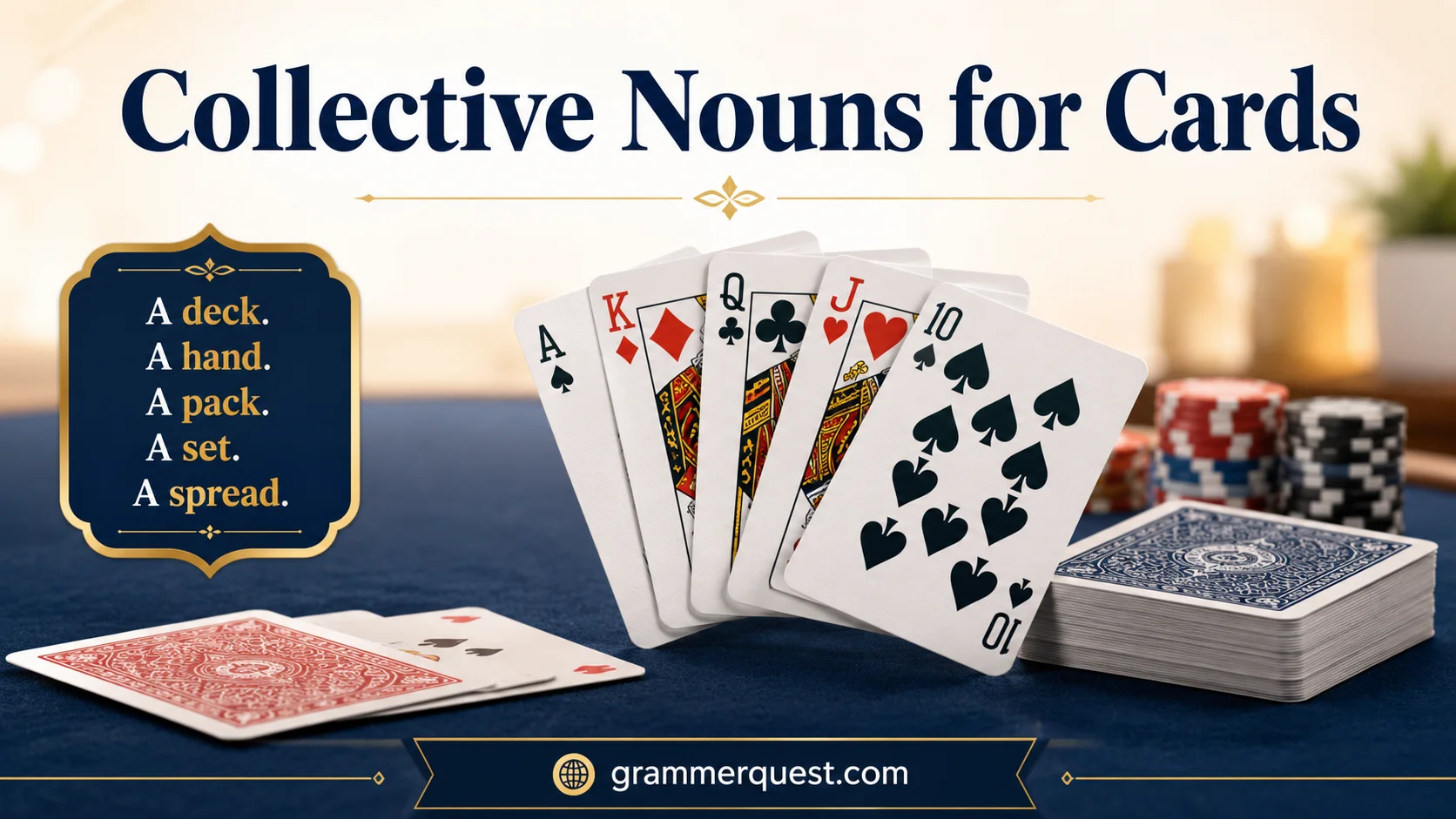
When learning Collective Nouns for Cards, it is useful to know the special words used to describe a group of cards. The most common collective noun is a packet of cards or a deck of cards, especially when referring to playing cards used in games. These collective nouns make writing and speaking more precise while helping learners understand how English groups similar objects together in a meaningful and organized way.
Understanding collective nouns can improve both vocabulary and grammar skills. Besides a deck or packet, some sources also mention terms like bouquet, house, and range for groups of cards in specific contexts. Learning these expressions adds variety to language use and makes communication more interesting. Whether you are a student, teacher, or language enthusiast, knowing collective nouns for cards is a valuable part of mastering English.
Collective Nouns for Cards (Table Overview)
| Collective Noun | Simple Example |
| Deck of cards | A deck of cards is shuffled. |
| Pack of cards | He opened a new pack of cards. |
| Hand of cards | She played a strong hand of cards. |
| Stack of cards | A stack of cards lay on the table. |
| Shoe of cards | The casino used a shoe of cards. |
Deck of Cards
A deck of cards is the most common term used in card games, usually containing 52 playing cards.
Examples (10 Sentences)
- I bought a new deck of cards for game night.
- The magician shuffled the deck of cards quickly.
- A standard deck of cards has four suits.
- She cut the deck of cards before dealing.
- The deck of cards was missing one joker.
- He arranged the deck of cards neatly.
- The teacher used a deck of cards for a math activity.
- The deck of cards slipped off the table.
- They shared a deck of cards during the trip.
- The deck of cards was brand new and crisp.
Pack of Cards
A pack of cards is another commonly used term, especially in casual speech.
Examples (10 Sentences)
- He opened a fresh pack of cards.
- The pack of cards was sealed tightly.
- We carried a pack of cards on the journey.
- She shuffled the pack of cards carefully.
- The pack of cards was placed on the shelf.
- I found an old pack of cards in the drawer.
- The pack of cards belonged to my brother.
- They used a pack of cards for poker night.
- The pack of cards had colorful designs.
- A damaged pack of cards cannot be used properly.
Hand of Cards
A hand of cards refers to the cards held by a player during a game.
Examples (10 Sentences)
- He showed his hand of cards proudly.
- She had a winning hand of cards.
- The hand of cards was very weak.
- He carefully studied his hand of cards.
- The player revealed his hand of cards.
- A good hand of cards can change the game.
- She shuffled her hand of cards nervously.
- The hand of cards included two aces.
- He improved his hand of cards with a lucky draw.
- The hand of cards was unbeatable.
Stack of Cards
A stack of cards refers to cards placed one on top of another in a neat pile.
Examples (10 Sentences)
- A stack of cards was placed on the table.
- He organized a stack of cards for the game.
- The stack of cards fell over suddenly.
- She sorted the stack of cards by suit.
- A tall stack of cards stood in the corner.
- The magician balanced a stack of cards.
- The stack of cards was shuffled again.
- They counted the stack of cards carefully.
- The stack of cards was slightly bent.
- A new stack of cards was brought in.
Shoe of Cards
A shoe of cards is a device used in casinos to hold multiple decks of cards for dealing.
Examples (10 Sentences)
- The dealer pulled cards from the shoe of cards.
- A shoe of cards holds several decks.
- The casino used a shoe of cards for blackjack.
- The shoe of cards was refilled quickly.
- He learned how to handle a shoe of cards.
- The shoe of cards ensures fair dealing.
- The dealer shuffled the shoe of cards carefully.
- A transparent shoe of cards was used.
- The shoe of cards sat on the gaming table.
- The rules required a sealed shoe of cards.
Read More: Collective Nouns for Weapons
Interesting Facts About Cards
Playing cards have a fascinating history and practical design. Modern cards are made from durable paperboard or plastic-coated materials, allowing them to last through thousands of shuffles. Their surfaces are designed to resist wear, bending, and moisture, which contributes to their long lifespan.
Each card has unique printed symbols representing suits and ranks, making them easy to identify during fast-paced games. The standard 52-card deck is widely used across the world in hundreds of games.
Unlike living creatures, cards do not have biological traits or dietary habits. However, they do have “usage patterns”—some decks are used heavily in casinos, while others are kept as collectibles or used occasionally in family games.
FAQs :
1. What is the most common collective noun for cards?
The most common collective noun for cards is a deck of cards.
2. Can I say a packet of cards?
Yes, packet of cards is another widely accepted term, especially in British English.
3. What does a deck of cards mean?
A deck of cards refers to a complete set of playing cards used in games.
4. Are collective nouns important in English?
Yes, collective nouns help describe groups of people, animals, or things more accurately.
5. Is “house of cards” a collective noun?
Yes, house of cards can describe cards arranged in a structure, though it is less common as a collective noun.
6. What is a bouquet of cards?
A bouquet of cards is a rare and specialized term used in certain contexts.
7. Why should students learn collective nouns?
Learning collective nouns improves vocabulary, grammar, and communication skills.
8. Are collective nouns used only for cards?
No, collective nouns are used for many groups, such as a flock of birds or a herd of cattle.
9. Which term is best for playing cards?
The best and most commonly used term is a deck of cards.
10. Can collective nouns make writing better?
Yes, they make writing more descriptive, clear, and engaging.
Conclusion :
Understanding Collective Nouns for Cards helps learners use English more effectively and confidently. The most common terms are deck of cards and packet of cards, while other expressions such as house, bouquet, and range may appear in specific situations. By learning these collective nouns, students can strengthen their vocabulary, improve grammar, and communicate with greater accuracy.

Henry Collins is a passionate grammar expert and the voice behind GrammerQuest.com. With a sharp eye for language and a love for clear communication, he simplifies complex grammar rules into easy, practical lessons.