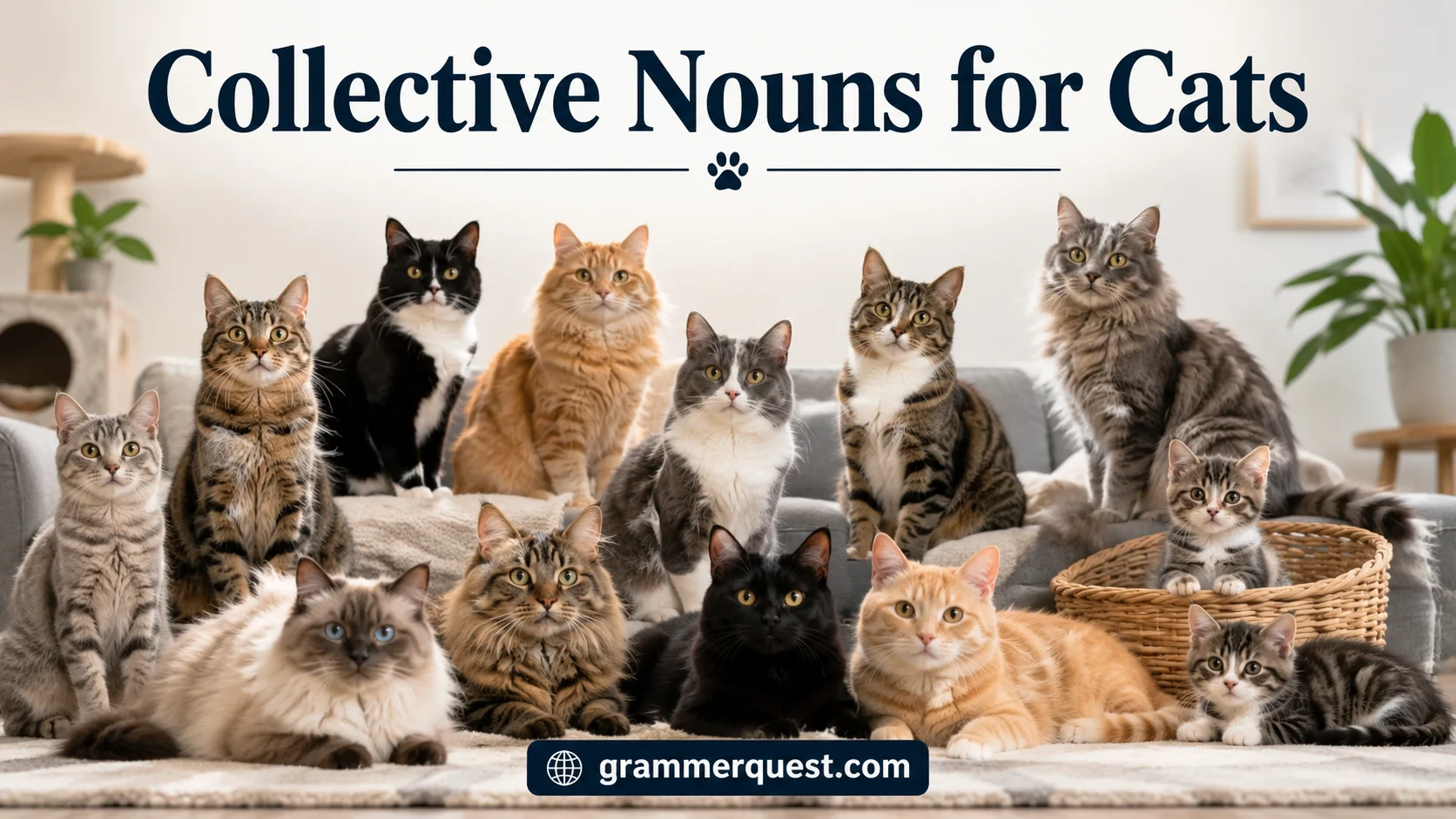
Collective Nouns for Cats is a simple guide that explains how we describe groups of cats in English. These collective nouns help learners understand language when talking about animals in groups. The most important term is clowder, which is correct word for group of cats. Other related words include clutter, glaring, and nuisance, less formal but still used in language learning. Understanding these terms improves vocabulary and grammar skills very easily today now.
We often hear about a pride of lions a shadow of jaguars and a leap of leopards as common examples of animal group names. A flock of birds a herd of cattle a pack of dogs and wolves are also widely used in daily speech. These collective nouns help people understand how animals are grouped in language and improve learning and communication very useful for students and writers learning English vocabulary skills every day in real life contexts situations clearly.
Collective Nouns for Cats (Overview Table)
| Collective Noun | Simple Example |
| Clowder | A clowder of cats in the garden |
| Clutter | A clutter of cats on the sofa |
| Glaring | A glaring of cats watching quietly |
| Pounce | A pounce of cats playing together |
| Kindle | A kindle of kittens with their mother |
Clowder of Cats
A clowder is the most commonly used collective noun for adult cats.
Example
- A clowder of cats was resting under the warm sun.
- I saw a clowder of cats in the alley behind the shop.
- The clowder of cats moved silently across the yard.
- A clowder of cats gathered near the food bowl.
- The farmer noticed a clowder of cats in the barn.
- A clowder of cats climbed over the old fence together.
- The clowder of cats watched the birds carefully.
- A clowder of cats appeared on the rooftop at night.
- The clowder of cats scattered when the dog barked.
- A clowder of cats slept peacefully on the porch.
Clutter of Cats
A clutter often describes cats gathered in a messy or relaxed group, usually indoors.
Example
- A clutter of cats filled the cozy living room.
- I found a clutter of cats sleeping on my bed.
- The clutter of cats blocked the hallway.
- A clutter of cats purred softly near the fireplace.
- The clutter of cats played with a ball of yarn.
- A clutter of cats jumped onto the kitchen counter.
- The clutter of cats ignored all the noise around them.
- A clutter of cats gathered around the food dish.
- The clutter of cats looked comfortable on the couch.
- A clutter of cats curled up together during winter.
Glaring of Cats
A glaring describes a group of cats watching something intensely, often in a quiet or alert manner.
Example
- A glaring of cats stared at the moving mouse.
- The glaring of cats remained still in the garden.
- A glaring of cats watched the fish pond carefully.
- The glaring of cats observed the birds from a distance.
- A glaring of cats sat quietly on the fence.
- The glaring of cats focused on the rustling leaves.
- A glaring of cats gathered near the shadow.
- The glaring of cats did not move for several minutes.
- A glaring of cats followed the sound in silence.
- The glaring of cats disappeared into the night.
Pounce of Cats
A pounce refers to a playful or active group of cats, often seen hunting or playing.
Example
- A pounce of cats chased each other in the yard.
- The pounce of cats jumped over the fence together.
- A pounce of cats played with a toy mouse.
- The pounce of cats ran across the grass happily.
- A pounce of cats attacked the cardboard box.
- The pounce of cats scattered when startled.
- A pounce of cats climbed the tree in seconds.
- The pounce of cats explored the garden together.
- A pounce of cats leaped onto the roof.
- The pounce of cats played until sunset.
Kindle of Kittens
A kindle specifically refers to a group of baby cats (kittens) with their mother.
Example
- A kindle of kittens slept beside their mother.
- The kindle of kittens played with soft toys.
- A kindle of kittens meowed loudly for milk.
- The kindle of kittens followed their mother closely.
- A kindle of kittens explored the small room.
- The kindle of kittens curled up together warmly.
- A kindle of kittens stumbled while learning to walk.
- The kindle of kittens hid under the blanket.
- A kindle of kittens climbed over each other playfully.
- The kindle of kittens grew stronger every day.
Read More: Collective Nouns for Insects
Interesting Facts About Cats
Cats are fascinating creatures with unique biological and behavioral traits. Most domestic cats can live between 12 to 18 years, while some even exceed 20 years with proper care. They possess highly flexible spines, sharp retractable claws, and excellent night vision, making them skilled hunters even in low light. Their whiskers act as sensitive tools to detect space and movement, helping them navigate tight areas.
Diet-wise, cats are obligate carnivores, meaning they require nutrients found only in animal-based proteins. Unlike many animals, they cannot fully thrive on plant-based diets. Their hunting instincts remain strong even in well-fed domestic environments, which explains why they often chase small moving objects. These traits make cats both independent and highly adaptive companions.
FAQs:
What is the collective noun for cats?
It is clowder, which is the correct and widely accepted term for a group of cats.
Are there other collective nouns for cats?
Yes, informal alternatives include clutter, glaring, nuisance, and doubt.
Is “clowder” used in everyday English?
Not commonly in daily speech, but it is correct in formal English and dictionaries.
Why do animals have collective nouns?
They help describe groups of animals in a structured and meaningful way in language.
What are some examples of collective nouns for other animals?
A pride of lions, a flock of birds, and a herd of cattle are common examples.
Is “pack of cats” correct?
No, “pack” is usually used for dogs or wolves, not cats.
Where can I find collective nouns?
You can find them in English dictionaries and grammar references.
Are collective nouns important for students?
Yes, they improve vocabulary, grammar understanding, and communication skills.
Why are some collective nouns unusual?
Because they come from old English usage and historical language development.
Can collective nouns change over time?
Yes, language evolves, so some terms may become more or less common.
Conclusion:
Collective nouns for cats, especially clowder, show how rich and creative the English language is. These terms help describe animal groups in a structured way and improve understanding of grammar and vocabulary.

Emma Brooke is a passionate language enthusiast and the voice behind GrammarQuest.com. With a sharp eye for detail and a love for clear communication, she simplifies complex grammar rules into easy, practical lessons. Her goal is to help you write with confidence, clarity, and style—whether you’re a student, professional, or everyday writer.