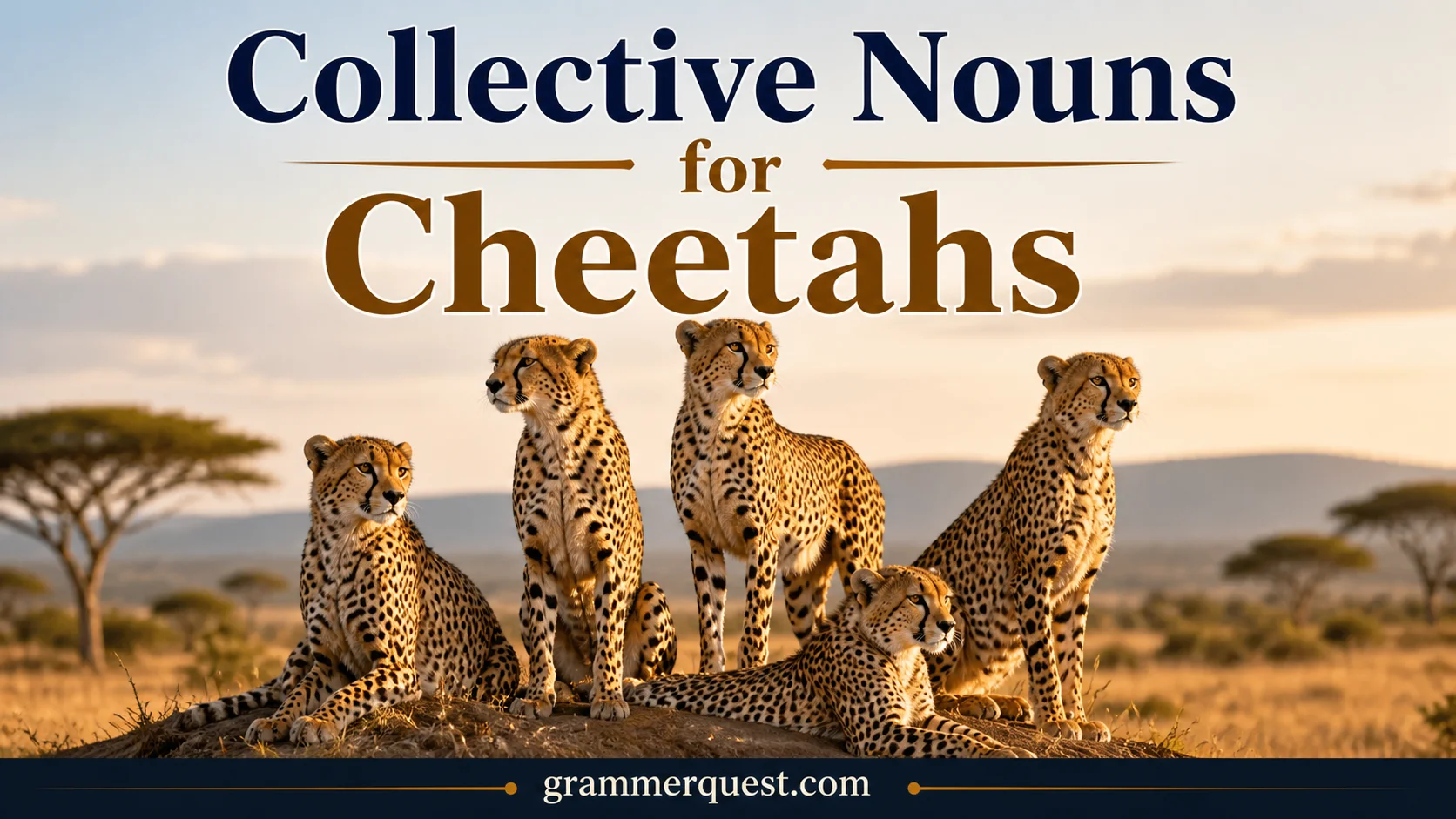
Collective Nouns for Cheetahs make an African safari more thrilling, adding knowledge, fun, and deeper understanding of wildlife, animals, and their groups in nature.
In Southern Africa, diverse ecosystems support an extraordinary variety of animals, including iconic Big Five species and vast herds roaming open savannas. On a game drive, you get the chance to witness nature in its most powerful form. Learning collective nouns and terms that describe groups helps explain behaviour, social structure, and physical traits, giving a more fascinating insight into life in the bush.
As a casual guide, I use this to engage children, encourage curiosity, and impress guests by sharing interesting facts about species commonly seen. Many feel fascinated by the beauty of a cheetah, a large feline with long legs, slender bodies, golden yellow fur, and black spots. Sadly, habitat loss, hunting, and human pressure have made them vulnerable, with low numbers surviving into adulthood.
Collective Nouns for Cheetahs (Overview Table)
| Type of Collective Noun | Simple Example |
| Coalition | A coalition of cheetahs resting together |
| Streak | A streak of cheetahs running across the plains |
| Ambush | An ambush of cheetahs hiding in tall grass |
| Family | A family of cheetahs with cubs |
| Group | A group of cheetahs near a waterhole |
Coalition of Cheetahs
A coalition is the most widely accepted collective noun for cheetahs, usually referring to male cheetahs that live and hunt together for survival advantages.
Examples: Coalition of Cheetahs Sentences
Example Sentences:
- A coalition of cheetahs moved silently through the grasslands.
- The coalition rested under the shade after a long chase.
- Tourists spotted a coalition of cheetahs near the riverbank.
- A strong coalition helps male cheetahs defend their territory.
- The coalition hunted together to catch a gazelle.
- A coalition of cheetahs marked their territory with scent.
- The safari guide explained how rare a coalition can be.
- Three cheetahs formed a coalition for better hunting success.
- The coalition of cheetahs rested after a successful hunt.
- Researchers studied how coalitions improve survival rates.
Streak of Cheetahs
A streak of cheetahs is a poetic expression inspired by their incredible speed and the visual blur they create while running.
Examples: Streak of Cheetahs Sentences
Example Sentences:
- A streak of cheetahs raced across the golden savanna.
- The streak disappeared in seconds during the hunt.
- Tourists saw a streak of cheetahs chasing prey.
- A streak of cheetahs moved like lightning through the grass.
- The streak of cheetahs startled a herd of antelope.
- We watched a streak of cheetahs from the safari jeep.
- The streak vanished into the horizon quickly.
- A streak of cheetahs showed unmatched speed and grace.
- The camera barely captured the streak of cheetahs.
- A streak of cheetahs is a breathtaking sight in the wild.
Ambush of Cheetahs
An ambush of cheetahs refers to their stealth hunting style, where they hide and wait before chasing prey with explosive speed.
Examples: Ambush of Cheetahs Sentences
Example Sentences:
- An ambush of cheetahs waited silently in tall grass.
- The ambush suddenly sprinted toward the unsuspecting antelope.
- A skilled ambush of cheetahs can hunt successfully.
- The ambush remained hidden until the perfect moment.
- Rangers observed an ambush of cheetahs near the waterhole.
- The ambush of cheetahs used teamwork during the chase.
- An ambush can stay still for long periods.
- The ambush of cheetahs surprised their prey instantly.
- A patient ambush increases hunting success.
- The ambush of cheetahs disappeared after the hunt.
Family of Cheetahs
A family of cheetahs usually includes a mother and her cubs, highlighting the nurturing side of these big cats.
Examples: Family of Cheetahs Sentences
Example Sentences:
- A family of cheetahs rested under a shady tree.
- The mother protected her family of cheetahs.
- A family of cheetahs played near the bushes.
- The cubs in the family of cheetahs learned hunting skills.
- A family of cheetahs stayed close for safety.
- The safari guide spotted a family of cheetahs near a hill.
- The mother taught her family of cheetahs to stalk prey.
- A family of cheetahs drank water together.
- The cubs followed their family carefully.
- A family of cheetahs is rare to see in the wild.
Group of Cheetahs
A group of cheetahs is a general term used when multiple cheetahs are seen together without specific social structure.
Examples: Group of Cheetahs Sentences
Example Sentences:
- A group of cheetahs gathered near the watering hole.
- The group moved slowly across the savanna.
- Tourists watched a group of cheetahs resting.
- A group of cheetahs shared a recent kill.
- The group scattered when danger approached.
- A group of cheetahs can sometimes hunt together.
- The guide pointed out a group of cheetahs in the distance.
- A group of cheetahs rested after chasing prey.
- The group stayed alert in the open plains.
- A group of cheetahs is rare but fascinating to observe.
Read More: Collective Nouns for Iguanas
Interesting Facts About Cheetahs
Longevity
Cheetahs typically live around 10–12 years in the wild, while those in captivity can live slightly longer due to better care and protection from predators.
Unique Physiological Features
- Cheetahs are the fastest land animals, reaching speeds up to 100–120 km/h.
- They have a lightweight body and long legs for speed.
- Their black tear marks reduce sun glare while hunting.
- A large lung capacity and strong heart support rapid sprinting.
Dietary Habits
- Cheetahs mainly hunt small to medium-sized antelopes like gazelles.
- They rely on speed rather than strength to catch prey.
- They usually hunt during early morning or late afternoon to avoid heat.
- Cheetahs often eat quickly to avoid losing food to predators like lions or hyenas.
FAQs:
1. What are Collective Nouns for Cheetahs?
Collective Nouns for Cheetahs are special terms used to describe groups of cheetahs, helping us understand their behaviour and social patterns.
2. What is the most common group name for cheetahs?
A group of cheetahs is often called a coalition, especially when males live and hunt together.
3. Where do cheetahs usually live?
Cheetahs mainly live in Africa, especially in open grasslands, savannas, and some desert regions.
4. Why are collective nouns important in wildlife learning?
They add knowledge, improve understanding, and make wildlife education more interesting and fun.
5. How fast is a cheetah?
The cheetah is the fastest land animal, built for speed over short distances.
6. What makes cheetahs unique in appearance?
They have long legs, slender bodies, golden yellow fur, and black spots with a tear stripe on the face.
7. Why are cheetahs considered vulnerable?
Due to habitat loss, hunting, and human interference, their population has declined and they are listed as vulnerable.
8. What do cheetahs eat?
They hunt small to medium animals, using their speed and agility in open environments.
9. How do collective nouns help travellers on safari?
They help travellers identify groups of animals and make the safari experience more engaging.
10. Can children benefit from learning collective nouns?
Yes, it helps engage children, encourage curiosity, and makes learning about nature more enjoyable.
Conclusion:
Collective Nouns for Cheetahs not only enrich your learning but also make every African safari more meaningful. They add depth, fun, and insight into wildlife, helping you better understand animals, their groups, and the challenges they face in nature today.

Emma Brooke is a passionate language enthusiast and the voice behind GrammarQuest.com. With a sharp eye for detail and a love for clear communication, she simplifies complex grammar rules into easy, practical lessons. Her goal is to help you write with confidence, clarity, and style—whether you’re a student, professional, or everyday writer.