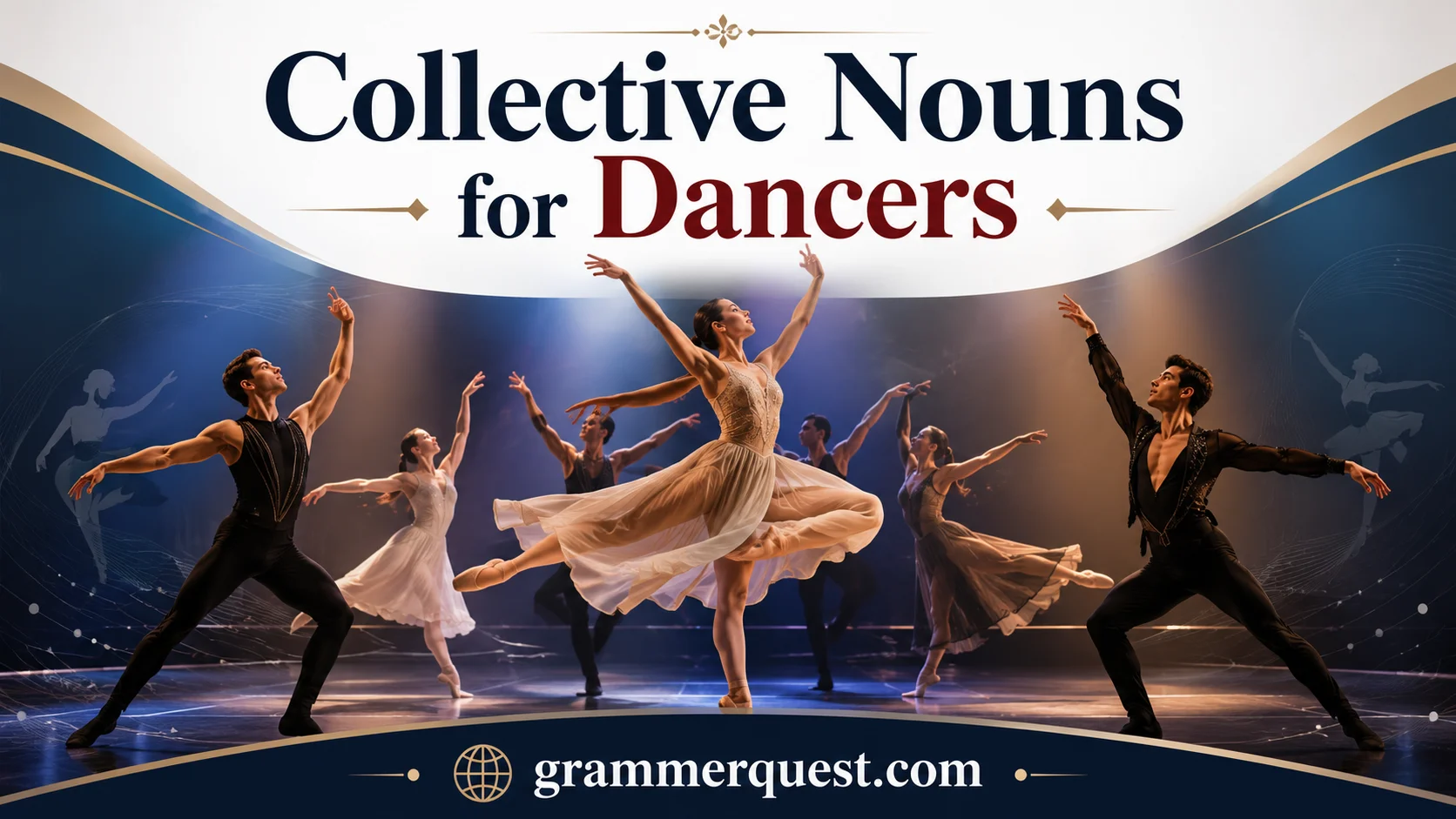
Collective Nouns for Dancers are useful grammar terms that describe a group of dancers with a single word. Learning these collective nouns makes your English more accurate, natural, and expressive. Whether you are a student, teacher, or language enthusiast, understanding the correct terms improves both writing and speaking skills. It also helps you communicate ideas clearly while making your sentences more interesting and easier to understand in everyday situations.
Knowing collective nouns for different groups adds variety and style to your English vocabulary. The most common term is a troupe of dancers, but similar expressions are also used for other groups of people and performers. Using these words correctly enhances grammar, improves sentence structure, and builds confidence in communication. With regular practice and simple examples, anyone can master these useful terms and make their writing more engaging and professional.
Table of Collective Nouns for Dancers
| Collective Noun | Type | Simple Example |
| Troupe | Performing group | A troupe of dancers performed beautifully. |
| Company | Professional organization | A company of dancers toured Europe. |
| Ensemble | Coordinated performers | An ensemble of dancers entertained the audience. |
| Group | General term | A group of dancers practiced daily. |
| Cast | Stage performers | The cast of dancers took a final bow. |
Troupe of Dancers
A troupe is one of the most common collective nouns for dancers. It refers to a group of performers who travel or perform together.
Examples
- A troupe of dancers entertained the crowd.
- The troupe of dancers practiced every afternoon.
- We watched a talented troupe of dancers at the festival.
- The troupe of dancers wore colorful costumes.
- A troupe of dancers performed traditional folk dances.
- The troupe of dancers traveled across the country.
- Everyone applauded the troupe of dancers.
- The troupe of dancers opened the concert.
- A famous troupe of dancers visited our city.
- The troupe of dancers finished with an exciting finale.
Company of Dancers
A company usually refers to a professional organization of dancers who perform regularly under one name.
Examples
- The company of dancers prepared for the show.
- A respected company of dancers visited our school.
- The company of dancers rehearsed for months.
- Every company of dancers needs skilled choreographers.
- The company of dancers performed ballet.
- The company of dancers received standing applause.
- The company of dancers hired new performers.
- We admired the company of dancers.
- The company of dancers toured several countries.
- The company of dancers inspired young artists.
Ensemble of Dancers
An ensemble describes dancers working together in perfect coordination, especially in theater or musical productions.
Examples
- The ensemble of dancers moved gracefully.
- An ensemble of dancers performed during the ceremony.
- The ensemble of dancers impressed the judges.
- Every ensemble of dancers practiced hard.
- The ensemble of dancers followed the music perfectly.
- We enjoyed the ensemble of dancers on stage.
- The ensemble of dancers received loud applause.
- The ensemble of dancers performed modern dance.
- An ensemble of dancers entertained the guests.
- The ensemble of dancers ended the event with style.
Group of Dancers
The word group is the simplest and most commonly used general collective noun.
Examples
- A group of dancers entered the stage.
- The group of dancers practiced together.
- We photographed a group of dancers.
- The group of dancers smiled confidently.
- A group of dancers won the competition.
- The group of dancers performed outdoors.
- The group of dancers followed the instructor.
- Everyone admired the group of dancers.
- A group of dancers celebrated their success.
- The group of dancers bowed to the audience.
Cast of Dancers
A cast refers to the dancers selected to perform in a particular show, musical, or theatrical production.
Examples
- The cast of dancers prepared backstage.
- A talented cast of dancers performed tonight.
- The cast of dancers rehearsed every evening.
- The cast of dancers wore matching costumes.
- We congratulated the cast of dancers.
- The cast of dancers performed brilliantly.
- The cast of dancers impressed the audience.
- Every cast of dancers needs teamwork.
- The cast of dancers thanked their choreographer.
- The cast of dancers ended the musical perfectly.
Read More: Collective Nouns for Economists
Interesting Facts About Dancers
What Makes Dancers Unique?
Dancers are highly trained performers who combine strength, balance, flexibility, coordination, and artistic expression to communicate stories and emotions through movement. Unlike wild animals, dancers are people, so concepts such as longevity, physiological features, and dietary habits relate to human health and professional training rather than biology.
Professional dancers often enjoy long careers by maintaining excellent physical fitness, although performance careers may vary depending on dance style and physical demands. Their bodies develop remarkable muscle control, flexibility, posture, endurance, and coordination through years of consistent practice. To support these physical demands, dancers usually follow balanced diets rich in lean proteins, whole grains, fruits, vegetables, healthy fats, and adequate hydration to maintain energy and aid recovery. Regular stretching, strength training, and proper rest are also essential parts of a dancer’s lifestyle.
Why Collective Nouns Matter
Collective nouns make English more vivid and expressive. Instead of simply saying “many dancers,” words like troupe, company, ensemble, and cast instantly describe how the dancers are organized or performing. These terms also reflect the teamwork, discipline, and unity that make dance performances so memorable.
FAQs :
1. What are Collective Nouns for Dancers?
Collective nouns for dancers are words that describe a group of dancers as a single unit. The most common term is troupe of dancers.
2. What is the most common collective noun for dancers?
The most widely used collective noun is a troupe of dancers, especially for professional dance performers.
3. Why are collective nouns important in English?
Collective nouns make sentences shorter, clearer, and more descriptive by referring to a group with one word.
4. Can I use “group of dancers” instead of “troupe of dancers”?
Yes, group of dancers is correct, but troupe of dancers is more specific and commonly used for performing artists.
5. Are collective nouns only used for people?
No. Collective nouns are also used for animals, objects, and things, such as a flock of birds or a bouquet of flowers.
6. Is “troupe” used only for dancers?
No. A troupe can also refer to a group of actors, singers, or other performers who work together.
7. How can I learn collective nouns more easily?
Reading books, practicing example sentences, and using collective nouns in daily writing are great ways to remember them.
8. Are collective nouns used in formal writing?
Yes. Collective nouns are commonly used in both formal and informal English to improve clarity and style.
9. What is an example sentence using a collective noun for dancers?
The troupe of dancers performed beautifully on the stage during the cultural festival.
10. Can students use collective nouns in school assignments?
Yes. Using the correct collective nouns makes school assignments, essays, and grammar exercises more accurate and impressive.
Conclusion :
Understanding Collective Nouns for Dancers helps you describe a group of dancers correctly while improving your English grammar and vocabulary. The term troupe of dancers is the most common and widely accepted expression. By learning and practicing these collective nouns, you can make your writing more natural, engaging, and professional while communicating your ideas with greater confidence.

Emma Brooke is a passionate language enthusiast and the voice behind GrammarQuest.com. With a sharp eye for detail and a love for clear communication, she simplifies complex grammar rules into easy, practical lessons. Her goal is to help you write with confidence, clarity, and style—whether you’re a student, professional, or everyday writer.