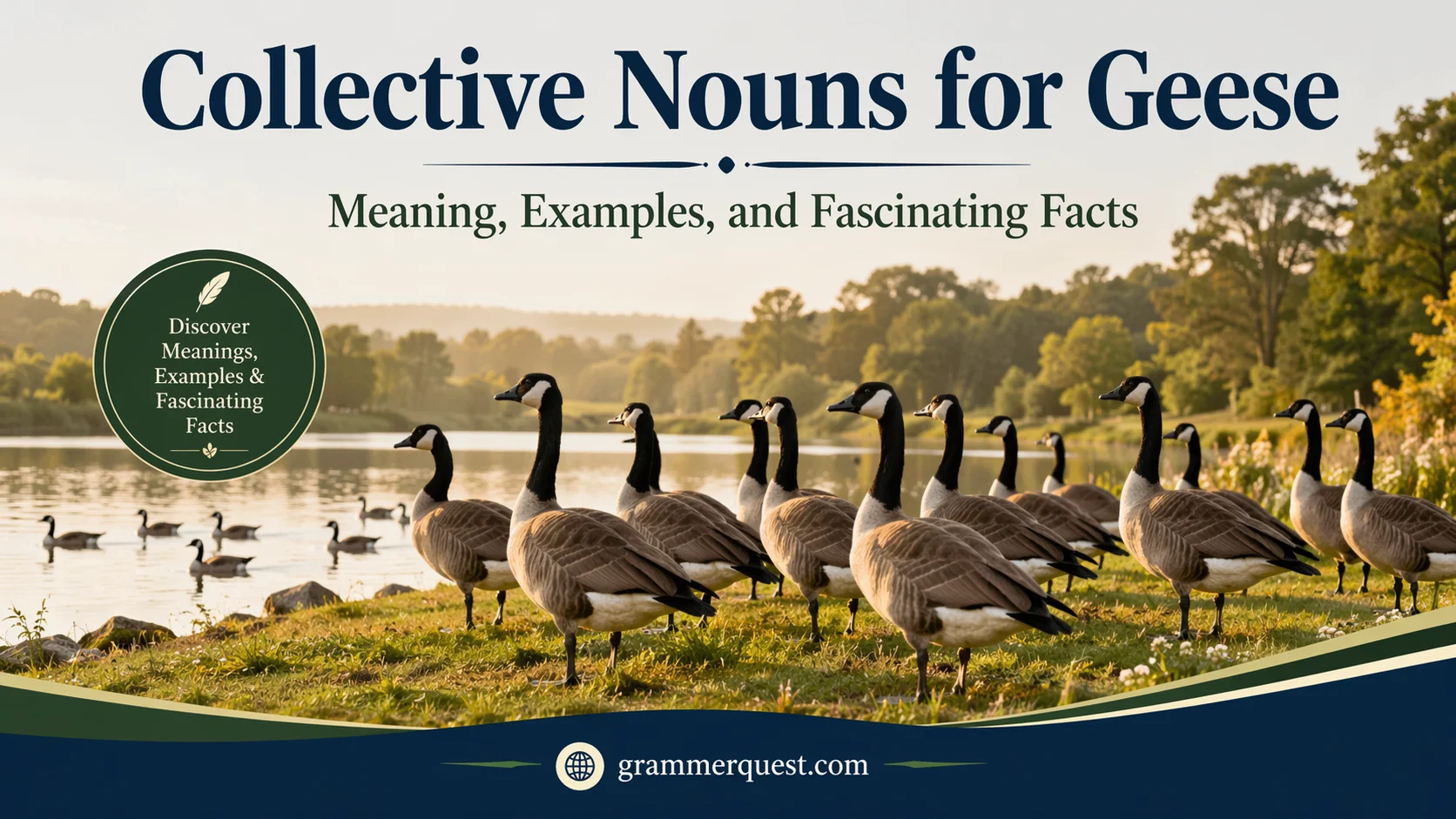
Collective Nouns for Geese: Meaning, Examples, and Fascinating Facts explains how geese gather, why their group names matter, and how these birds sound natural in speech for many curious readers.
In daily use, a gaggle is the best-known name for a group of geese, while wedge and skein are also common. The word goose is the singular form, and geese is the plural. These waterfowl belong to the family Antidae and the order Anseriformes, which also includes ducks and swans. Learning these collective nouns helps readers understand meaning, synonyms, and real examples more easily in simple and friendly English today.
Geese are interesting birds because they appear in gardens, near bird feeders, and sometimes on TV, so people notice them in many places. In the animal kingdom, many animals have special group names, and this makes the study fun. A careful list can help anyone identify the right term quickly, especially when a collection of birds is moving together across the Earth with better understanding for readers and writers alike.
Common Collective Nouns for Geese
Below is a simple table to help you understand the most commonly used collective nouns for geese:
| Type | Example |
| Gaggle | A gaggle of geese on the pond |
| Flock | A flock of geese flying overhead |
| Skein | A skein of geese in the sky |
| Team | A team of geese in formation |
| Wedge | A wedge of geese migrating south |
A Gaggle of Geese
Examples:
- A gaggle of geese gathered near the lake.
- We saw a gaggle of geese walking across the road.
- The farmer chased a gaggle of geese away.
- A loud gaggle of geese filled the yard.
- Children laughed at the gaggle of geese.
- A gaggle of geese rested by the river.
- The gaggle of geese moved together slowly.
- A gaggle of geese blocked the pathway.
- Tourists watched a gaggle of geese nearby.
- A gaggle of geese made a lot of noise.
A Flock of Geese
Examples:
- A flock of geese flew across the sky.
- We admired a flock of geese at sunset.
- A flock of geese landed in the field.
- The flock of geese migrated south.
- A flock of geese rested on the lake.
- Farmers noticed a flock of geese passing by.
- A flock of geese created a beautiful pattern.
- The flock of geese moved in perfect harmony.
- A flock of geese disappeared into the clouds.
- We followed a flock of geese along the river.
A Skein of Geese
Examples:
- A skein of geese flew in a V-shape.
- We spotted a skein of geese high above.
- A skein of geese crossed the horizon.
- The skein of geese looked organized.
- A skein of geese signaled seasonal change.
- Birds formed a skein of geese in flight.
- A skein of geese moved gracefully.
- The skein of geese traveled long distances.
- A skein of geese vanished into the distance.
- We admired a skein of geese at dawn.
A Team or Wedge of Geese
Examples (Team):
- A team of geese flew together.
- The team of geese stayed aligned.
- A team of geese migrated far away.
- We saw a team of geese above us.
- The team of geese worked together.
- A team of geese changed direction quickly.
- The team of geese followed their leader.
- A team of geese crossed the mountains.
- The team of geese rested briefly.
- A team of geese continued their journey.
Read More: Collective Nouns for Spiders: Meaning, Usage, and Interesting Wildlife Facts
Interesting Facts About Geese
Geese are fascinating birds with unique traits that make them stand out in the animal kingdom.
Longevity
Geese can live for a surprisingly long time. In the wild, many species live up to 10–20 years, while domesticated geese can live even longer with proper care.
Unique Physiological Features
Geese have strong wings and are capable of flying long distances during migration. Their V-shaped flying pattern helps reduce wind resistance and conserve energy. They also have excellent navigation skills, often returning to the same locations each year.
Dietary Habits
Geese are mostly herbivores. They feed on grass, grains, seeds, and aquatic plants. Occasionally, they may eat small insects, but plant-based food makes up the majority of their diet.
FAQs:
1. What are Collective Nouns for Geese?
They are special names used for groups of geese, such as gaggle, wedge, and skein.
2. What is the most common collective noun for geese?
The most common one is gaggle.
3. What does “wedge” mean for geese?
It describes geese flying in a V-shaped formation.
4. What is a skein of geese?
A skein refers to geese flying in a long, loose formation.
5. What is the singular form of geese?
The singular form is goose.
6. What family do geese belong to?
Geese belong to the family Antidae.
7. Which order do geese belong to?
They belong to the order Anseriformes.
8. Are ducks and swans related to geese?
Yes, ducks and swans are part of the same order as geese.
9. Why do animals have collective nouns?
They help identify and describe groups of animals clearly.
10. Where can we see geese in real life?
Geese can be seen in gardens, near water, and sometimes on TV.
Conclusion:
Collective nouns for geese make it easier to understand how these birds move and live in groups. Words like gaggle, wedge, and skein give simple but powerful ways to describe their behavior. Learning these terms also helps us connect language with nature, making the study of geese more interesting and enjoyable in everyday life.

Emma Brooke is a passionate language enthusiast and the voice behind GrammarQuest.com. With a sharp eye for detail and a love for clear communication, she simplifies complex grammar rules into easy, practical lessons. Her goal is to help you write with confidence, clarity, and style—whether you’re a student, professional, or everyday writer.