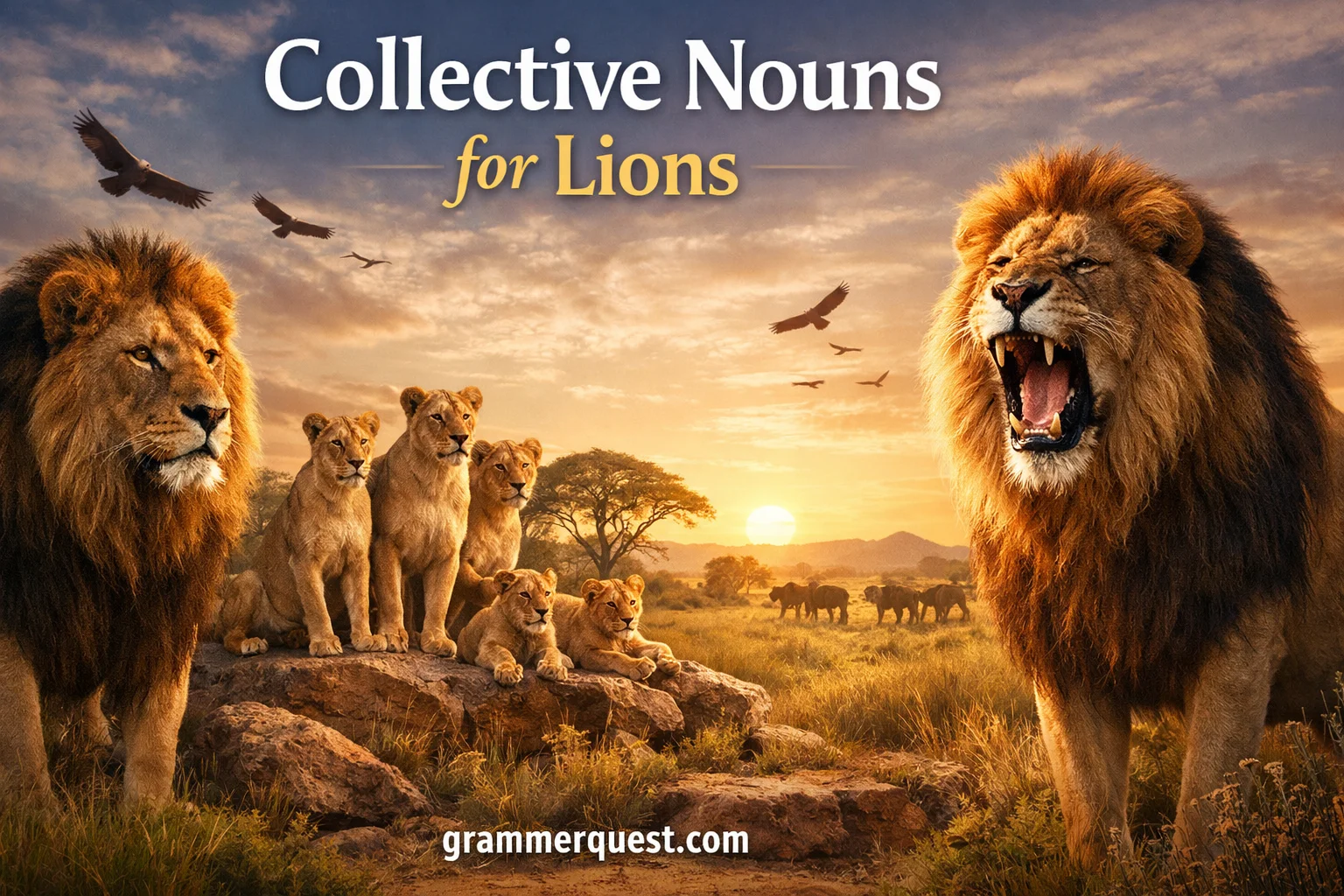
Collective Nouns for Lions help learn collective nouns to describe a group of animals, people, and things clearly in English with simple examples and better understand.
When you discover different kinds of words, you begin to understand how they describe a group in real life. In this article, I share simple examples that help learners, especially those receiving comprehensive training in English. The best way to come across such topics is by covering wild life during speaking and writing activities, where teachers often improve students’ skills, especially their vocabulary and usage.
These topics are frequently related to names and types of animals, and they include many relevant words that give useful information about their place and lifestyle, which are extremely abundant in nature. One term commonly used for lions is pride. Interestingly, this word carries a different meaning depending on the context. As an abstract noun, it refers to a sense of satisfaction or accomplishment; however, it also represents a group of lions, which are social creatures that usually stay in families, and hence the term fits perfectly.
Collective Nouns for Lions
| Type of Collective Noun | Simple Example Sentence |
| Pride | A pride of lions is resting under the tree. |
| Coalition | A coalition of lions defended their territory. |
| Troop | A troop of lions moved across the savannah. |
| Group | A group of lions was seen near the river. |
| Sawt (Archaic) | A sawt of lions once described roaming hunters. |
Pride of Lions
What is a Pride?
A pride is the most common and widely accepted collective noun for lions. It refers to a family group consisting of related females, their cubs, and a few dominant males.
Example Sentences
- A pride of lions was resting in the shade of an acacia tree.
- The pride moved together across the open grassland.
- We spotted a pride of lions near the waterhole.
- A pride of lions is very protective of its cubs.
- The pride hunted a large buffalo last night.
- A pride of lions greeted the returning male lion.
- The pride stayed close during the heavy rain.
- Tourists watched a pride of lions from a safe distance.
- A pride of lions marked its territory with strong roars.
- The pride shared their fresh kill among the members.
Coalition of Lions
What is a Coalition?
A coalition refers mainly to a group of male lions that join forces to protect territory and increase hunting success.
Example Sentences
- A coalition of lions patrolled the borders of their territory.
- The coalition worked together to challenge rival males.
- We saw a coalition of lions resting after a long hunt.
- A strong coalition of lions can dominate a large area.
- The coalition chased away intruders quickly.
- A coalition of lions was seen near the rocky hills.
- Young males often form a coalition for survival.
- The coalition roared loudly to warn competitors.
- A coalition of lions successfully took over a pride.
- The coalition shared food after a successful hunt.
Troop of Lions
What is a Troop?
Although less common, a troop can be used to describe a moving or traveling group of lions, emphasizing coordinated movement.
Example Sentences
- A troop of lions crossed the dusty plain at sunrise.
- The troop moved silently through the tall grass.
- We observed a troop of lions heading toward the river.
- A troop of lions is rarely seen in daylight travel.
- The troop hunted together with great coordination.
- A troop of lions startled a herd of zebras.
- The troop rested under the shade of baobab trees.
- A troop of lions followed the scent of prey.
- The troop traveled long distances in search of food.
- A troop of lions created a powerful presence in the wild.
Group of Lions
What is a Group?
A group is a general collective noun used when no specific term is applied, often in casual or descriptive writing.
Example Sentences
- A group of lions was seen near the forest edge.
- The group of lions relaxed after a successful hunt.
- We watched a group of lions playing with cubs.
- A group of lions gathered around a water source.
- The group moved slowly through the savannah.
- A group of lions shared their meal peacefully.
- Tourists photographed a group of lions resting together.
- The group of lions protected their young cubs.
- A group of lions waited patiently for prey.
- The group stayed close during the storm.
Sawt of Lions (Archaic Term)
What is Sawt?
The term sawt (also spelled sault) is an old or rare collective noun sometimes used in historical or poetic English to describe lions.
Example Sentences
- A sawt of lions was described in ancient tales.
- The sawt of lions roamed the wild desert lands.
- Legends spoke of a sawt of lions guarding kingdoms.
- A sawt of lions symbolized power and courage.
- The sawt of lions was feared by travelers.
- Ancient writers mentioned a sawt of lions hunting together.
- A sawt of lions appeared in old folklore stories.
- The sawt of lions moved like shadows in the night.
- A sawt of lions protected their territory fiercely.
- Poets often described a sawt of lions as majestic.
Read More: Collective Nouns for Coyotes
Interesting Facts About Lions
Lions are not only fascinating linguistically but also biologically remarkable creatures.
- Longevity: In the wild, lions typically live 10–14 years, while in captivity they can live up to 20 years due to medical care and a controlled environment.
- Physiological Features: Lions are the only big cats that show clear sexual dimorphism—males have manes, which help protect their necks during fights and attract mates. Their powerful muscles and strong jaws make them elite hunters.
- Dietary Habits: Lions are carnivores and mainly hunt large herbivores such as zebras, wildebeests, and buffalo. They rely on teamwork and strategic hunting rather than speed alone.
FAQs:
1. What are collective nouns for lions?
Collective nouns are words that describe a group of animals like lions. The most common term is pride.
2. Why is a group of lions called a pride?
The word pride represents lions’ social nature and how they stay in families.
3. Can “pride” have another meaning?
Yes, as an abstract noun, it refers to a sense of satisfaction or accomplishment.
4. How many lions can be in a pride?
A group can range from a few lions, like two, to many, even up to forty.
5. Why are collective nouns important in English?
They help learn vocabulary and improve speaking and writing skills.
6. Where are collective nouns mostly used?
They are frequently used in topics related to animals, people, and things.
7. How can students learn collective nouns easily?
Through examples, activities, and comprehensive training in English.
8. Do teachers use these topics in class?
Yes, teachers often use them to improve students’ understanding.
9. Are there many collective nouns for animals?
Yes, they are extremely abundant and vary by types of animals.
10. What makes lions unique in this topic?
Their lifestyle and social behavior make the term pride very fitting.
Conclusion:
In simple terms, Collective Nouns for Lions help learners understand how a single word can describe a group. The term pride not only names lions together but also shows their social and family-based lifestyle, making it meaningful and easy to remember.

Emma Brooke is a passionate language enthusiast and the voice behind GrammarQuest.com. With a sharp eye for detail and a love for clear communication, she simplifies complex grammar rules into easy, practical lessons. Her goal is to help you write with confidence, clarity, and style—whether you’re a student, professional, or everyday writer.