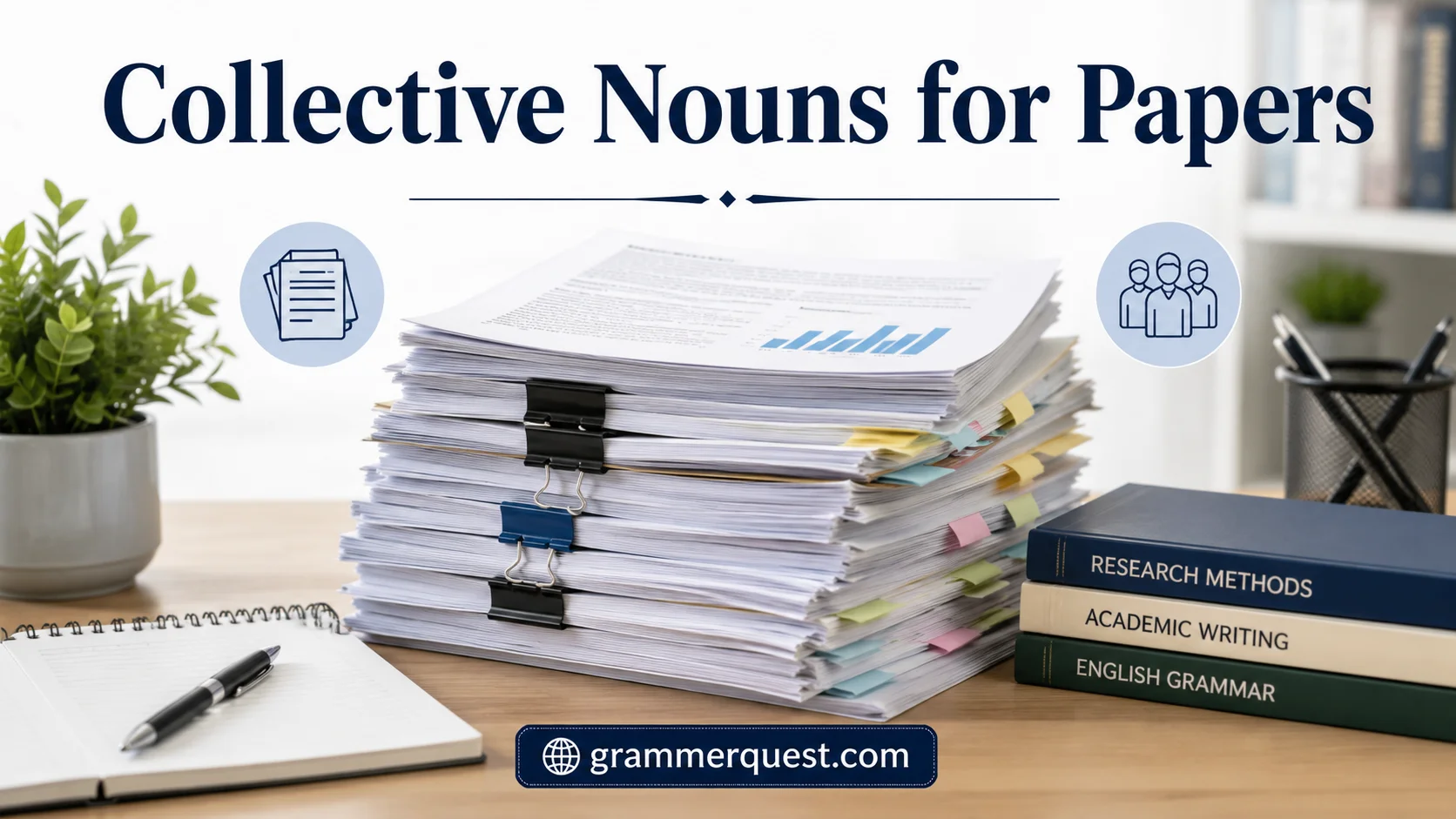
Collective Nouns for Papers are important grammar expressions used to describe a group of newspapers as a single unit in English language. These terms help learners improve clarity, fluency, and natural communication in both writing and speaking. By using correct collective nouns, students can understand how language organizes objects in meaningful groups. This concept also strengthens grammar accuracy and builds confidence in everyday English usage, especially when discussing newspapers in academic or practical contexts for better understanding and communication skills skills
Collective nouns are an important part of English grammar that describe groups of people, animals, and objects as one unit. Many learners find it confusing because a collective noun may be singular or plural depending on context. Understanding this rule improves writing, speaking fluency and helps make English more natural and accurate. Regular practice builds confidence in daily communication and helps students use correct verb agreement in real life situations for better grammar mastery and improved English skills overall today
Collective Nouns for Papers
The table below highlights some commonly used collective nouns for papers.
| Collective Noun | Simple Example |
| Stack of Papers | A stack of papers sat on the desk. |
| Bundle of Papers | He carried a bundle of papers. |
| Pile of Papers | There was a pile of papers on the floor. |
| Packet of Papers | She handed over a packet of papers. |
| Sheaf of Papers | The clerk organized a sheaf of papers. |
Stack of Papers
A stack of papers refers to papers arranged neatly one on top of another.
Examples of Stack of Papers
- A stack of papers was placed on the teacher’s desk.
- The secretary sorted a stack of papers quickly.
- I found a stack of papers beside the printer.
- The lawyer reviewed a stack of papers.
- A stack of papers covered the table.
- He carried a stack of papers into the office.
- The student dropped a stack of papers accidentally.
- A stack of papers waited to be filed.
- The manager signed a stack of papers.
- She organized a stack of papers by date.
Bundle of Papers
A bundle of papers refers to papers tied or gathered together.
Examples of Bundle of Papers
- He delivered a bundle of papers to the archive.
- A bundle of papers lay on the shelf.
- The clerk tied a bundle of papers with string.
- She carried a bundle of papers home.
- The bundle of papers contained old records.
- We found a bundle of papers in the cabinet.
- A bundle of papers fell from the box.
- The accountant sorted a bundle of papers.
- The reporter carried a bundle of papers.
- A bundle of papers was stored safely.
Pile of Papers
A pile of papers refers to papers gathered together in a heap.
Examples of Pile of Papers
- A pile of papers sat in the corner.
- The desk was covered with a pile of papers.
- She organized the pile of papers.
- A pile of papers blocked the keyboard.
- The editor reviewed a pile of papers.
- We moved the pile of papers carefully.
- A pile of papers needed filing.
- The wind scattered a pile of papers.
- He placed another document on the pile of papers.
- The pile of papers grew larger each day.
Packet of Papers
A packet of papers refers to a small grouped collection of documents.
Examples of Packet of Papers
- The teacher distributed a packet of papers.
- I received a packet of papers at the meeting.
- The packet of papers contained instructions.
- She prepared a packet of papers for the conference.
- A packet of papers was mailed yesterday.
- The lawyer submitted a packet of papers.
- Students carried a packet of papers to class.
- The clerk checked the packet of papers.
- We reviewed a packet of papers together.
- A packet of papers was placed on every desk.
Sheaf of Papers
A sheaf of papers refers to a collection of papers fastened or held together.
Examples of Sheaf of Papers
- The writer carried a sheaf of papers.
- A sheaf of papers rested on the table.
- The assistant filed a sheaf of papers.
- He handed me a sheaf of papers.
- The sheaf of papers contained research notes.
- She organized the sheaf of papers neatly.
- A sheaf of papers was clipped together.
- The editor examined a sheaf of papers.
- We found a sheaf of papers in the drawer.
- The secretary delivered a sheaf of papers.
Read More: Collective Nouns for Corn
Interesting Facts About Papers
The Long History of Paper
Paper has been an essential part of human civilization for nearly two thousand years. It was first developed in ancient China and later spread throughout the world. Today, paper remains one of the most widely used materials for education, communication, and record-keeping. Historical documents preserved on paper have helped future generations learn about past civilizations, cultures, and events.
Unique Features of Paper
Paper is a remarkably versatile material. It can be folded, cut, printed on, recycled, and transformed into countless products. Different types of paper are designed for specific purposes, including newspapers, books, notebooks, packaging materials, and official documents. Its lightweight nature makes it easy to transport and store.
Paper and Sustainability
Modern paper production often involves recycling programs that help reduce waste and conserve resources. Recycled paper can be reused multiple times, making it an environmentally friendly material when managed responsibly. Many organizations encourage the use of recycled paper to support sustainable practices.
Paper in Daily Life
People interact with paper every day, whether reading books, writing notes, receiving receipts, or handling official documents. Despite the rise of digital technology, paper continues to play an important role in schools, offices, businesses, and homes around the world.
Paper Collections Have Special Names
The English language offers several collective nouns for groups of papers, including stack, bundle, pile, packet, and sheaf. Each term conveys a slightly different arrangement or purpose, enriching communication and helping speakers describe groups of papers more accurately.
FAQs :
1. What are collective nouns for papers?
They are special grammar words used to describe a group of newspapers as one single unit.
2. Why do we use collective nouns for papers?
They help make sentences clearer and more natural when talking about groups of newspapers.
3. Is “bundle” a collective noun for papers?
Yes, “bundle” can be used when newspapers are tied or grouped together.
4. Can collective nouns be singular or plural?
Yes, they can be singular or plural depending on the sentence context.
5. What verb is used with collective nouns?
Singular or plural verbs are used based on whether the group acts as one unit or individuals.
6. Are collective nouns important in English grammar?
Yes, they improve fluency, accuracy, and natural sentence structure.
7. How do collective nouns help students?
They help students speak and write English more confidently and correctly.
8. Is “stack of papers” a collective noun?
Yes, “stack” is commonly used to describe grouped papers.
9. Do native speakers use collective nouns daily?
Yes, they are commonly used in everyday English communication.
10. Can learning collective nouns improve writing skills?
Yes, it helps improve clarity, grammar, and overall writing quality.
Conclusion :
Collective nouns for papers are useful grammar tools that make English more structured and meaningful. By learning and practicing them, students can improve fluency, understand grammar rules, and communicate more naturally in both speaking and writing.

George Whitaker is the voice behind GrammarQuest, dedicated to making grammar simple, engaging, and easy to understand. He helps learners turn confusion into confidence with clear explanations and real-world examples.