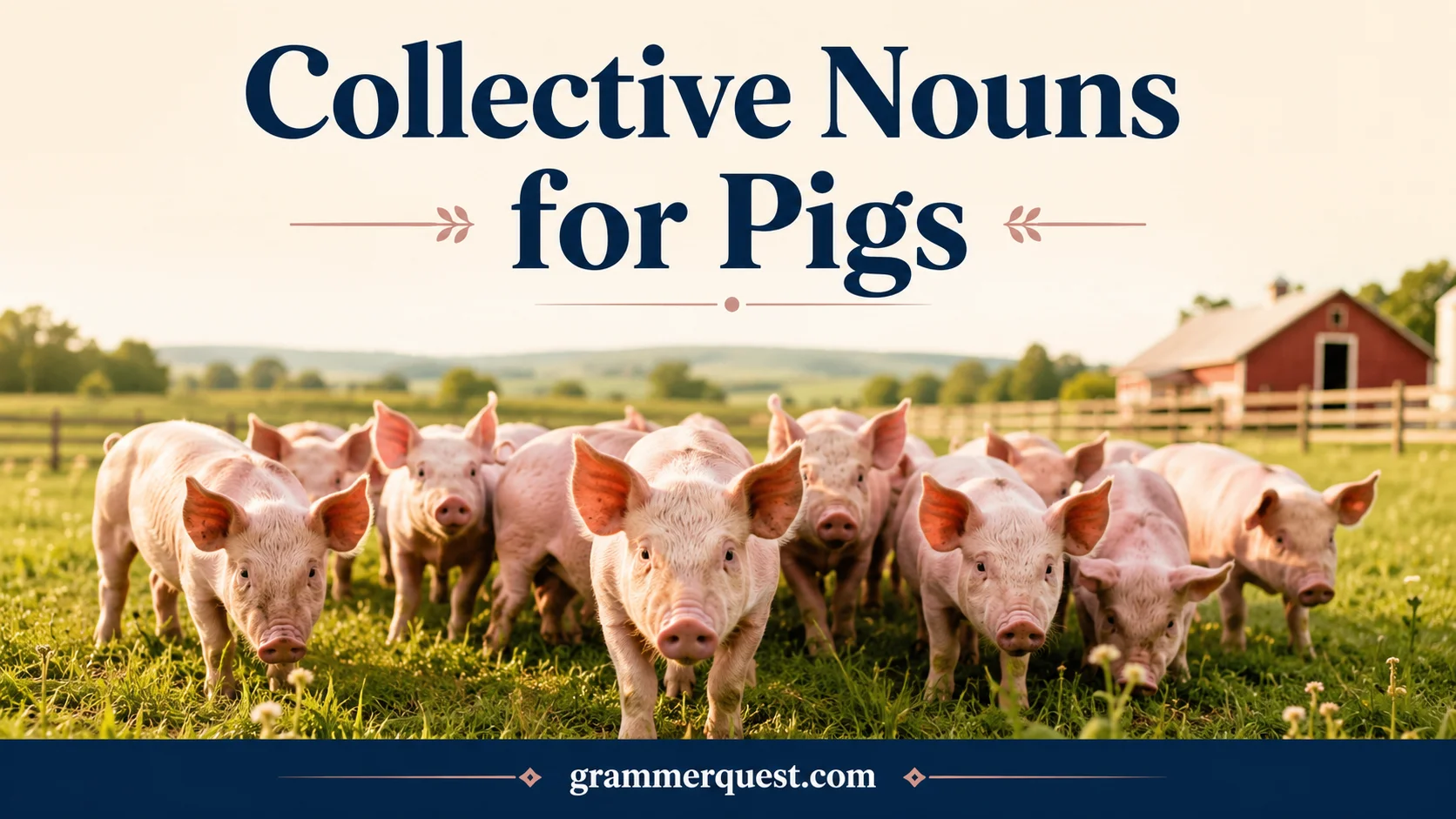
When studying Collective Nouns for Pigs, it is useful to understand how collective nouns, collective terms, and terms of venery are used in the animal kingdom. In Animalia, animals are grouped through animal classification, taxonomy, and nomenclature. Each group receives a specific name, helping people identify animals more easily. Common examples include a flock of sheep, a herd of cows, and groups of pigs. These animal collective names are an important part of collective terminology and help make learning about animals more interesting and organized.
A document or listing of collective nouns for animals usually includes animal groups from mammals, reptiles, fish, amphibians, birds, and insects. It also provides collective noun terms, collective expressions, and grouping terms for many species. The world’s fauna and wildlife show remarkable species diversity, with bats, whales, dolphins, and porpoises among well-known examples. Learning venery terms and other naming systems helps readers better understand the richness and diversity of life found worldwide.
Collective Nouns Used for Pigs
| Collective Noun | Simple Example |
| Drift | A drift of pigs moved across the farm. |
| Sounder | A sounder of pigs searched for food. |
| Team | A team of pigs rested in the mud. |
| Litter | A litter of piglets followed their mother. |
| Passel | A passel of pigs gathered near the barn. |
Drift of Pigs
What Does “Drift of Pigs” Mean?
The word “drift” is commonly used for a moving group of pigs, especially when they wander together across fields or farms.
Examples
- A drift of pigs crossed the muddy path.
- A drift of pigs rested under the tree.
- The farmer watched a drift of pigs near the fence.
- A drift of pigs wandered around the field.
- Children laughed at a drift of pigs playing in the mud.
- A drift of pigs moved slowly toward the barn.
- We saw a drift of pigs beside the river.
- A drift of pigs searched for food together.
- The loud sounds came from a drift of pigs nearby.
- A drift of pigs enjoyed the cool weather.
Sounder of Pigs
What Does “Sounder of Pigs” Mean?
“Sounder” is one of the most widely recognized collective nouns for pigs. It is often used for wild pigs or hogs living together in groups.
Examples
- A sounder of pigs ran through the forest.
- Hunters spotted a sounder of pigs near the lake.
- A sounder of pigs gathered around the waterhole.
- We heard noises from a sounder of pigs at night.
- A sounder of pigs explored the farmland.
- Farmers protected their crops from a sounder of pigs.
- A sounder of pigs rested in the shade.
- The guide pointed toward a sounder of pigs in the distance.
- A sounder of pigs moved together carefully.
- Tourists photographed a sounder of pigs in the wild.
Team of Pigs
What Does “Team of Pigs” Mean?
The term “team” is sometimes used when pigs work or move together in an organized way.
Examples
- A team of pigs walked beside the farmer.
- We saw a team of pigs near the wooden gate.
- A team of pigs played in the muddy water.
- The children fed a team of pigs at the farm.
- A team of pigs rested after eating.
- A team of pigs followed each other closely.
- The loud grunts came from a team of pigs.
- A team of pigs crowded around the feeding area.
- Farmers cared for a team of pigs every morning.
- A team of pigs stayed together during the rain.
Litter of Piglets
What Does “Litter of Piglets” Mean?
A “litter” refers to baby pigs born to the same mother at one time. This is one of the most common animal collective nouns.
Examples
- A litter of piglets slept beside their mother.
- The farmer showed us a litter of piglets.
- A litter of piglets played happily in the straw.
- We watched a litter of piglets running around.
- A litter of piglets followed the sow closely.
- The barn was full of sounds from a litter of piglets.
- A litter of piglets explored the farmyard.
- Children loved feeding a litter of piglets.
- A litter of piglets rested together after eating.
- The mother protected a litter of piglets carefully.
Passel of Pigs
What Does “Passel of Pigs” Mean?
“Passel” is an informal and fun term used for a group of pigs gathered together.
Examples
- A passel of pigs rolled in the mud.
- We noticed a passel of pigs beside the fence.
- A passel of pigs gathered near the feeding trough.
- The farmer counted a passel of pigs in the pen.
- A passel of pigs made loud noises all morning.
- Visitors laughed at a passel of pigs chasing each other.
- A passel of pigs rested near the barn.
- The muddy field was filled with a passel of pigs.
- A passel of pigs searched for food together.
- We photographed a passel of pigs during our farm visit.
Also Read This: Collective Nouns for Rhinoceri
Interesting Facts About Pigs
Pigs Are Surprisingly Intelligent
Pigs are considered among the smartest animals in the world. They can solve simple problems, recognize their names, and even learn tricks faster than some dogs. Their intelligence allows them to communicate with one another using different sounds and body movements. Because pigs are highly social animals, they enjoy living in groups and often form close bonds with other pigs.
Pigs Have Unique Physical Features
One fascinating feature of pigs is their powerful snout. They use it to dig into soil while searching for roots, insects, and food. Pigs also have an excellent sense of smell, which is why some are trained to locate rare truffles underground. Although many people think pigs are dirty animals, they actually roll in mud to cool their bodies because they cannot sweat effectively.
Pigs Have Varied Diets
Pigs are omnivores, meaning they eat both plants and animals. Their diet can include fruits, vegetables, grains, roots, and small insects. On farms, pigs are usually fed specially prepared food to keep them healthy and strong. Wild pigs often spend many hours searching for food in forests and grasslands.
Pigs Can Live for Many Years
Domestic pigs usually live between 12 and 20 years when properly cared for. Their lifespan depends on breed, environment, and nutrition. Some smaller pig breeds kept as pets may live even longer with excellent care and healthy diets.
Pigs Are Social Animals
Pigs naturally prefer living in groups because it provides protection and companionship. Young piglets stay close to their mothers, while adult pigs often communicate through grunts and squeals. Their social behavior is one reason why collective nouns for pigs are so meaningful and interesting in the English language.
FAQs :
1. What are Collective Nouns for Pigs?
Collective nouns for pigs are special terms used to describe a group of pigs together.
2. Why do pigs have collective nouns?
Like many animals, pigs have collective nouns to make communication more accurate and descriptive.
3. Are collective nouns for pigs commonly used?
Some are commonly used in farming and writing, while others appear mainly in educational or historical contexts.
4. What is a collective noun?
A collective noun is a word that refers to a group of people, animals, or things as a single unit.
5. Do all animals have collective nouns?
Most animals have at least one recognized collective noun, though some are more popular than others.
6. What are terms of venery?
Terms of venery are traditional names used for groups of animals, often originating from medieval hunting language.
7. Why should students learn collective nouns?
Learning collective nouns improves vocabulary, grammar skills, and understanding of descriptive language.
8. Are collective nouns the same worldwide?
Many collective nouns are widely accepted in English, but usage can vary by region and source.
9. Where are collective nouns usually found?
They can be found in grammar books, dictionaries, wildlife references, and educational websites.
10. How do collective nouns help in writing?
They make sentences more precise, engaging, and informative by clearly describing groups.
Conclusion :
Collective Nouns for Pigs add variety and richness to the English language. They help describe groups of pigs in a clear and memorable way while connecting learners to broader concepts such as collective nouns, animal classification, and terms of venery. Understanding these expressions not only strengthens vocabulary but also provides insight into the fascinating relationship between language and the animal kingdom.

Henry Collins is a passionate grammar expert and the voice behind GrammerQuest.com. With a sharp eye for language and a love for clear communication, he simplifies complex grammar rules into easy, practical lessons.