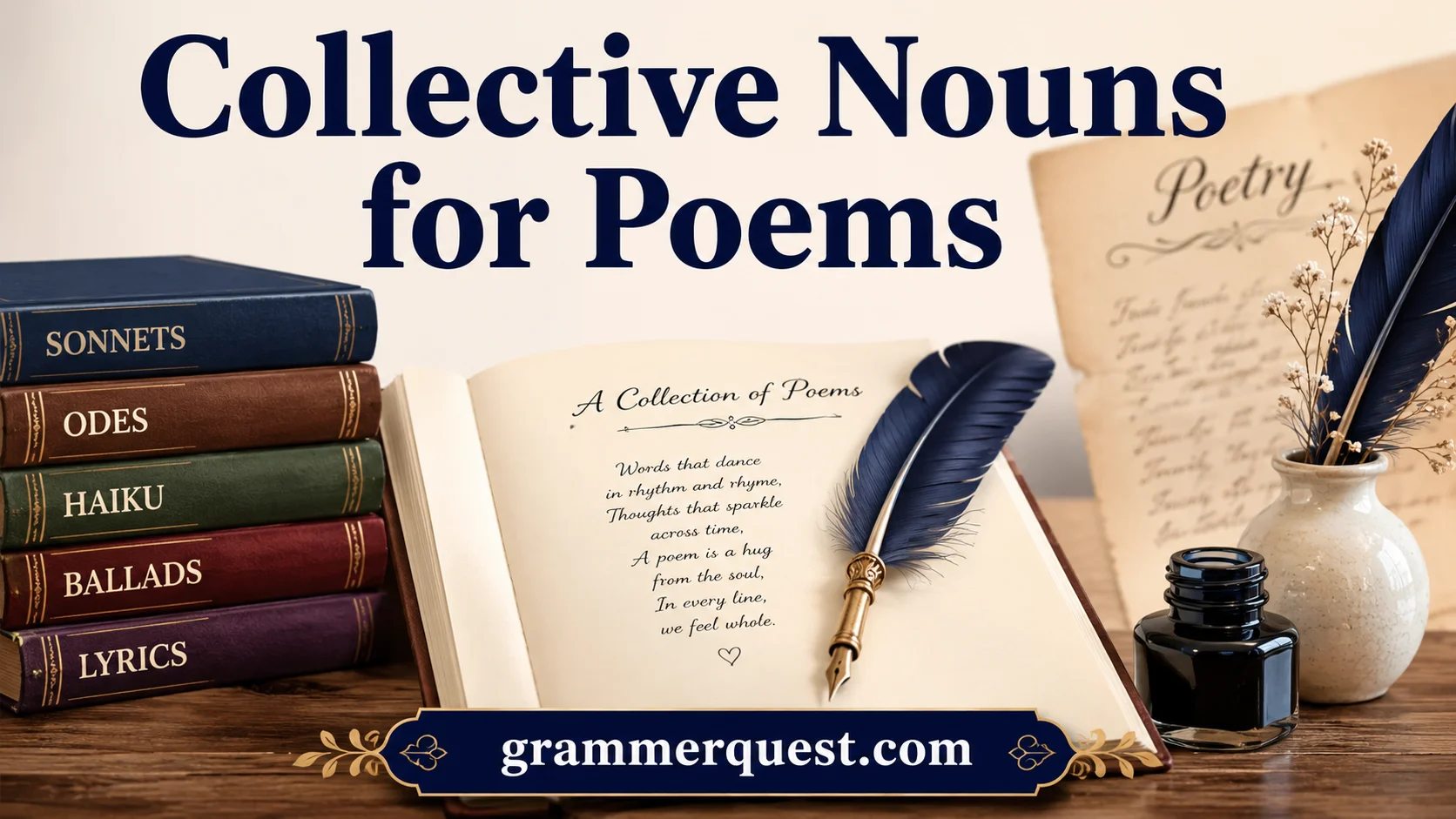
Collective Nouns for Poems make writing more creative by giving a single name to a group of related things or ideas. These special collective nouns help writers add beauty, rhythm, and meaning to their work. Whether you are learning English grammar or improving your poetry skills, understanding these expressions can make your writing clearer and more engaging. They also encourage imagination by showing how language can describe groups in unique and memorable ways with style.
Poetry becomes more expressive when writers use collective nouns with creativity and purpose. Traditional examples, such as a flock of birds or a school of fish, show how these terms have enriched language for centuries. Poets can also invent original group names to create fresh imagery and stronger emotions. Learning these grammar rules improves vocabulary, inspires better writing, and helps readers enjoy poems with greater understanding and appreciation every time they read them.
Collective Nouns for Poems Table
| Type | Simple Example |
| Collection of Poems | A collection of poems was published. |
| Anthology of Poems | She bought an anthology of poems. |
| Volume of Poems | The volume of poems became popular. |
| Book of Poems | The book of poems sat on the shelf. |
| Compilation of Poems | The compilation of poems featured many authors. |
Collection of Poems
A collection is one of the most common collective nouns used for poems. It refers to a group of poems gathered together by one or more poets.
Examples of Collection of Poems
- A collection of poems was displayed in the library.
- The teacher shared a collection of poems with the class.
- Her collection of poems won an award.
- We enjoyed reading a collection of poems about nature.
- The collection of poems contained fifty pieces.
- He published a collection of poems last year.
- The collection of poems inspired many readers.
- A collection of poems lay on the desk.
- The collection of poems featured different themes.
- Students analyzed a collection of poems during the lesson.
Anthology of Poems
An anthology is a carefully selected group of poems, often written by different poets and compiled into one book.
Examples of Anthology of Poems
- The anthology of poems included famous writers.
- She borrowed an anthology of poems from the library.
- Our class studied an anthology of poems.
- The anthology of poems covered many eras.
- He edited an anthology of poems for students.
- The anthology of poems became a bestseller.
- We found several classic works in the anthology of poems.
- The anthology of poems celebrated cultural diversity.
- The publisher released a new anthology of poems.
- Readers appreciated the anthology of poems greatly.
Volume of Poems
A volume refers to a book containing a set or collection of poems, usually by a single author.
Examples of Volume of Poems
- The poet released a volume of poems this year.
- A volume of poems rested on the shelf.
- The volume of poems explored human emotions.
- Students discussed the volume of poems in class.
- Her volume of poems gained critical praise.
- The volume of poems featured beautiful imagery.
- We purchased a volume of poems at the bookstore.
- The volume of poems was translated into several languages.
- A volume of poems can make a wonderful gift.
- The volume of poems attracted many readers.
Book of Poems
A book of poems is a simple and widely understood term for a group of poems published together.
Examples of Book of Poems
- I received a book of poems as a gift.
- The book of poems contained inspiring verses.
- She read a book of poems every evening.
- The book of poems became very popular.
- A book of poems sat beside the lamp.
- The author signed his book of poems.
- Students enjoyed the book of poems.
- The book of poems explored friendship and love.
- We found a rare book of poems in the archive.
- The book of poems was beautifully illustrated.
Compilation of Poems
A compilation is a group of poems gathered from different sources into a single publication.
Examples of Compilation of Poems
- The compilation of poems featured modern writers.
- She created a compilation of poems for the event.
- The compilation of poems highlighted local talent.
- Readers enjoyed the compilation of poems.
- The compilation of poems covered many themes.
- We studied a compilation of poems in class.
- The compilation of poems included award-winning works.
- The editor prepared a compilation of poems for publication.
- A compilation of poems was released online.
- The compilation of poems attracted positive revi
Read More: Collective Nouns for Homework
Interesting Facts About Poems
Poems are among the oldest forms of human expression and have existed for thousands of years. Ancient civilizations used poetry to tell stories, preserve history, and share cultural values long before written prose became common. Unlike living creatures, poems do not possess physiological features or dietary habits. However, they have remarkable structural characteristics such as rhythm, rhyme, meter, and imagery that make them unique forms of literature. Poems can survive for centuries through oral traditions and written records, allowing future generations to experience the thoughts and emotions of past cultures. Today, poetry continues to evolve through books, digital media, spoken-word performances, and social platforms, demonstrating its enduring importance in human communication.
FAQs :
1. What are Collective Nouns for Poems?
Collective Nouns for Poems are creative or descriptive terms used to refer to a group of poems. While there is no single official collective noun, writers often use imaginative expressions based on the theme or style of the poems.
2. Is there an official collective noun for poems?
No, there is no universally accepted collective noun for poems. Common choices include collection, anthology, volume, or compilation, depending on the context.
3. Why are collective nouns important in poetry?
Collective nouns make writing more precise and expressive. They help describe groups of poems in a way that sounds natural and adds richness to the language.
4. Can poets create their own collective nouns?
Yes. Poets often invent unique collective nouns to match the mood, style, or message of their work, making their writing more creative and memorable.
5. What is the difference between a collection and an anthology?
A collection usually contains poems by one author, while an anthology includes poems written by multiple authors.
6. Are collective nouns used only in poetry?
No. Collective nouns are used in everyday English to describe groups of people, animals, objects, and ideas, not just poems.
7. What are some examples of collective nouns?
Common examples include a flock of birds, a school of fish, a pride of lions, a bouquet of flowers, and a team of players.
8. How do collective nouns improve writing?
They make sentences shorter, clearer, and more descriptive while helping readers visualize groups more effectively.
9. Can students use collective nouns in school assignments?
Yes. Using collective nouns correctly improves grammar, vocabulary, and the overall quality of essays, stories, and poems.
10. How can I learn more collective nouns?
You can improve by reading books, practicing grammar exercises, and exploring examples in poetry, literature, and everyday English.
Conclusion :
Collective Nouns for Poems bring creativity and clarity to writing by providing meaningful ways to describe groups of poems. Whether you use traditional terms like collection and anthology or create your own imaginative expressions, these nouns make language more engaging and memorable. Learning and using collective nouns correctly strengthens your grammar, expands your vocabulary, and helps you write poetry with greater confidence and originality.

Emma Brooke is a passionate language enthusiast and the voice behind GrammarQuest.com. With a sharp eye for detail and a love for clear communication, she simplifies complex grammar rules into easy, practical lessons. Her goal is to help you write with confidence, clarity, and style—whether you’re a student, professional, or everyday writer.