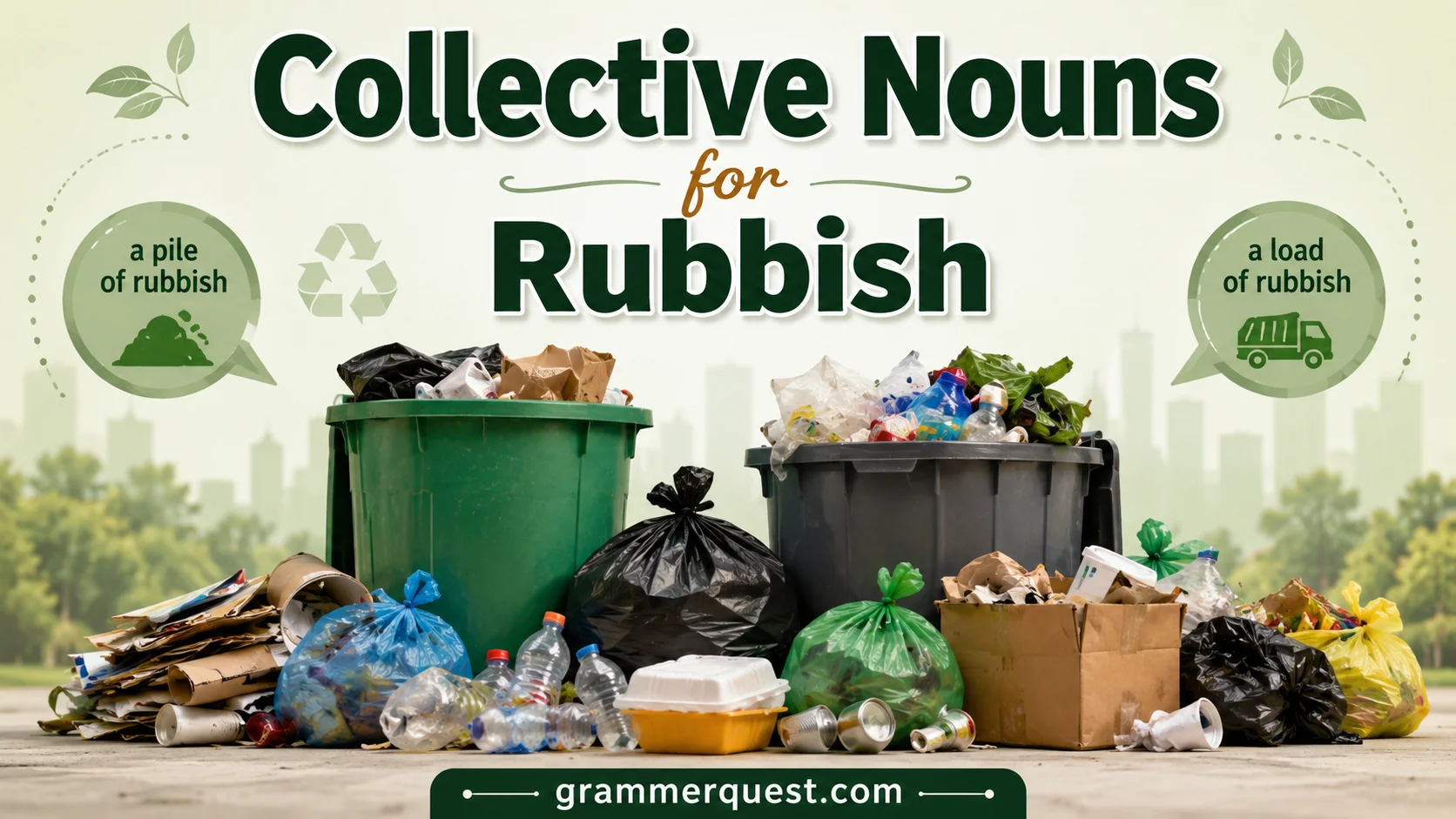
Collective Nouns for Rubbish are useful words that describe a group of rubbish, waste, garbage, trash, or litter in a clear and natural way. These terms make your English grammar stronger and help you write with greater accuracy. Whether you are a student, writer, or English learner, understanding these collective nouns makes it easier to describe everyday objects and use the correct words in different situations. Learning them also improves both speaking and writing skills with confidence.
Knowing collective nouns for rubbish helps you understand how groups of things are named in everyday English. Some terms are more common in American English (AmE), while others are preferred in British English (BrE), making it useful to learn both styles. With simple explanations and practical examples, you can avoid common mistakes, expand your vocabulary, and communicate more naturally in conversations, school assignments, and professional writing.
Collective Nouns for Rubbish
| Type | Simple Example |
| Pile of Rubbish | A pile of rubbish blocked the alley. |
| Heap of Rubbish | A heap of rubbish was waiting to be collected. |
| Stack of Rubbish | A stack of rubbish bags stood outside the shop. |
| Collection of Rubbish | The workers removed a collection of rubbish. |
| Load of Rubbish | The truck carried a load of rubbish. |
Pile of Rubbish
A pile is one of the most common ways to describe rubbish gathered together in one place.
Examples
- A pile of rubbish filled the corner of the yard.
- The workers removed the pile of rubbish quickly.
- We placed the rubbish into a neat pile.
- The wind scattered the pile of rubbish.
- A large pile of rubbish attracted birds.
- The children stayed away from the pile of rubbish.
- The city cleaned every pile of rubbish.
- A small pile of rubbish remained after the cleanup.
- The pile of rubbish smelled unpleasant.
- They covered the pile of rubbish before the rain.
Heap of Rubbish
A heap refers to a large, untidy amount of rubbish thrown together.
Examples
- A heap of rubbish stood behind the building.
- The truck collected the heap of rubbish.
- Birds searched through the heap of rubbish.
- The heap of rubbish grew every day.
- Workers cleared the heap of rubbish.
- The storm spread the heap of rubbish across the road.
- The heap of rubbish attracted insects.
- We avoided the heap of rubbish.
- The council removed the heap of rubbish.
- The old heap of rubbish disappeared after cleaning.
Stack of Rubbish
A stack is used when rubbish, especially bags or boxes, is arranged neatly.
Examples
- A stack of rubbish bags waited outside.
- The cleaner organized the stack of rubbish.
- The stack of rubbish reached the fence.
- They loaded the stack of rubbish into the truck.
- A stack of rubbish stood near the gate.
- We counted the stack of rubbish bags.
- The stack of rubbish was ready for collection.
- The workers moved the stack of rubbish carefully.
- Rain soaked the stack of rubbish bags.
- The stack of rubbish was removed before morning.
Collection of Rubbish
A collection refers to rubbish gathered from different places.
Examples
- The collection of rubbish filled the container.
- Workers sorted the collection of rubbish.
- The collection of rubbish included plastic bottles.
- The city arranged a collection of rubbish every week.
- A collection of rubbish was ready for recycling.
- They inspected the collection of rubbish.
- The collection of rubbish was separated by type.
- Everyone helped with the collection of rubbish.
- The collection of rubbish reduced pollution.
- The truck carried the collection of rubbish away.
Load of Rubbish
A load describes the amount of rubbish carried by a vehicle or container.
Examples
- The truck transported a load of rubbish.
- They unloaded the load of rubbish carefully.
- A heavy load of rubbish filled the trailer.
- The workers collected another load of rubbish.
- The load of rubbish went to the recycling center.
- One load of rubbish was not enough to clear the area.
- The driver secured the load of rubbish.
- They removed a full load of rubbish from the park.
- The landfill received the load of rubbish.
- Every load of rubbish was checked before disposal.
Read More: Collective Nouns for Prose
Interesting Facts About Rubbish
Although rubbish is not a living thing, it has a significant impact on the environment. Some types of rubbish remain in nature for hundreds of years before breaking down. Plastic bottles can take around 450 years to decompose, while glass may last for thousands of years. Proper waste management and recycling help reduce pollution and protect wildlife. Organic rubbish can naturally decompose and become compost, enriching the soil. Sorting rubbish into recyclable and non-recyclable materials is one of the easiest ways to reduce environmental damage and conserve natural resources.
FAQs :
1. What are collective nouns for rubbish?
Collective nouns for rubbish are words used to describe a group or collection of waste, garbage, trash, or litter, such as a pile, heap, or collection.
2. What is the most common collective noun for rubbish?
The most common collective noun for rubbish is pile, as it naturally describes rubbish gathered in one place.
3. Is “heap of rubbish” grammatically correct?
Yes, heap of rubbish is a correct and widely used expression in everyday English.
4. Are rubbish and garbage the same?
They have the same meaning, but rubbish is more common in British English (BrE), while garbage is mainly used in American English (AmE).
5. Can I say “collection of rubbish”?
Yes. Collection of rubbish is a correct phrase, especially when referring to rubbish gathered for cleaning or disposal.
6. Why are collective nouns important?
Collective nouns make your writing clearer, improve your grammar, and help describe groups of people, animals, or things more accurately.
7. Are collective nouns for rubbish used in formal writing?
Yes. Words like collection, pile, and heap can be used in both formal and informal writing, depending on the context.
8. Is there one official collective noun for rubbish?
No. There is no single official collective noun. Different words, such as pile, heap, collection, or mass, are used depending on the situation.
9. Can students use these collective nouns in school assignments?
Yes. Learning collective nouns for rubbish helps students improve their vocabulary, grammar, and writing skills.
10. How can I learn collective nouns more easily?
The best way is to read examples, practice writing sentences, and use collective nouns regularly in everyday English.
Conclusion :
Learning Collective Nouns for Rubbish helps you describe groups of waste, garbage, trash, and litter more clearly and naturally. Words like pile, heap, and collection improve both spoken and written English while strengthening your grammar and vocabulary. By practicing these terms with simple examples, you can communicate more confidently and choose the right expression for different situations in both American English (AmE) and British English (BrE).

Henry Collins is a passionate grammar expert and the voice behind GrammerQuest.com. With a sharp eye for language and a love for clear communication, he simplifies complex grammar rules into easy, practical lessons.