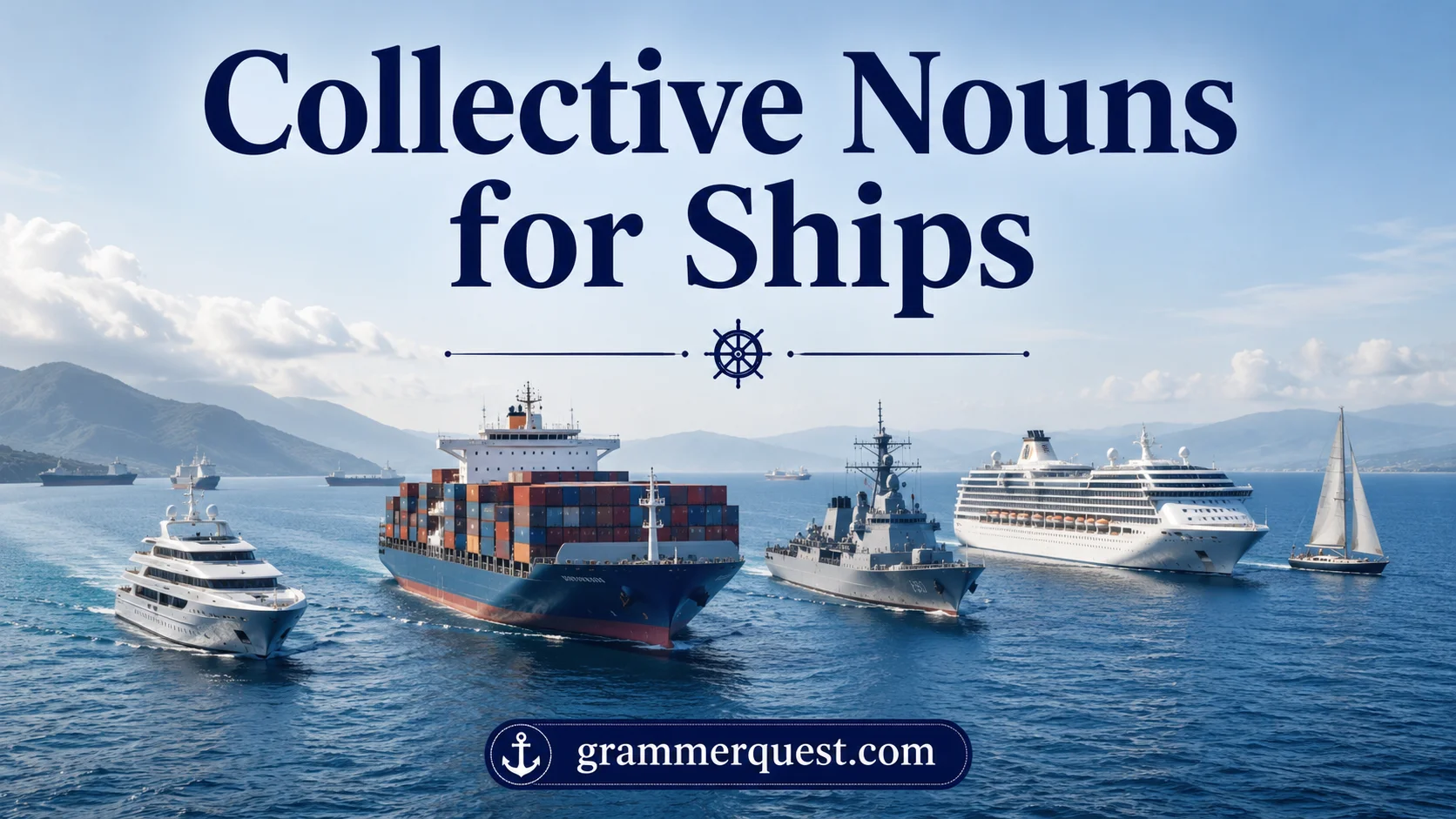
Collective Nouns for Ships are important grammar terms used to describe a group of ships as a single unit. The most common collective nouns are fleet and armada, both of which refer to multiple ships traveling or operating together. Learning these terms helps improve vocabulary, writing skills, and understanding of English grammar. Whether used in maritime discussions, history, or everyday language, collective nouns for ships make communication more precise and effective.
A fleet usually refers to a group of ships working under one command, while an armada often describes a large and powerful collection of vessels. Understanding these collective nouns can also help with subject-verb agreement, a common grammar challenge. By exploring examples and usage, learners can confidently use collective nouns, enhance sentence structure, and strengthen their overall command of the English language.
Table: Collective Nouns for Ships (Quick Overview)
| Type (Collective Noun) | Simple Example |
| Fleet | A fleet of cargo ships |
| Armada | An armada of warships |
| Flotilla | A flotilla of fishing boats |
| Convoy | A convoy of merchant ships |
| Squadron | A squadron of naval ships |
1. Fleet of Ships
A fleet refers to a large group of ships, usually owned or operated by a company or nation.
Example Sentences (Fleet)
- The fleet of cargo ships sailed across the ocean.
- A large fleet gathered at the harbor before departure.
- The shipping company expanded its fleet last year.
- The fleet arrived safely after a long journey.
- A modern fleet can track weather conditions in real time.
- The navy deployed its entire fleet for training.
- The fleet transported goods across continents.
- A fleet of oil tankers waited offshore.
- The fishing fleet returned with a heavy catch.
- The country strengthened its naval fleet.
2. Armada of Ships
An armada is a large fleet of warships, often used in historical or military contexts.
Example Sentences (Armada)
- The armada prepared for battle at dawn.
- An ancient armada once ruled the seas.
- The enemy armada was spotted near the coast.
- A powerful armada crossed the narrow strait.
- The royal armada defended the kingdom.
- An entire armada was assembled for the mission.
- The historic armada became part of naval legend.
- The armada moved silently through the fog.
- The country’s armada was the strongest in the region.
- A massive armada participated in the naval exercise.
3. Flotilla of Ships
A flotilla refers to a small group of ships, often light naval vessels or small boats.
Example Sentences (Flotilla)
- The flotilla of boats explored the river.
- A rescue flotilla arrived after the storm.
- The fishing flotilla left early in the morning.
- A small flotilla patrolled the coastline.
- The tourist flotilla sailed through the islands.
- The navy sent a flotilla for inspection.
- A flotilla of yachts gathered for the race.
- The flotilla helped evacuate stranded people.
- A training flotilla practiced navigation skills.
- The harbor welcomed a colorful flotilla of boats.
4. Convoy of Ships
A convoy is a group of ships traveling together for protection and safety.
Example Sentences (Convoy)
- The convoy crossed the dangerous waters safely.
- A merchant convoy carried valuable goods.
- The naval convoy was escorted by warships.
- The convoy traveled slowly through the storm.
- Pirates once attacked a passing convoy.
- The oil tanker convoy moved across the sea.
- A heavily guarded convoy entered the port.
- The convoy maintained strict communication signals.
- Relief supplies were sent in a convoy of ships.
- The long convoy stretched across the horizon.
5. Squadron of Ships
A squadron is a naval formation of ships grouped for military operations or training.
Example Sentences (Squadron)
- The squadron trained in deep waters.
- A naval squadron entered the harbor.
- The squadron was assigned to patrol duty.
- Each squadron followed strict commands.
- The enemy squadron was detected at sea.
- A fast-moving squadron chased the target vessel.
- The training squadron practiced formation drills.
- The squadron completed its mission successfully.
- Several ships formed a defensive squadron.
- The admiral commanded the entire squadron.
Read More: Collective Nouns for Apples
Interesting Facts About Ships
Ships are among the most important human inventions for travel and trade across water. They are designed with advanced engineering features such as hull structures, propulsion systems, and navigation technologies that allow them to travel thousands of kilometers. Modern ships can remain operational for decades with proper maintenance, showing remarkable longevity. Their “behavior” in groups—such as fleets or convoys—helps improve safety, coordination, and efficiency during long voyages. While ships do not have biological traits or dietary habits, they metaphorically “consume” fuel like diesel or heavy oil, which powers their engines and keeps them moving across oceans.
FAQs :
1. What is the most common collective noun for ships?
The most common collective noun for ships is a fleet, which refers to a group of ships operating together.
2. What does an armada of ships mean?
An armada is a large group of ships, often associated with naval or military operations.
3. Is “fleet” used for both military and civilian ships?
Yes, a fleet can refer to military ships, fishing vessels, cargo ships, or any organized group of ships.
4. Why are collective nouns important?
Collective nouns help describe groups efficiently and make writing and speaking more precise.
5. Can ships have more than one collective noun?
Yes, ships can be referred to as a fleet, armada, or occasionally a squadron, depending on the context.
6. What is the difference between a fleet and an armada?
A fleet is any organized group of ships, while an armada usually suggests a very large and powerful group.
7. Are collective nouns used in everyday English?
Yes, collective nouns are commonly used in books, news articles, conversations, and educational materials.
8. How do collective nouns improve grammar?
They help writers avoid repetition and make sentences clearer and more concise.
9. What is an example sentence using “fleet”?
“The fishing fleet returned to the harbor before sunset.”
10. What is an example sentence using “armada”?
“The nation sent an armada of ships across the sea for the mission.”
Conclusion :
Understanding Collective Nouns for Ships can improve both your grammar and vocabulary. The terms fleet and armada are the most widely used collective nouns for groups of ships and help make communication clearer and more effective. By learning these expressions and practicing them in sentences, you can strengthen your English skills and gain a better understanding of how collective nouns are used in everyday language.

George Whitaker is the voice behind GrammarQuest, dedicated to making grammar simple, engaging, and easy to understand. He helps learners turn confusion into confidence with clear explanations and real-world examples.