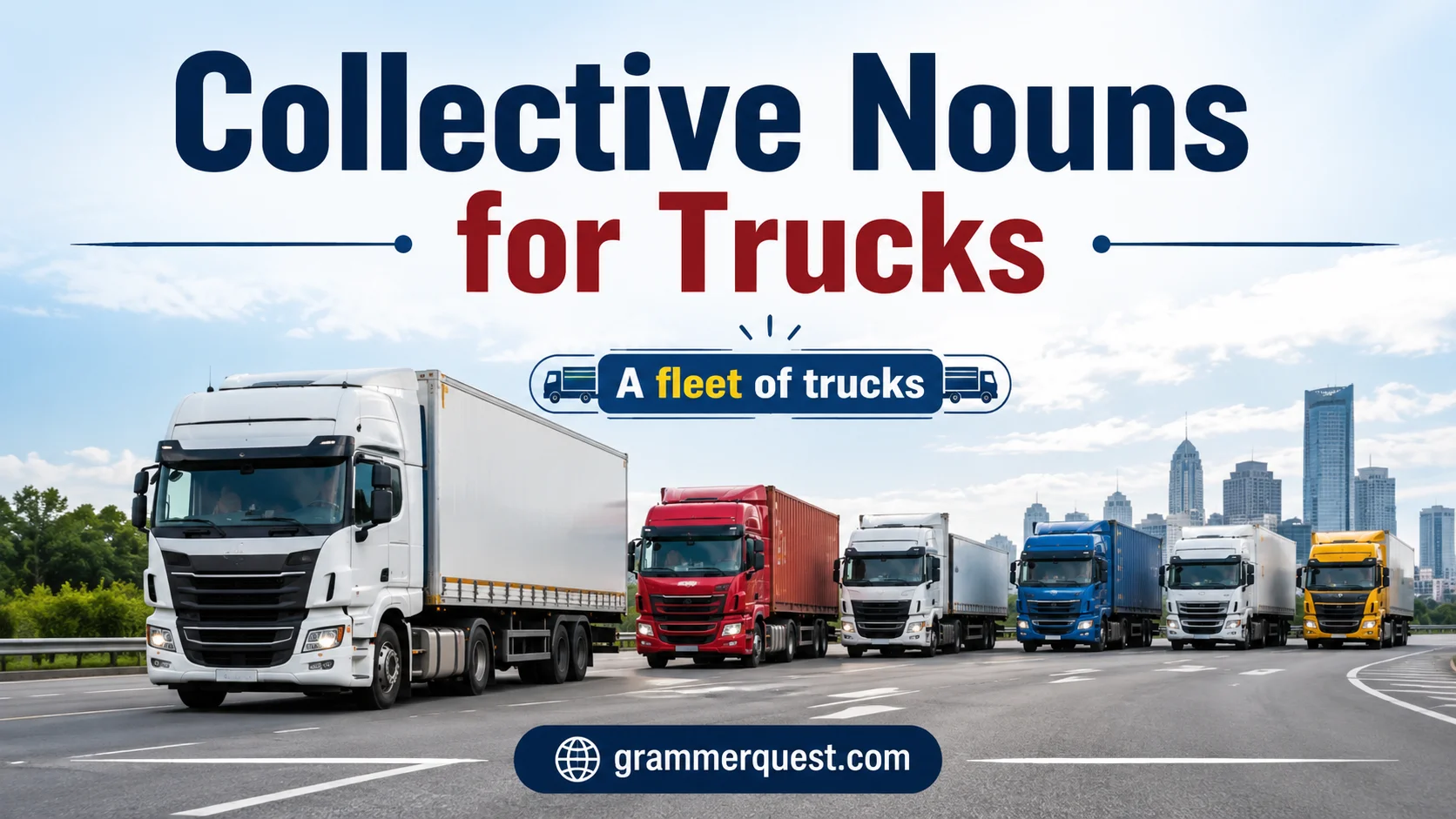
Collective Nouns for Trucks are useful words that describe a group of trucks as one unit in English grammar. These terms help improve vocabulary, make writing more accurate, and create clear descriptions in everyday communication. Whether you are a student, teacher, or language learner, understanding collective nouns makes sentences more natural and engaging. Learning these expressions also strengthens grammar skills and improves confidence in both speaking and writing.
Common collective nouns for trucks include fleet, convoy, and line, depending on the situation. These words are often used in transportation, logistics, business, and travel to describe groups of trucks moving or working together. Using the correct collective noun makes your writing more professional, expressive, and easy to understand. This guide will help you learn the most common collective nouns for trucks with simple explanations and practical examples.
Collective Nouns for Trucks
The table below highlights some common collective nouns used for trucks.
| Collective Noun | Type | Simple Example |
| Fleet | Group of trucks | A fleet of trucks delivered supplies. |
| Convoy | Trucks traveling together | A convoy of trucks crossed the highway. |
| Line | Trucks arranged in order | A line of trucks waited at the checkpoint. |
| Caravan | Trucks moving together | A caravan of trucks headed north. |
| Train | Trucks following one another | A train of trucks moved through the desert. |
Fleet of Trucks
A fleet is the most common collective noun for trucks. It refers to a group of trucks owned or operated by a company or organization.
Examples of Fleet of Trucks
- A fleet of trucks arrived at the warehouse.
- The company purchased a new fleet of trucks.
- A fleet of trucks transported food across the country.
- The fleet of trucks was painted blue.
- A fleet of trucks carried building materials.
- The fleet of trucks left early in the morning.
- The logistics firm manages a fleet of trucks.
- A fleet of trucks delivered packages during the holiday season.
- The fleet of trucks required regular maintenance.
- A fleet of trucks helped distribute emergency supplies.
Convoy of Trucks
A convoy refers to a group of trucks traveling together, usually for safety, organization, or efficiency.
Examples of Convoy of Trucks
- A convoy of trucks moved along the highway.
- The convoy of trucks crossed the mountain pass.
- A convoy of trucks delivered aid to the village.
- The convoy of trucks traveled through the night.
- Soldiers escorted a convoy of trucks.
- A convoy of trucks transported equipment.
- The convoy of trucks stopped for fuel.
- A convoy of trucks headed toward the city.
- The convoy of trucks remained closely grouped.
- A convoy of trucks carried supplies to remote areas.
Line of Trucks
A line of trucks describes trucks arranged one behind another, often waiting or moving slowly.
Examples of Line of Trucks
- A line of trucks waited at the border.
- The line of trucks stretched for miles.
- A line of trucks entered the construction site.
- The line of trucks moved slowly.
- A line of trucks parked beside the road.
- The line of trucks carried heavy loads.
- We saw a line of trucks near the factory.
- A line of trucks waited to unload cargo.
- The line of trucks blocked the entrance.
- A line of trucks traveled through the valley.
Caravan of Trucks
A caravan refers to a group of trucks traveling together over long distances.
Examples of Caravan of Trucks
- A caravan of trucks crossed the desert.
- The caravan of trucks carried goods to market.
- A caravan of trucks moved through the countryside.
- The caravan of trucks stopped at a rest area.
- A caravan of trucks followed the same route.
- The caravan of trucks traveled safely together.
- A caravan of trucks transported machinery.
- The caravan of trucks reached its destination.
- A caravan of trucks departed before sunrise.
- The caravan of trucks drove through the mountains.
Train of Trucks
A train of trucks describes multiple trucks moving one after another in a connected sequence.
Examples of Train of Trucks
- A train of trucks rolled down the highway.
- The train of trucks carried mining equipment.
- A train of trucks passed through town.
- The train of trucks moved steadily forward.
- A train of trucks delivered supplies.
- The train of trucks followed the lead vehicle.
- A train of trucks traveled across the plains.
- We watched a train of trucks on the road.
- The train of trucks headed toward the port.
- A train of trucks carried valuable cargo.
Read More: Collective Nouns for Peas
Interesting Facts About Trucks
The Longevity of Trucks
Trucks are built to last for many years and often travel hundreds of thousands of miles during their lifetime. Well-maintained commercial trucks can remain operational for decades, making them one of the most durable vehicles on the road. Their strong frames, powerful engines, and heavy-duty components are specifically designed to withstand challenging conditions and long-distance transportation.
Unique Structural Features of Trucks
Trucks have several distinctive features that set them apart from other vehicles. They typically have reinforced chassis systems, large cargo areas, powerful diesel engines, and specialized suspension systems capable of carrying heavy loads. Some trucks are equipped with multiple axles to distribute weight evenly, while others have advanced braking and safety technologies for handling large cargo shipments.
The “Diet” of Trucks: Fuel and Energy
Unlike animals that consume food, trucks rely on fuel as their source of energy. Most heavy-duty trucks use diesel fuel because it provides excellent efficiency and power. In recent years, alternative energy sources such as natural gas, electricity, and hydrogen have become increasingly popular. These innovations help reduce emissions while maintaining the performance needed for transportation and logistics operations.
Trucks and Global Commerce
Trucks play a critical role in modern economies. They transport goods between factories, warehouses, stores, and consumers. Without trucks, many products would not reach their destinations efficiently. Their ability to travel on roads of all types makes them one of the most versatile transportation methods available.
Specialized Types of Trucks
There are many specialized trucks designed for different tasks. Examples include dump trucks, tanker trucks, fire trucks, garbage trucks, tow trucks, and refrigerated trucks. Each type is engineered to perform specific duties, demonstrating the versatility and importance of trucks in everyday life.
FAQs :
1. What is a collective noun for trucks?
A collective noun for trucks is a word used to describe a group of trucks as one unit, such as a fleet or convoy.
2. Why are collective nouns important in English?
They make writing clearer, more natural, and more precise when talking about groups.
3. Is “fleet” a collective noun for trucks?
Yes, fleet is one of the most common collective nouns used for trucks and other vehicles.
4. Can “convoy” be used for trucks?
Yes, convoy is often used when trucks travel together in a group.
5. Are collective nouns only used for animals?
No, collective nouns are also used for people, things, and vehicles like trucks.
6. What is the difference between “fleet” and “convoy”?
A fleet usually means a company’s group of trucks, while a convoy means trucks moving together.
7. Can I use collective nouns in school writing?
Yes, collective nouns are very useful in essays, grammar work, and English assignments.
8. Do collective nouns improve vocabulary?
Yes, they help you learn new words and make your language stronger and more professional.
9. Is “line” a collective noun for trucks?
Yes, line can be used in some contexts to describe trucks arranged one after another.
10. How can I remember collective nouns easily?
The best way is to read examples, use them in sentences, and practice them often.
Conclusion :
Collective nouns for trucks help us describe groups of trucks in a simple and effective way. Words like fleet, convoy, and line make English more clear, useful, and interesting. Learning these terms improves grammar, builds vocabulary, and makes writing more natural.

Emma Brooke is a passionate language enthusiast and the voice behind GrammarQuest.com. With a sharp eye for detail and a love for clear communication, she simplifies complex grammar rules into easy, practical lessons. Her goal is to help you write with confidence, clarity, and style—whether you’re a student, professional, or everyday writer.