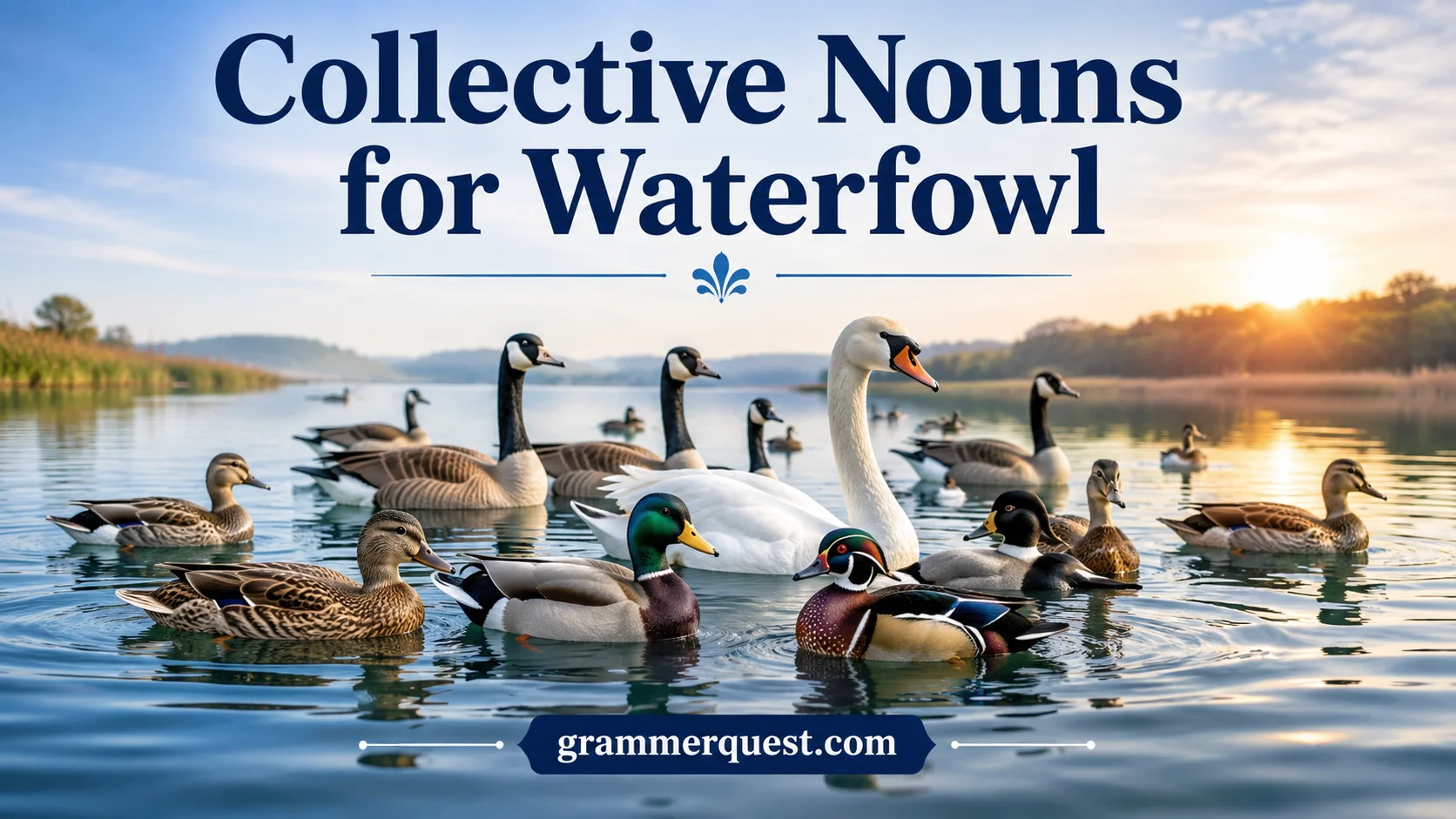
Collective nouns help describe groups of animals or things as one unit. In grammar, they explain how a flock of waterfowl, ducks, or birds behaves as a single noun system with correct usage in context.
In English grammar, collective nouns refer to groups like waterfowl, ducks, swans, and geese. These words are used in singular or plural form depending on context, helping writers express clear meaning, structure, and communication in sentences.
The study of waterfowl includes taxonomy and classification of aquatic birds in the Anatidae family. Historically, terms of venery like a “pride of lions” or “ballet of swans” show how language evolved, giving rich examples of collective expressions in nature and writing style.
Common Collective Nouns for Waterfowl (Quick Reference Table)
| Collective Noun | Type of Waterfowl | Simple Example |
| Flock | Ducks/Geese/Swans | A flock of ducks is swimming in the pond. |
| Raft | Ducks | A raft of ducks floated on the lake. |
| Skein | Geese (in flight) | A skein of geese flew across the sky. |
| Wedge | Geese (V formation) | A wedge of geese crossed the horizon. |
| Brace | Ducks (pair/hunting) | A brace of ducks was spotted near the river. |
A Flock of Waterfowl
A flock is the most general collective noun for waterfowl and refers to any group of ducks, geese, or swans gathered together.
Example Sentences (Flock of Waterfowl)
- A flock of ducks landed near the riverbank.
- The flock of geese migrated south for winter.
- We saw a flock of swans gliding gracefully.
- A large flock of waterfowl gathered at dawn.
- The flock moved together across the wetland.
- A flock of ducks quacked loudly near the reeds.
- The fisherman watched a flock of geese overhead.
- A flock of swans rested on the calm lake.
- The flock scattered when the dog barked.
- A flock of waterfowl filled the evening sky.
A Raft of Ducks
A raft is a charming term used specifically for ducks floating together on water, resembling a floating group or cluster.
Example
- A raft of ducks floated peacefully on the pond.
- The raft of ducks moved slowly with the current.
- We spotted a raft of ducks near the shore.
- A raft of ducks gathered around the feeding area.
- The raft of ducks created ripples on the water.
- A colorful raft of ducks rested under the sun.
- The raft of ducks drifted across the lake.
- A raft of ducks splashed playfully together.
- The fisherman admired the raft of ducks nearby.
- A raft of ducks disappeared into the reeds.
A Skein of Geese
A skein refers to geese flying in a loose formation, often seen during migration. It is one of the most poetic collective nouns.
Example
- A skein of geese flew across the evening sky.
- The skein of geese headed south for winter.
- We watched a skein of geese in perfect formation.
- A skein of geese honked loudly overhead.
- The skein of geese moved like a flowing pattern.
- A skein of geese passed over the mountains.
- The sky filled with a skein of geese.
- A skein of geese traveled together at sunset.
- The skein of geese disappeared into the clouds.
- A skein of geese created a beautiful silhouette.
A Wedge of Geese
A wedge describes geese flying in a V-shaped formation, which helps them conserve energy during long migrations.
Example
- A wedge of geese flew overhead in perfect formation.
- The wedge of geese pointed southward.
- We saw a wedge of geese crossing the river.
- The wedge of geese moved in synchronized flight.
- A wedge of geese cut through the cold wind.
- The wedge of geese changed direction together.
- A wedge of geese passed over the forest.
- The wedge of geese was clearly visible in the sky.
- A wedge of geese honked as they flew.
- The wedge of geese disappeared into the horizon.
A Brace / Team of Waterfowl
A brace typically refers to a pair of ducks, often used in hunting contexts, while a team can describe waterfowl working or moving together.
Example
- A brace of ducks was seen near the marsh.
- The hunter spotted a brace of waterfowl.
- A brace of ducks walked along the shore.
- We saw a team of ducks crossing the field.
- A team of geese guarded their nesting area.
- The brace of ducks stayed close together.
- A team of swans moved gracefully across the lake.
- The brace of ducks flew low over the water.
- A team of waterfowl gathered near the reeds.
- The brace of ducks disappeared into the grass.
Read More: Collective Nouns for Barracuda
Interesting Facts About Waterfowl
Waterfowl are among the most adaptable and fascinating bird groups in the natural world. Many species, such as swans, are known for their long lifespans, sometimes living over 20–30 years in the wild. Their bodies are specially designed for aquatic life, featuring webbed feet for swimming, waterproof feathers coated with natural oils, and lightweight bones that help them float effortlessly. Their diet is equally diverse—they feed on aquatic plants, insects, small fish, and algae, depending on the species and habitat. This adaptability allows them to thrive in lakes, rivers, wetlands, and even coastal environments around the world.
FAQs
1. What are collective nouns for waterfowl?
Collective nouns for waterfowl are words used to describe groups of birds like ducks, geese, and swans as a single unit, such as a flock.
2. What is the most common collective noun for ducks?
The most common collective noun for ducks is a flock, though other traditional venery terms also exist.
3. Are collective nouns singular or plural in grammar?
Collective nouns are usually singular in form, but they can take singular or plural verbs depending on whether the group acts as one unit or individually.
4. What is the scientific family of waterfowl?
Waterfowl belong to the Anatidae family, which includes ducks, geese, and swans.
5. Why do different collective nouns exist for birds?
Different collective nouns come from historical hunting traditions, poetic language, and descriptive imagery developed over centuries.
6. Can collective nouns change in modern English?
Yes, modern English allows flexibility, but traditional forms are still widely used in formal writing and education.
7. What is an example sentence using a collective noun?
A flock of geese is flying over the river. Here, “flock” acts as the collective noun.
8. What are terms of venery?
Terms of venery are old English collective nouns created in medieval times, often used for specific animals in a poetic way.
9. Are all bird groups called a flock?
No, some birds have unique collective nouns, but “flock” is the most general and commonly used term.
10. What is the importance of learning collective nouns?
Learning collective nouns improves grammar skills, vocabulary, and helps in clearer communication in both writing and speech.
Conclusion
Collective nouns for waterfowl are an important part of English grammar that help describe groups of birds like ducks, geese, and swans in a clear and meaningful way. They combine language structure with natural observation, making communication more expressive and accurate. From traditional terms of venery to modern grammar usage, these words show how language evolves while still preserving historical richness. Understanding them improves both writing style and overall language comprehension.

Henry Collins is a passionate grammar expert and the voice behind GrammerQuest.com. With a sharp eye for language and a love for clear communication, he simplifies complex grammar rules into easy, practical lessons.