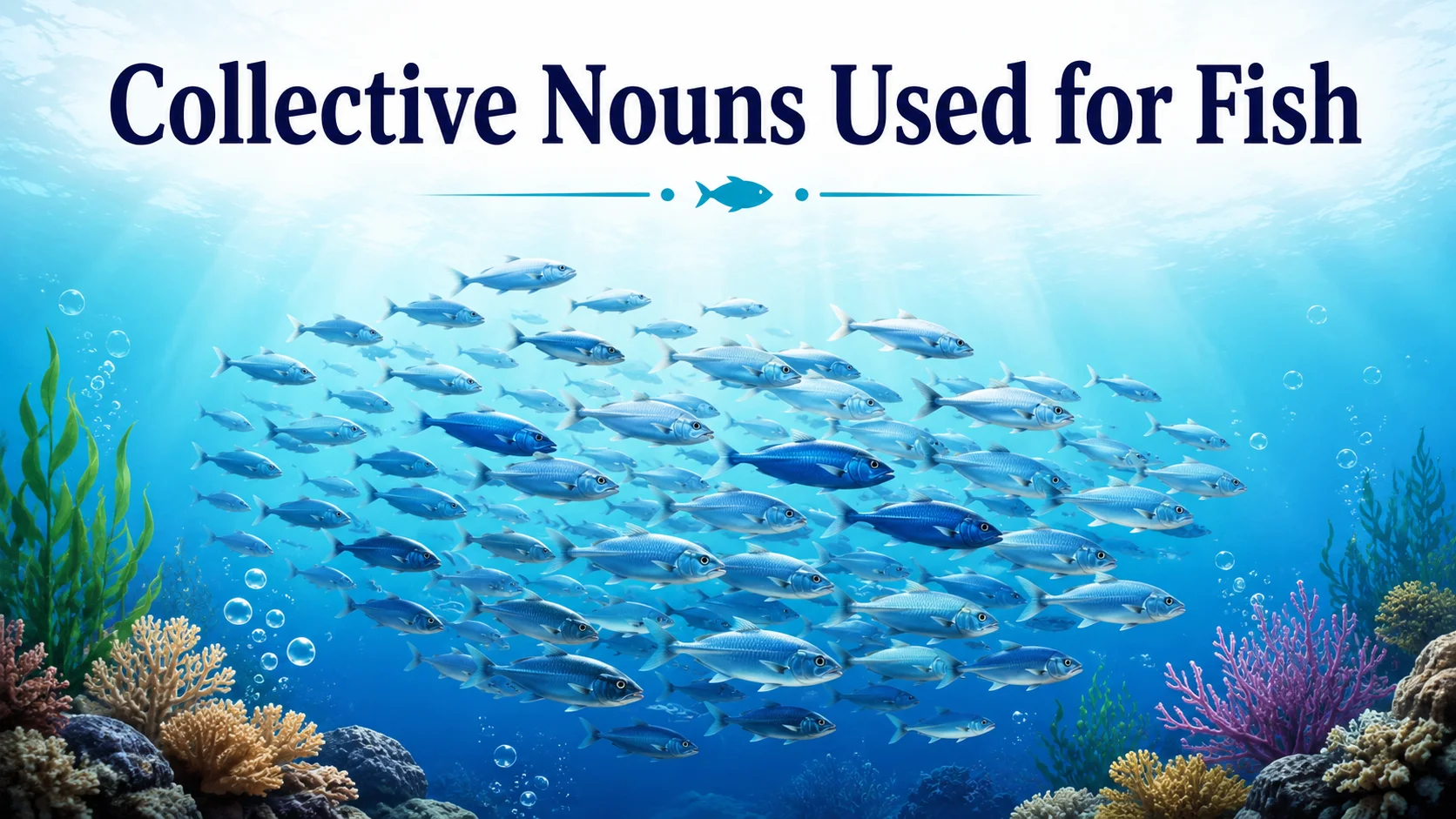
Collective Nouns Used for Fish help people understand how fish groups are named in everyday English grammar. Many people use a school of fish or shoal of fish when talking about sea creatures and aquatic animals. Learning these collective nouns, group nouns, and noun forms improves language learning, writing, speaking, and builds confidence for students who want better vocabulary skills.
During my fishing trips, I often heard fishing mates talk about shiver of sharks, fever of stingrays, and bale of turtles while exploring the ocean and rocky shores.These interesting collective nouns make marine life, sea animals, and underwater species easier to remember. Understanding these unique names also improves descriptive language, vocabulary building, and makes learning more enjoyable.
Common Collective Nouns for Fish (Overview Table)
| Collective Noun | Simple Example |
| School of fish | A school of fish swimming together |
| Shoal of fish | A shoal of fish near the reef |
| Run of fish | A run of salmon upstream |
| Catch of fish | A catch of fish from fishing nets |
| Raft of fish | A raft of fish floating near surface |
School of Fish
A school of fish is the most commonly used collective noun. It refers to fish swimming in a highly organized, synchronized group.
Examples:
- A school of fish moved quickly through the coral reef.
- We saw a school of fish near the boat.
- The school of fish changed direction instantly.
- A school of fish shimmered in the sunlight.
- Divers observed a school of fish underwater.
- The school of fish swam away from the shark.
- A large school of fish gathered near the shore.
- The school of fish moved like a single body.
- Fishermen spotted a school of fish in the deep sea.
- A school of fish created beautiful patterns in the water.
Shoal of Fish
A shoal of fish refers to a loose group of fish that stay together but are less synchronized than a school.
Examples:
- A shoal of fish drifted near the rocks.
- The shoal of fish scattered when disturbed.
- We watched a shoal of fish swimming calmly.
- A shoal of fish gathered near the coral.
- The shoal of fish moved slowly in shallow water.
- A shoal of fish appeared near the fishing net.
- The shoal of fish avoided the larger predator.
- A shoal of fish rested near the seabed.
- Divers saw a shoal of fish during their dive.
- A shoal of fish moved gently with the current.
Run of Fish
A run of fish is often used when fish migrate in large numbers, especially for spawning.
Examples:
- A run of salmon moved upstream.
- The river was full of a run of fish.
- Fishermen waited for the run of fish season.
- A run of fish traveled against the strong current.
- The run of fish attracted many birds.
- We witnessed a huge run of fish migration.
- A run of fish filled the narrow river.
- The run of fish marked the spawning season.
- A run of fish passed through the waterfall.
- Scientists studied the run of fish carefully.
Catch of Fish
A catch of fish refers to fish that have been caught, usually by fishermen.
Examples:
- The fisherman brought a large catch of fish.
- The catch of fish was sold in the market.
- A small catch of fish was enough for dinner.
- The catch of fish included several species.
- They returned home with a fresh catch of fish.
- The catch of fish was unusually large today.
- Boats displayed their catch of fish at the dock.
- The catch of fish was measured carefully.
- A good catch of fish means a successful trip.
- The catch of fish was shared among villagers.
Raft of Fish
A raft of fish describes a group of fish floating together near the water surface, often seen in calm waters.
Examples:
- A raft of fish floated near the surface.
- We spotted a raft of fish in the lagoon.
- The raft of fish shimmered under the sun.
- A raft of fish gathered in warm water.
- The raft of fish moved slowly together.
- Tourists saw a raft of fish from the bridge.
- A raft of fish rested in the shallow bay.
- The raft of fish drifted with the tide.
- A raft of fish created ripples on the water.
- The raft of fish stayed close to the reef.
Read More: Collective Nouns for Plovers
Interesting Facts About Fish
Fish are among the oldest living vertebrates on Earth, with some species dating back over 500 million years. One fascinating fact is their longevity—certain species like the Greenland shark can live for over 250 years, making them one of the longest-living vertebrates.
Fish also have unique physiological features, such as gills that allow them to extract oxygen directly from water. Their streamlined bodies help them move efficiently, and many species have specialized adaptations like bioluminescence for communication or camouflage.
In terms of dietary habits, fish are extremely diverse. Some are herbivores feeding on algae, others are carnivores hunting smaller fish, and some are omnivores consuming both plant and animal matter. This diversity allows fish to thrive in almost every aquatic environment on Earth.
FAQs :
What is the most common collective noun used for fish?
The most common collective noun is a school of fish, although shoal of fish is also widely used.
What does a shoal of fish mean?
A shoal of fish describes a group of fish swimming together, often without moving in the same direction.
Is a school of fish different from a shoal?
Yes, a school of fish usually moves together in an organized way, while a shoal may not.
Why are collective nouns important in English?
Collective nouns make descriptions easier and improve writing, speaking, and everyday communication.
What is a group of sharks called?
A group of sharks is called a shiver of sharks.
What is the collective noun for stingrays?
The collective noun for stingrays is a fever of stingrays.
What is a group of turtles called?
A group of turtles is known as a bale of turtles.
What is the collective noun for rainbow fish?
A group of rainbow fish is called a party of rainbow fish.
Why should students learn collective nouns?
Learning collective nouns helps improve vocabulary, grammar knowledge, and communication skills.
Are collective nouns only used for fish?
No, collective nouns are used for many animals, birds, insects, and other living creatures.
Conclusion :
Understanding collective nouns used for fish makes learning English more enjoyable and practical. Whether talking about a school of fish, a shoal of fish, or unusual names for sea animals, these words help describe groups more clearly and make conversations more interesting.

Henry Collins is a passionate grammar expert and the voice behind GrammerQuest.com. With a sharp eye for language and a love for clear communication, he simplifies complex grammar rules into easy, practical lessons.