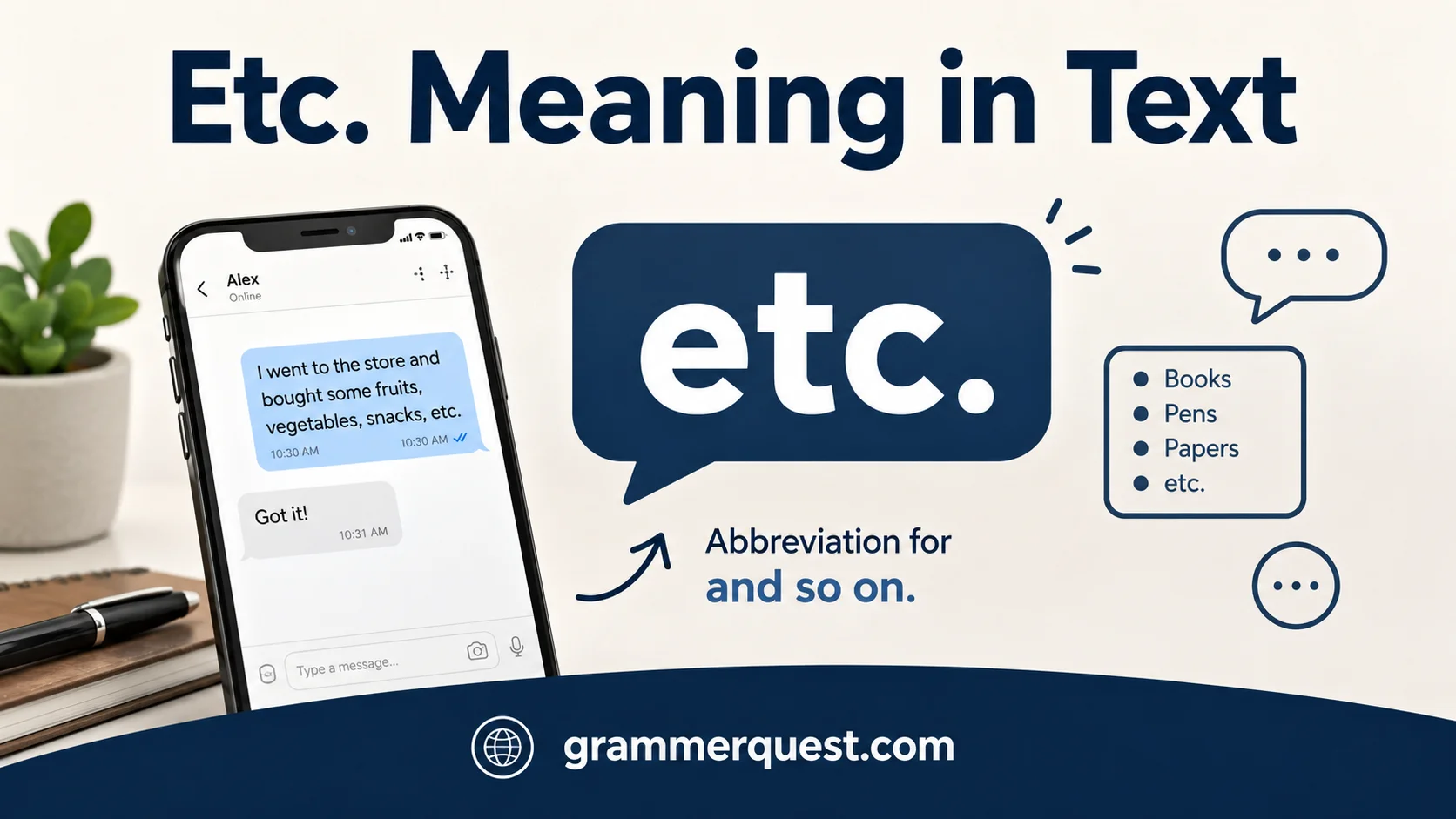
Seeing “Etc.” in a text message, email, social media post, or article can leave you wondering what the writer means. The good news is that this abbreviation has a simple meaning. Etc. stands for the Latin phrase et cetera, which means “and other similar things” or “and so on.” Writers use it after a list when they don’t want to name every item.
For example, if someone writes, “Bring pens, pencils, notebooks, etc.,” they aren’t asking you to bring only those three things. They’re indicating that other similar school supplies may also be needed. Cambridge Dictionary defines etc. as an abbreviation for et cetera and explains that it helps avoid giving a complete list.
Although etc. looks tiny, it can carry a useful bit of meaning. It tells the reader that the examples shown aren’t the whole story. However, good writing still requires judgment. If the missing information matters, writing etc. may make your sentence too vague.
Quick Answer: What Does Etc. Mean in Text?
Etc. means “and other similar things,” “and so on,” or “and the rest.” It comes from the Latin phrase et cetera and usually appears at the end of a list.
For example:
“I need to buy paper, envelopes, stamps, etc.”
Here, etc. suggests that other related mailing supplies may also be needed.
In texting, etc. has essentially the same meaning as it does in formal writing. The main difference is the setting. A person might use it casually in a text such as:
“I have to finish my homework, clean my room, do laundry, etc.”
The abbreviation saves space because the writer doesn’t need to spell out every remaining task.
At a Glance
| Question | Answer |
| What does etc. mean? | And other similar things |
| What does etc. stand for? | Et cetera |
| What language does it come from? | Latin |
| Where does it usually appear? | At the end of a list |
| Is “ect.” correct? | No. Etc. is correct |
| Can it mean “and so on”? | Yes |
| Can it appear in texts? | Yes |
| Does it need a period? | Etc. is traditionally written with a period |
| Can you write “and etc.”? | Usually no, because the phrase becomes redundant |
| Does etc. mean the list is complete? | No. It signals that similar items have been left out |
Comparison Overview
The easiest way to understand etc. meaning in text is to compare it with expressions that perform a similar job.
| Expression | Meaning | Example | Best Use |
| etc. | And other similar things | Books, magazines, newspapers, etc. | Written lists |
| and so on | Continuing in the same way | We discussed costs, deadlines, staffing, and so on. | Conversation and general writing |
| and so forth | And other similar things | The policy covers fees, refunds, cancellations, and so forth. | More formal-sounding writing |
| e.g. | For example | Bring writing tools, e.g., pens and pencils. | Introducing examples |
| i.e. | That is; in other words | He works remotely, i.e., from home. | Clarifying meaning |
| et al. | And others | Smith et al. | Referring to people or authors |
The key distinction is simple: etc. extends a category, while e.g. introduces examples. Meanwhile, i.e. explains or restates something rather than adding more examples.
Main Differences Between Etc. Meaning in Text and Similar Expressions
Understanding etc. meaning in text becomes much easier when you know what it does differently from related expressions.
Etc. vs. “And So On”
These expressions often communicate nearly the same idea.
“She enjoys reading, painting, gardening, etc.”
and
“She enjoys reading, painting, gardening, and so on.”
Both suggest that the list continues.
The difference is mostly stylistic. Etc. is compact and common in written lists. And so on feels more natural in ordinary conversation.
Etc. vs. “And So Forth”
And so forth also means that other similar things follow. It can sound slightly more formal or traditional than and so on.
For example:
“The report covers sales, expenses, customer feedback, and so forth.”
You could replace and so forth with etc. without changing the basic meaning:
“The report covers sales, expenses, customer feedback, etc.”
Etc. vs. E.g.
This distinction matters because writers often confuse the two.
E.g. means “for example.” It introduces examples without necessarily suggesting that the list continues in the same way.
Etc. means “and other similar things.” It tells the reader that additional items belong to the same category.
Compare these:
“You can use citrus fruits, e.g., lemons and oranges.”
“You can use lemons, oranges, limes, etc.”
The first sentence gives examples. The second indicates that the list continues.
Etc. vs. I.e.
I.e. comes from the Latin id est and means “that is” or “in other words.”
It doesn’t introduce a list of additional things.
For example:
“The meeting is virtual, i.e., it takes place online.”
The writer isn’t giving several examples of virtual meetings. Instead, the second phrase clarifies the first.
Etc. vs. Et Al.
Et al. is another Latin abbreviation, but it has a different job.
It generally appears when referring to multiple people or authors, particularly in academic citations.
For example:
“Garcia et al. examined the effects of the new policy.”
Here, et al. means “and others.”
By contrast, etc. generally refers to things, ideas, categories, activities, or similar items.
What Does “Etc.” Stand For?
Etc. stands for et cetera.
The phrase comes from Latin. Et means “and,” while cetera refers to the other things. In modern English, the phrase has developed into the familiar idea of “and other similar things.”
Cambridge Dictionary lists etc. as the abbreviation of et cetera and gives its meaning as “and other similar things.”
A useful way to remember it is:
et cetera → etc. → and other similar things
The shortened form is especially useful when a list contains several obvious examples and naming every remaining item would add little value.
How Do You Pronounce Etc.?
In US English, etc. is commonly pronounced approximately “et-SET-er-uh.” Cambridge gives the US pronunciation as /etˈset̬.ər.ə/.
When reading a sentence aloud, the abbreviation usually sounds like the complete phrase:
“Pens, pencils, notebooks, et cetera.”
The abbreviation appears in writing, while the full expression can be spoken naturally.
What Does Etc. Mean in a Text Message?
In a text message, etc. means exactly what it means elsewhere: “and other similar things.”
Texting often favors short expressions, so etc. can be convenient when someone wants to show that a list continues without typing every item.
For example:
“I need to get groceries—milk, eggs, bread, vegetables, etc.”
The writer doesn’t necessarily expect the reader to guess every possible grocery item. Instead, etc. keeps the message brief while showing that the list contains more related items.
Examples of Etc. in Texting
- “I have work, errands, appointments, etc. all day.”
- “Bring your charger, headphones, laptop, etc.”
- “We talked about school, jobs, family, etc.”
- “She likes hiking, swimming, cycling, etc.”
- “I need to clean the kitchen, bathroom, bedroom, etc.”
In casual texts, etc. can also communicate a sense of “you get the idea.” Still, the surrounding context should make the category understandable.
How to Use “Etc.” in a Sentence
The basic pattern is straightforward:
Specific examples + etc.
For example:
“The store sells apples, bananas, oranges, etc.”
The writer gives several examples and then uses etc. to indicate that other similar fruits are available.
The examples should normally have a clear relationship. If the list jumps from one unrelated idea to another, the reader may not know what etc. includes.
Strong Examples
“The course covers grammar, vocabulary, pronunciation, etc.”
The category is clear: these are areas of language learning.
“The kitchen contains plates, bowls, cups, utensils, etc.”
Again, the category is obvious: kitchen or dining items.
“She enjoys hiking, camping, fishing, etc.”
The reader can reasonably infer that other outdoor activities may follow.
Weak Example
“He bought a laptop, apples, a jacket, etc.”
What does etc. mean here?
The reader can’t tell whether the missing items are electronics, groceries, clothing, or random purchases. The sentence needs a clearer category.
A better version would be:
“He bought a laptop, monitor, keyboard, etc.”
Now the category is obvious: computer equipment.
Examples of “Etc.” in Everyday Writing
A few carefully chosen examples make the rule easier to remember.
| Context | Example Sentence | What Etc. Suggests |
| Shopping | “We need rice, flour, sugar, etc.” | Other grocery staples |
| School | “Bring notebooks, pens, folders, etc.” | Other school supplies |
| Travel | “Pack clothes, toiletries, chargers, etc.” | Other travel necessities |
| Hobbies | “She enjoys painting, drawing, pottery, etc.” | Other creative activities |
| Work | “The meeting covered budgets, deadlines, staffing, etc.” | Other business topics |
| Home | “Clean the kitchen, bathroom, bedrooms, etc.” | Other rooms or household areas |
| Technology | “Check the router, cables, modem, etc.” | Other network equipment |
Notice the pattern. The examples aren’t random. They establish a category, and etc. tells the reader that the category contains more items.
How to Punctuate “Etc.” Correctly
Punctuation around etc. can cause confusion because different style guides handle some details differently.
Does “Etc.” Have a Period?
The traditional spelling is etc., with a period.
That period marks the abbreviation of et cetera.
For example:
“Bring paper, pens, folders, etc.”
However, punctuation practices can vary by style guide and publication. The Australian Government’s Style Manual, for example, recommends avoiding Latin shortened forms such as etc. in most general content and using plain English where possible.
For ordinary US English, though, etc. remains a familiar and widely recognized form.
Should You Put a Comma Before Etc.?
A comma often appears before etc. when it follows the final item in a series:
“Bring pens, pencils, notebooks, etc.”
The comma separates the list from the abbreviation.
However, punctuation depends on the sentence structure and the style guide being followed. The bigger point is to avoid blindly adding punctuation simply because etc. appears.
What If Etc. Comes at the End of a Sentence?
You don’t need two periods.
Write:
“She bought pens, notebooks, folders, etc.”
The period in etc. also serves as the sentence-ending period.
If another punctuation mark follows, that mark can appear after the abbreviation:
“Which supplies should we bring—pens, notebooks, folders, etc.?”
Here, the question mark closes the entire sentence.
Read This: WYTB Meaning in Text
Common Mistakes With “Etc.”
A few errors appear repeatedly in everyday writing.
Writing “Ect.” Instead of “Etc.”
The correct abbreviation is:
etc.
Not:
ect.
The letters come from et cetera, which explains the order: e-t-c.
A simple memory trick is to think:
Et Cetera → ETC
Writing “And Etc.”
The phrase “and etc.” is generally redundant.
Why? Because et cetera already contains the meaning of “and other things.”
Compare:
❌ “Bring pens, pencils, notebooks, and etc.”
✅ “Bring pens, pencils, notebooks, etc.”
The second version is cleaner.
Using Etc. After “Such As”
Another common issue is unnecessary repetition.
For example:
“Bring items such as pens, pencils, notebooks, etc.”
This construction is widespread, but some style guides recommend removing etc. because “such as” already signals that the list provides examples rather than a complete inventory. The Australian Government Style Manual specifically advises against using etc. after phrases such as “for example,” “such as,” and “including.”
Depending on the style you’re following, you could write:
“Bring items such as pens, pencils, and notebooks.”
Or:
“Bring pens, pencils, notebooks, etc.”
The second version is more compact. The first is often cleaner in polished prose.
Using Etc. When the Category Isn’t Clear
This mistake can make otherwise good writing frustrating to read.
Consider:
“The company sells computers, shoes, coffee, etc.”
The reader can’t determine what etc. represents.
Instead, group related items:
“The company sells laptops, desktop computers, monitors, etc.”
Now the category is clear.
Using Etc. When Exact Information Matters
Imagine receiving these instructions:
“Bring identification, forms, receipts, etc.”
That could create a problem if the reader needs to know exactly which documents to bring.
When missing information could cause confusion, don’t hide it behind etc. Give the complete list or explain the requirements directly.
When Should You Use “Etc.”?
Etc. works best when the omitted items aren’t important individually.
Use it when:
- The list contains several related examples.
- The category is easy to understand.
- Listing every item would make the sentence unnecessarily long.
- The reader doesn’t need an exhaustive list.
- The remaining items are predictable from context.
For example:
“The store sells household products such as soap, detergent, sponges, etc.”
The reader understands the general category without seeing every product on the shelf.
When Should You Avoid Etc.?
Skip it when:
- The reader needs the complete list.
- The missing items have legal or financial importance.
- The category isn’t obvious.
- The sentence becomes vague.
- You can communicate the idea more clearly with a specific phrase.
- You are writing instructions where precision matters.
Think of etc. as a shortcut, not a substitute for important information.
If a reader needs to act on the information, clarity should win.
Etc. Meaning in Different Types of Text
The meaning doesn’t change dramatically across different settings. However, the usefulness of the abbreviation can.
Etc. in Text Messages
Text messages often use etc. to shorten casual lists.
“I need to finish homework, laundry, dishes, etc.”
It works well because the writer isn’t trying to provide a formal checklist.
Etc. in Emails
In an email, etc. can be perfectly acceptable when the omitted items don’t matter.
“Please bring your laptop, charger, notebook, etc.”
However, professional communication often benefits from precision. If employees need five specific documents for a meeting, naming all five is better than writing etc.
Etc. in Academic Writing
Academic writing usually values precision.
That doesn’t mean etc. never belongs in academic work. It means writers should avoid using it as a lazy way to cover unclear ideas.
For instance:
“The study considered factors such as age, income, education, etc.”
This may leave readers wondering which other variables the researchers considered.
If those variables matter to the research, list them.
Etc. in Business Writing
Business writing should make the reader’s next step obvious.
A sentence like:
“Send the contract, invoice, tax documents, etc.”
may work if the recipient already knows the process. If not, a complete document list would be safer.
In business communication, specificity often saves more time than brevity.
Case Study: Why Context Matters
Consider two messages.
Message A:
“Bring snacks, drinks, plates, etc.”
This is reasonably clear. The reader understands that etc. probably refers to other party supplies.
Message B:
“Bring the documents, IDs, receipts, etc.”
This is much less helpful if the recipient must prepare for an official appointment.
Why?
The first message deals with flexible items. The second could involve critical documents. Missing one item might cause a serious problem.
The lesson is simple:
Use “etc.” when omitted details are unimportant. Don’t use it when the reader needs exact information.
That’s the difference between concise writing and incomplete writing.
15 Examples of “Etc.” in Sentences
Here are practical examples across several contexts:
- “The children brought crayons, markers, paper, etc.”
- “We bought apples, pears, grapes, etc.”
- “She enjoys reading, writing, drawing, etc.”
- “Pack socks, shoes, toiletries, etc.”
- “The course covers grammar, vocabulary, spelling, etc.”
- “The office needs printers, paper, folders, etc.”
- “He studies biology, chemistry, physics, etc.”
- “The restaurant serves burgers, sandwiches, salads, etc.”
- “You can pay by cash, card, check, etc.”
- “The garden contains roses, tulips, lilies, etc.”
- “We discussed deadlines, budgets, staffing, etc.”
- “The website offers articles, guides, tutorials, etc.”
- “She likes hiking, swimming, cycling, etc.”
- “Bring a charger, headphones, cables, etc.”
- “The box contained screws, bolts, nails, etc.”
In each example, etc. follows a recognizable category. That’s what makes the abbreviation useful rather than confusing.
Quick Facts About “Etc.”
A few facts summarize the most important points:
- Etc. is an abbreviation of et cetera.
- Et cetera is a Latin expression.
- Its modern English meaning is roughly “and other similar things.”
- It generally appears after a list.
- It signals that the list isn’t complete.
- Ect. is a misspelling of the standard abbreviation.
- “And etc.” is usually redundant.
- Etc. and e.g. don’t mean the same thing.
- Et al. has a different function and commonly refers to people or authors.
- You shouldn’t rely on etc. when the omitted details are essential.
- Some modern style guides recommend using plain English instead of Latin abbreviations in many contexts.
A Simple Rule for Remembering Etc. Meaning in Text
Here’s an easy way to remember it:
If you can say “and other similar things,” you can probably understand what “etc.” means.
For example:
“The desk has pens, pencils, rulers, etc.”
Becomes:
“The desk has pens, pencils, rulers, and other similar things.”
The second version makes the meaning obvious.
However, don’t assume that etc. can repair an unclear list. The reader needs enough information to identify the category first.
FAQs:
1. What does etc. mean in text?
Etc. means “and so on” or “and other similar things.” It’s used when you don’t want to list every item in a group.
2. Is etc. formal or informal?
Etc. can be used in both formal and informal writing. However, in professional writing, make sure it clearly refers to items that are similar to those already mentioned.
3. What does etc. stand for?
Etc. is short for the Latin phrase et cetera, which means “and the rest” or “and other things.”
4. Can I use etc. in text messages?
Yes. Etc. is common in texts, chats, emails, and everyday writing when you want to shorten a list or avoid unnecessary details.
5. What is an example of etc. in a sentence?
For example: “Bring your notebook, pens, pencils, etc.” Here, etc. means there are other similar school supplies that aren’t listed.
Conclusion:
Understanding Etc. Meaning in Text makes everyday communication easier. Etc. is an abbreviation of et cetera and means “and so on” or “and other similar things.” You can use it after listing several examples when the remaining items are obvious or similar. Whether you’re texting a friend, writing an email, or creating a formal document, using etc. correctly can make your writing shorter, clearer, and more natural.

Emma Brooke is a passionate language enthusiast and the voice behind GrammarQuest.com. With a sharp eye for detail and a love for clear communication, she simplifies complex grammar rules into easy, practical lessons. Her goal is to help you write with confidence, clarity, and style—whether you’re a student, professional, or everyday writer.