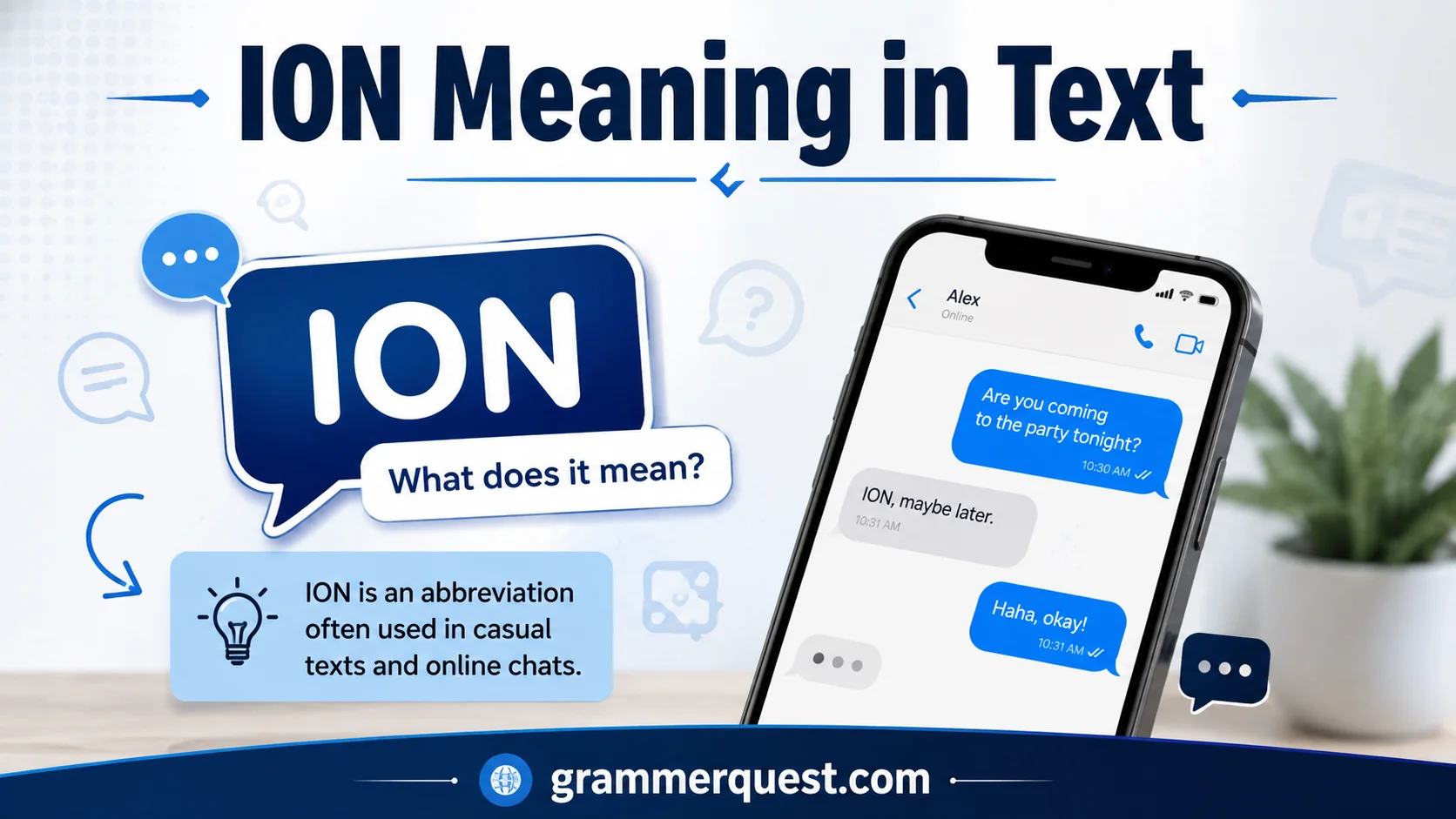
When you see ION in a text message, chat, or social media post, it usually means “I don’t” or “I don’t know,” depending on the context. ION Meaning in Text can be confusing because people often use it as a casual slang abbreviation in informal conversations. For example, someone might say, “ION wanna go today,” meaning “I don’t want to go today.” It’s commonly used in texting, messaging apps, and online conversations because it makes messages shorter, faster, and more casual.
The meaning of ION can change based on the sentence and conversation. In some cases, it may simply represent “I don’t”, while in other situations, people may use it differently as internet slang. Therefore, you should always check the context before deciding what someone means. While ION is fine for casual chats with friends, it may not be appropriate for professional emails, formal messages, or academic writing. Understanding these abbreviations can help you communicate more naturally in today’s digital conversations.
Quick Answer: What Does ION Mean in Text?
In texting and online slang, ION usually means “I don’t.”
It’s an informal, phonetic-style spelling of the phrase. For example:
- “ION know.” = “I don’t know.”
- “ION care.” = “I don’t care.”
- “ION want that.” = “I don’t want that.”
- “ION think so.” = “I don’t think so.”
- “ION remember.” = “I don’t remember.”
You’ll mainly encounter this usage in casual conversations, social media posts, comments, and online chats. It isn’t standard formal English, so “I don’t” remains the better choice for professional or academic writing.
At a Glance
| Term | Meaning in Text | Typical Use |
| ION | I don’t | Casual texting and social media |
| ION know | I don’t know | Casual replies |
| ION care | I don’t care | Showing indifference |
| ION think | I don’t think | Expressing doubt or disagreement |
| ION want | I don’t want | Refusing or declining |
| ION remember | I don’t remember | Expressing uncertainty |
So, if someone writes “ion know what happened,” don’t reach for a chemistry textbook. They’re simply saying, “I don’t know what happened.”
Comparison Overview
The meaning of ION becomes much easier when you compare its common uses side by side. Context acts like a signpost: the words around “ion” usually tell you exactly which meaning the writer intended.
| Context | Meaning of ION | Example | Plain-English Meaning |
| Text message | I don’t | “Ion know.” | “I don’t know.” |
| Social media | I don’t | “Ion like that.” | “I don’t like that.” |
| Casual chat | I don’t | “Ion wanna go.” | “I don’t want to go.” |
| Topic change | In other news | “ION, did you see that?” | “In other news, did you see that?” |
| Chemistry | Ion | “The ion has a positive charge.” | A charged atom or molecule |
The “I don’t” meaning is the one most relevant when you see lowercase ion inside casual texting slang. However, the surrounding sentence always matters.
For example, compare these two sentences:
“Ion know why he left.”
Here, “ion” clearly means “I don’t.”
“The sodium ion has a positive charge.”
Here, “ion” refers to a charged particle, not texting slang.
That distinction is simple once you look at the whole sentence rather than the three letters alone.
Main Differences Between ION Meaning in Text
The biggest difference comes down to context, formality, and meaning.
| Feature | ION = “I don’t” | Ion = Scientific Term | ION = “In Other News” |
| Context | Texting and social media | Science and chemistry | Casual online writing |
| Meaning | I don’t | Charged atom or molecule | Topic transition |
| Formality | Very informal | Standard technical term | Informal |
| Example | “Ion know.” | “A chloride ion has a negative charge.” | “ION, what happened yesterday?” |
| Common audience | Friends and online communities | Students, scientists, professionals | Online readers |
| Main clue | Followed by a verb or phrase | Discusses charge, atoms, electrons, etc. | Introduces a new topic |
The slang version is particularly easy to recognize when ION appears before a verb.
For instance:
- ION know
- ION think
- ION care
- ION want
- ION remember
In each case, you can mentally replace ION with I don’t and the sentence makes sense.
What Does ION Stand for in Texting?
When people use ION as texting slang, it usually stands for “I don’t.” However, calling it a traditional abbreviation can be slightly misleading.
It doesn’t work exactly like IDK, which takes the first letters of “I don’t know.” Instead, ion is closer to a stylized or phonetic representation of how “I don’t” can sound in casual speech. Slang references describe it as an informal spelling used in online chats and social media.
That’s why:
ION + know = I don’t know
ION + care = I don’t care
ION + want = I don’t want
The spelling isn’t designed to follow formal grammar rules. It captures a casual speech pattern and transfers that sound into writing.
Why Do People Type ION Instead of “I Don’t”?
Digital communication often favors speed, tone, and personality over formal correctness.
When someone writes:
“Ion wanna argue about it.”
they’re not necessarily trying to save a huge amount of typing time. The spelling can also make the message feel more relaxed and conversational.
It resembles the way someone might speak quickly rather than carefully pronounce every word.
Internet slang often develops through exactly this kind of informal language play. Research into online slang has found that internet communities create non-standard forms through processes involving sounds, shortened forms, blends, and other linguistic patterns.
In other words, ION is less about saving keystrokes and more about sounding natural within a particular online speech style.
ION Meaning on Social Media
Social media has helped informal expressions travel quickly between communities and platforms. You may see ion in comments, captions, DMs, memes, and short replies.
The meaning usually stays the same: “I don’t.”
ION Meaning on TikTok
On TikTok, you may encounter phrases such as:
- “ion even know.”
- “ion wanna hear it.”
- “ion think y’all understand.”
- “ion care anymore.”
The exact emotional tone depends on the rest of the sentence.
For example, “ion care” can sound dismissive. Meanwhile, “ion know” might simply communicate uncertainty.
That’s an important point: ION itself doesn’t determine the entire tone. The words that follow it, punctuation, emojis, and surrounding conversation all contribute to the meaning.
ION Meaning on Snapchat
Snapchat conversations tend to be informal, so ion can appear naturally in messages between friends.
Imagine this exchange:
Person A: “Are you coming with us?”
Person B: “ion think so.”
The second person means:
“I don’t think so.”
The abbreviation keeps the response casual. It doesn’t necessarily make the person sound rude or dismissive.
ION Meaning on Instagram and Other Platforms
The same pattern appears across other social platforms.
You might see:
“ion like that song tbh.”
That means:
“I don’t like that song, to be honest.”
Or:
“ion know what y’all talking about.”
That means:
“I don’t know what you all are talking about.”
The platform can change, but the basic slang meaning remains stable.
Examples of ION in Text Messages
Seeing several examples makes the pattern much easier to recognize.
| ION Example | Standard English | What It Expresses |
| “ION know.” | “I don’t know.” | Uncertainty |
| “ION care.” | “I don’t care.” | Indifference |
| “ION want to go.” | “I don’t want to go.” | Refusal or reluctance |
| “ION think that’s right.” | “I don’t think that’s right.” | Doubt |
| “ION remember.” | “I don’t remember.” | Lack of memory |
| “ION understand.” | “I don’t understand.” | Confusion |
| “ION have time.” | “I don’t have time.” | Lack of availability |
| “ION like it.” | “I don’t like it.” | Dislike |
| “ION feel like going.” | “I don’t feel like going.” | Lack of interest |
| “ION wanna argue.” | “I don’t want to argue.” | Avoiding conflict |
ION in a Casual Conversation
Here’s a realistic example:
Alex: “Are you going to the party tonight?”
Jordan: “ion think so.”
Alex: “Why not?”
Jordan: “ion really feel like being around people today.”
In standard English, Jordan is saying:
“I don’t think so. I don’t really feel like being around people today.”
Notice how ion doesn’t change the underlying meaning. It simply makes the message feel more casual.
How to Use ION Correctly in a Text
There’s no complicated grammar rule for slang. The main rule is context.
Use ION in Casual Conversations
ION works best when you’re talking informally with people who understand internet slang.
Good settings include:
- Text messages with friends
- Group chats
- Social media comments
- Casual DMs
- Informal online communities
- Memes and captions
For example:
“ion know what to eat tonight.”
That feels natural in a casual conversation.
Avoid ION in Formal Writing
You shouldn’t normally write:
“ION think this proposal meets our requirements.”
in a business email.
Instead, write:
“I don’t think this proposal meets our requirements.”
Use standard English for:
- Job applications
- Business emails
- School assignments
- Academic papers
- Reports
- Formal letters
- Professional presentations
The issue isn’t that ION is impossible to understand. The problem is that it belongs to a different register of language.
Consider Your Audience
Think about who will read your message.
If you’re texting a close friend, slang can make your message feel relaxed and authentic. If you’re communicating with a professor, customer, manager, or unfamiliar professional contact, standard English is the safer choice.
Match the language to the room.
That one habit will prevent most problems with internet slang.
ION vs. “I Don’t”: What’s the Difference?
The meaning can be nearly identical, but the style is completely different.
| ION | I Don’t |
| Informal slang | Standard English |
| Common online | Common everywhere |
| Casual tone | Neutral tone |
| Often appears in texting | Suitable for formal writing |
| May depend on slang familiarity | Widely understood |
| Reflects informal speech patterns | Follows conventional spelling |
Consider these two messages:
“ion think that’s gonna work.”
“I don’t think that’s going to work.”
Both communicate the same basic idea. The first sounds much more casual.
When Should You Use ION?
Use ION when:
- You’re chatting with friends.
- The conversation already uses slang.
- You’re writing an informal social media post.
- You want to mirror a casual speech style.
- Your audience understands the expression.
When Should You Use “I Don’t”?
Use “I don’t” when:
- You’re writing professionally.
- You’re submitting academic work.
- You’re speaking to someone unfamiliar with slang.
- You want maximum clarity.
- The message has serious or formal consequences.
Other Meanings of ION
Although “I don’t” is the main meaning in many texting contexts, ION has other meanings.
ION as a Scientific Term
In chemistry and physics, an ion is an atom or molecule with a net electrical charge.
A neutral atom has equal numbers of positively charged protons and negatively charged electrons. When an atom gains or loses electrons, it develops a net charge.
There are two major categories:
- Cations have a positive charge.
- Anions have a negative charge.
For example, sodium can lose an electron and become Na⁺, a positively charged sodium ion. Chlorine can gain an electron and become Cl⁻, a negatively charged chloride ion.
So the sentence:
“Sodium ions are present in the solution.”
has nothing to do with texting slang.
This scientific meaning is a standard technical term. The spelling may look identical to the texting form, but the context completely changes the definition.
ION as “In Other News”
There’s another online use of ION that means “in other news.” This usage introduces a new topic or signals a sudden shift in the conversation. Dictionary.com documents this as an occasional internet-slang use.
For example:
“ION, did you hear that the concert got canceled?”
Here, the writer is essentially saying:
“In other news, did you hear that the concert got canceled?”
This meaning is less straightforward than “I don’t”, which is why the sentence structure matters.
How to Tell Which Meaning of ION Someone Means
When you see ION, don’t decide its meaning from the letters alone. Look at the sentence.
Check the Words Around ION
If ION appears before a verb, “I don’t” is often the obvious interpretation.
For example:
“ion like it.”
Becomes:
“I don’t like it.”
Check the Conversation
If someone is discussing a science assignment and writes:
“The ion gained an electron.”
they’re clearly talking about chemistry.
If someone texts:
“ion know what happened.”
they’re using slang.
Check Whether “I Don’t” Fits
This is the fastest test.
Replace ION with I don’t.
If the sentence still makes sense, you’ve probably found the intended meaning.
“Ion want pizza.”
→ “I don’t want pizza.”
That works perfectly.
Look for a Topic Shift
If ION introduces a completely new thought, consider whether “in other news” makes sense.
For example:
“ION, how did your interview go?”
“In other news” fits better than “I don’t.”
Context is the key that unlocks the whole thing.
Common Phrases Using ION
Certain combinations appear repeatedly in informal messages.
ION Know
“ION know” means “I don’t know.”
Example:
“Ion know where she went.”
Meaning:
“I don’t know where she went.”
ION Think
“ION think” means “I don’t think.”
Example:
“Ion think that’s a good idea.”
This often expresses doubt or disagreement.
ION Care
“ION care” means “I don’t care.”
Example:
“Ion care what they say.”
Depending on context, this can sound neutral, annoyed, confident, or dismissive.
ION Want
“ION want” means “I don’t want.”
Example:
“Ion want anything right now.”
ION Remember
“ION remember” means “I don’t remember.”
Example:
“Ion remember his name.”
ION Understand
“ION understand” means “I don’t understand.”
Example:
“Ion understand what you mean.”
These patterns make the slang easier to decode. Once you recognize the structure, ION stops looking like a random three-letter code.
Read More: ISO Meaning in Text: What Does “ISO” Mean in a Message?
ION Meaning in Different Texting Contexts
ION at the Beginning of a Sentence
This is one of the most common patterns.
“Ion know what to say.”
The writer means:
“I don’t know what to say.”
ION in a Response
Sometimes it appears as part of a short answer.
Person A: “Are you coming tonight?”
Person B: “ion think so.”
The writer isn’t necessarily being careless. They’re using a casual online style.
ION in Social Media Comments
In comments, ION can help someone sound conversational.
For example:
“ion understand why everyone loves this.”
That means:
“I don’t understand why everyone loves this.”
Depending on the post, the sentence could express genuine confusion, disagreement, sarcasm, or playful criticism.
That’s why tone can’t always be determined from ION alone.
Is ION a Real Word?
Yes and no. It depends on which ion you mean.
Ion is absolutely a real English word when it refers to a charged atom or molecule.
However, ION meaning “I don’t” is informal internet slang. It isn’t a standard replacement for the phrase in formal English.
This distinction matters because people sometimes assume that any commonly used internet expression has become standard English. That isn’t necessarily true.
Language changes constantly. Online communities create, adapt, and spread new forms rapidly. Researchers studying internet slang have found that digital communication supports many non-standard linguistic patterns and forms.
So you can understand ION perfectly while still choosing “I don’t” when writing formally.
Is ION a Proper English Abbreviation?
Not in the conventional sense.
ION isn’t a standard abbreviation for “I don’t” used in formal English. It’s better described as an informal slang spelling.
That distinction explains why you generally shouldn’t replace every instance of “I don’t” with “ION.”
For example:
Casual:
“ion know what you mean.”
Standard:
“I don’t know what you mean.”
Professional:
“I don’t understand what you mean.”
The underlying message stays the same. The register changes.
ION vs. Similar Texting Abbreviations
ION can look similar to other texting shortcuts, but each expression has a different function.
| Slang | Meaning | Example |
| ION | I don’t | “Ion know.” |
| IDK | I don’t know | “IDK what happened.” |
| IDC | I don’t care | “IDC anymore.” |
| TBH | To be honest | “TBH, I disagree.” |
| IMO | In my opinion | “IMO, it’s better.” |
| IDGAF | I don’t give a f*** | Strong expression of indifference |
One useful distinction is that ION can combine with another word to build a phrase.
For example:
ION know.
Meanwhile, IDK already represents the entire phrase:
I don’t know.
That makes ION function more like a replacement for “I don’t” than a complete replacement for every phrase beginning with those words.
Common Mistakes When Interpreting ION
Assuming ION Always Means “I Don’t”
That’s the most common mistake.
If the sentence discusses electrons, charges, atoms, chemistry, or electricity, the scientific meaning probably applies.
Confusing ION With IDK
These expressions aren’t identical.
ION = I don’t
IDK = I don’t know
So:
“ion care”
means:
“I don’t care.”
But:
“idk”
means:
“I don’t know.”
Using ION in Formal Writing
Internet slang belongs in the right setting.
Writing “ION think this is correct” in an academic essay would look out of place. Standard English makes your meaning clearer and keeps your tone appropriate.
Ignoring Context
Never interpret a slang term in isolation when the sentence gives you clues.
The same three letters can point to completely different concepts. Context does the heavy lifting.
How to Respond When Someone Says ION
Your response depends on the words that follow ION.
If someone says:
“ion know.”
You might reply:
“That’s okay. Let’s figure it out.”
If someone says:
“ion wanna go.”
You could say:
“No worries. Maybe next time.”
If someone says:
“ion think that’s a good idea.”
You might respond:
“Fair enough. What would you suggest instead?”
The important thing is to interpret the whole message, not just the slang.
A Simple Case Study: Understanding ION From Context
Imagine receiving this message:
“ion think I’m going tonight.”
At first glance, “ion” may look like a typo.
Now replace it with “I don’t.”
“I don’t think I’m going tonight.”
The sentence becomes perfectly clear.
Now imagine a chemistry student writes:
“The ion has three more electrons than protons.”
Replacing “ion” with “I don’t” would make no sense.
That tells you the scientific meaning applies.
What This Case Study Shows
The word itself doesn’t provide enough information. Instead, look at:
- The words around ION
- The subject of the conversation
- The sentence structure
- The audience
- The platform
- The overall tone
This approach works with many internet slang terms, not just ION.
Is ION Appropriate for Professional Communication?
Generally, no.
Even if your reader understands the slang, professional communication rewards clarity and consistency.
Use:
“I don’t think this approach will work.”
instead of:
“ion think this approach will work.”
The first version works in nearly every setting. The second belongs to casual digital communication.
Better Choices for Different Situations
| Situation | Recommended Form |
| Texting a close friend | ION is fine |
| Group chat | ION can work |
| TikTok comment | ION can work |
| Instagram DM | ION can work |
| Business email | Use I don’t |
| School assignment | Use I don’t |
| Academic paper | Use I don’t |
| Job application | Use I don’t |
| Formal report | Use I don’t |
The simplest rule is this:
Use slang when the setting is casual. Use standard English when clarity and professionalism matter.
FAQs:
1. What does ION mean in text?
ION commonly means “I don’t” in casual texting and online conversations. Its exact meaning can depend on the context of the message.
2. Is ION a slang word?
Yes. ION is commonly used as internet slang in informal texts, chats, and social media. It’s generally not suitable for formal or professional communication.
3. What does “ION wanna” mean in texting?
“ION wanna” usually means “I don’t want to.” For example, “ION wanna go” means “I don’t want to go.”
4. Can I use ION in formal writing?
It’s best to avoid ION in formal writing. Use complete phrases such as “I don’t” instead in emails, school assignments, business communication, and professional documents.
5. Does ION always mean “I don’t”?
Not necessarily. ION can have different meanings depending on the conversation and context. Always read the surrounding message to understand what the sender intends.
Conclusion:
ION is a popular texting abbreviation that commonly means “I don’t.” It helps people communicate quickly and casually in digital conversations. Since its meaning can depend on context, pay attention to the entire sentence before interpreting it. Use ION with friends or in informal chats, but choose standard language for professional and formal communication.

Emma Brooke is a passionate language enthusiast and the voice behind GrammarQuest.com. With a sharp eye for detail and a love for clear communication, she simplifies complex grammar rules into easy, practical lessons. Her goal is to help you write with confidence, clarity, and style—whether you’re a student, professional, or everyday writer.