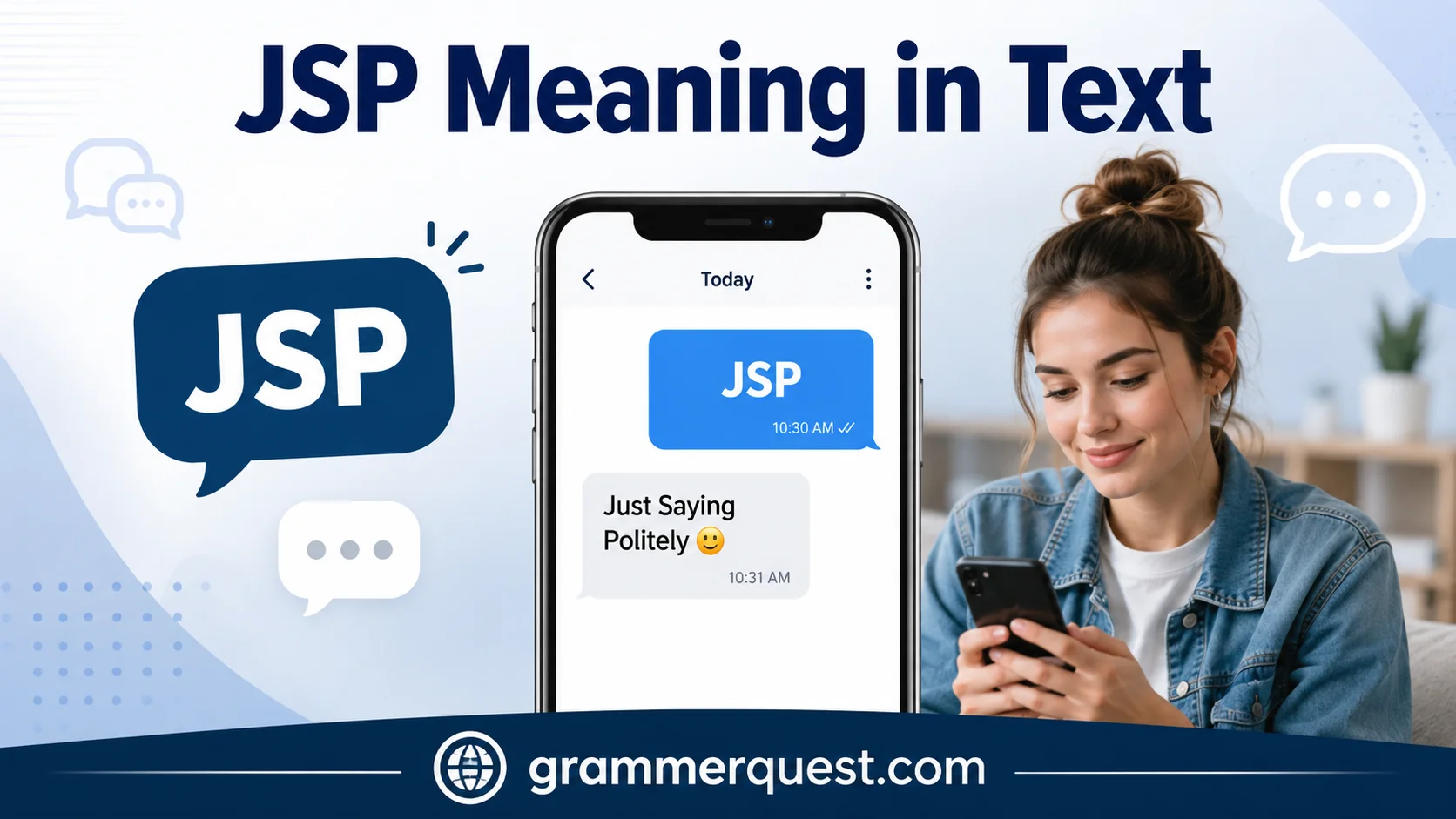
JSP Meaning in Text refers to a text abbreviation and acronym used in messages, chats, comments, and text message conversations. Its meaning in text depends on the context, platform, and tone. In the digital world, people may use JSP in digital communication, online communication, social messaging, texting, or chat language. If you’ve seen or encountered JSP and feel confused, check what surrounds it to understand what it stands for and how the speaker intends it.
The meaning of JSP can change across platforms, so context, tone variations, and actual usage matter. For example, a friend might use JSP in a teasing message, joke, humor, or playful comment with lol, JK, or 😂. If you’re unsure, ask for clarification before you respond. Looking at the conversation, speaker, and purpose can help you understand the acronym meaning and choose the correct usage in casual digital slang or online slang.
Quick Answer
JSP usually means “Just Playing” in casual English texting.
Someone might use it after teasing you or making a deliberately dramatic statement. It essentially tells you:
- “I’m joking.”
- “I’m only teasing you.”
- “Don’t take that seriously.”
- “I’m just messing around.”
Quick example
Friend: “You’re officially banned from choosing the restaurant next time. JSP 😂”
Here, JSP = Just Playing. The sender isn’t actually banning anyone. They’re making a playful complaint.
However, don’t treat JSP as having one universal meaning. In French texting, jsp commonly abbreviates “je sais pas,” which means “I don’t know.” In programming discussions, JSP can mean JavaServer Pages.
So, before interpreting the abbreviation, read the whole conversation.
Comparison Overview
The easiest way to understand JSP meaning in text is to compare its major uses.
| JSP meaning | Context | What it means | Example |
| Just Playing | English texting | I’m joking or teasing | “I’m blocking you. JSP 😂” |
| Je sais pas | French texting | I don’t know | “Jsp, je peux pas.” |
| JavaServer Pages | Programming | A Java web technology | “The application uses JSP.” |
| Other niche meanings | Specific communities | Depends on the group or subject | Check the surrounding context |
For an ordinary English-language text conversation, “Just Playing” is the interpretation most relevant to this article. Slang references also identify this as a common chat and social-media use.
Main Differences Between JSP Meanings in Text
Although the letters look identical, the meanings aren’t interchangeable.
JSP as “Just Playing”
When someone writes JSP after a joke or teasing remark, they’re usually signaling playful intent.
For example:
“You’re the most annoying person I know. JSP 😂”
The first sentence sounds harsh by itself. JSP changes the intended tone by indicating that the sender is joking.
JSP as “Je sais pas”
In French texting, jsp commonly stands for “je sais pas,” an informal shortening of je ne sais pas, meaning “I don’t know.”
For example:
“Tu viens demain ?”
“Jsp.”
The response means:
“I don’t know.”
That’s completely different from “Just Playing.”
JSP as “JavaServer Pages”
In a programming conversation, JSP usually has nothing to do with slang.
JavaServer Pages is a server-side Java technology designed to help create web pages with dynamically generated content. Oracle’s documentation explains that JSP pages combine static content with JSP elements and are typically translated into Java servlets for processing.
For example:
“The developer is updating a JSP page.”
Here, the writer almost certainly isn’t saying “Just Playing.” The technical context gives the abbreviation away.
What Does JSP Mean in Texting?
In casual English messages, JSP means “Just Playing.” It works as a compact way to tell another person that the preceding comment wasn’t serious.
Think of it as a small tone marker.
When you speak face-to-face, your voice, facial expression, and body language can tell someone you’re joking. Text messages remove most of those clues. A sentence such as “I hate you” could sound genuinely hostile without additional context.
Add “JSP 😂”, and the intended meaning becomes much clearer.
What “Just Playing” Means in a Text
Depending on the conversation, JSP can communicate:
- I’m joking.
- I’m teasing you.
- I’m kidding around.
- I’m messing with you.
- I’m not being serious.
- Don’t take that literally.
- I’m only being playful.
The exact emotional shade depends on the message that comes before it.
Example
“You really thought I’d let you win? JSP 😂”
The sender isn’t necessarily insulting the other person. They’re adding a playful twist to the conversation.
That’s the beauty of shorthand: three letters can act like a tiny signpost saying, “Read this playfully.”
What Does JSP Stand for in Texting?
In the slang context, JSP stands for “Just Playing.”
The words break down simply:
- J = Just
- S = Playing
Unlike some abbreviations, however, the three-letter form isn’t universally recognized. Some people may know JK immediately while having no idea what JSP means.
In fact, slang references note that “JP” can also be used for “Just Playing.”
That’s why the safest interpretation comes from context rather than the abbreviation alone.
JSP vs. “Just Playing”
| Form | Meaning | Tone |
| JSP | Just Playing | Very casual |
| JP | Just Playing | Short and casual |
| Just Playing | Full phrase | Clearer |
| I’m just playing | Full sentence | Natural and conversational |
| I’m kidding | Similar idea | Clear and familiar |
If you’re talking to someone who doesn’t use much texting slang, “Just playing” is clearer than JSP.
How Is JSP Used in Text Messages?
JSP usually appears after a statement that could be misunderstood. The sender adds it to clarify that the comment was playful rather than serious.
Here are the most common situations.
After a Joke
Someone may write JSP after a joke that sounds serious at first.
“I’m never speaking to you again. JSP 😂”
The dramatic statement creates the joke. JSP reveals the punchline.
After Teasing Someone
Friends often tease each other without intending genuine criticism.
“You take three business days to answer one text. JSP.”
The sender isn’t necessarily making a serious complaint. They’re poking fun at the person’s slow replies.
After Pretending to Be Angry
A person might pretend to be annoyed to create playful drama.
“You ate the last slice? I’m done with you. JSP 😂”
The exaggeration signals that the statement isn’t meant literally.
During Friendly Banter
JSP can also appear naturally in fast-moving conversations between friends.
“You’re definitely the worst gamer here. JSP.”
The phrase helps keep the banter light.
In Flirty Conversations
JSP can even appear in playful flirting.
“You know you missed me. JSP 😉”
Here, the abbreviation doesn’t necessarily make the statement completely meaningless. It simply gives the sender room to keep the exchange playful rather than overly serious.
JSP Meaning in Different Texting Contexts
Context can completely change how the recipient reads JSP.
| Context | Likely interpretation | Why |
| Close friends | Just Playing | Friends commonly tease each other |
| Flirting | Just Playing | Can soften playful romantic teasing |
| Group chat | Just Playing | Helps clarify exaggerated jokes |
| Social media | Just Playing | Can signal that a comment isn’t serious |
| French conversation | Je sais pas | French texting convention |
| Programming discussion | JavaServer Pages | Technical abbreviation |
| Formal email | Usually inappropriate | Too informal and potentially unclear |
The Six Clues That Reveal JSP’s Meaning
When you aren’t sure what someone means, look at:
- The language being used
- The sentence immediately before JSP
- The relationship between the sender and recipient
- The platform or community
- Emojis and punctuation
- The subject being discussed
Those clues usually solve the mystery quickly.
Examples of JSP in a Text Conversation
Isolated examples can only take you so far. Real conversations show how the abbreviation works.
Example 1: Friendly Teasing
Alex: “You’re the worst cook I know.”
Sam: “Seriously? 😂”
Alex: “JSP. Your pasta was actually good.”
Meaning: Alex was teasing Sam rather than genuinely criticizing the cooking.
Example 2: Playful Threat
Alex: “I’m deleting your number.”
Sam: “Wait, what?”
Alex: “JSP 😂 You’re stuck with me.”
Meaning: The dramatic statement wasn’t serious.
Example 3: Flirty Conversation
Alex: “You’d miss me if I stopped texting.”
Sam: “Not a chance.”
Alex: “JSP 😉”
Meaning: Alex is keeping the exchange playful rather than making a serious emotional claim.
Example 4: Group Chat
Alex: “Nobody invited me, so I’m leaving this group.”
Sam: “Don’t leave 😂”
Alex: “JSP. I’m staying.”
Meaning: The sender pretended to leave for comedic effect.
Example 5: A More Confusing Case
Alex: “You’re impossible to deal with. JSP.”
Sam: “Are you actually mad?”
This example matters because JSP doesn’t magically make a message harmless.
If the preceding comment sounds genuinely hurtful, the recipient might still feel confused or offended. Digital tone is slippery. A three-letter abbreviation can’t always fix it.
Read This: BTA Meaning in Text: What Does BTA Mean in a Text?
Does JSP Always Mean “Just Playing”?
No. Context matters.
In English casual texting, “Just Playing” is a recognized interpretation. However, JSP can mean something entirely different in another language or subject area.
Why Context Changes the Meaning
Consider these three messages:
“Relax, JSP 😂”
Likely meaning: Just Playing
“Tu viens ce soir ? Jsp.”
Likely meaning: Je sais pas — I don’t know
“This website uses JSP.”
Likely meaning: JavaServer Pages
The letters haven’t changed. The context has.
A Simple Rule
If JSP appears in an English conversation about jokes, teasing, or banter, “Just Playing” is a strong interpretation.
If it appears in French conversation, consider “je sais pas.”
If the conversation involves Java, web development, servers, or .jsp files, think JavaServer Pages.
JSP Meaning on Social Media
The JSP text meaning can carry over into social media because platforms often rely on short, informal communication.
You may encounter abbreviations like JSP in:
- Direct messages
- Group chats
- Comments
- Replies
- Gaming conversations
- Informal online communities
The principle remains the same: the surrounding message matters more than the letters alone.
JSP in Comments
Imagine someone comments:
“That might be the worst haircut I’ve ever seen. JSP 😂”
The writer likely intends playful criticism rather than a serious attack.
However, social media lacks the personal relationship that exists between close friends. A stranger may not understand the joke.
That’s where ambiguity enters the picture.
JSP in DMs
In private messages, people may use JSP with friends, romantic interests, or acquaintances.
For example:
“I’m ignoring you for the rest of the day. JSP 😭”
The emoji and the exaggerated wording reinforce the playful reading.
Is JSP Rude or Offensive?
JSP itself isn’t rude or offensive. The surrounding statement determines whether the overall message feels friendly, sarcastic, dismissive, or insulting.
Consider the difference:
“I’m stealing your fries. JSP 😂”
That’s harmless teasing between friends.
Now consider:
“You look awful today. JSP.”
That could still hurt. Adding JSP doesn’t erase the insult.
Why This Matters
Text strips away vocal tone. The recipient can’t hear whether you’re smiling or rolling your eyes.
So, before using JSP, ask yourself:
- Could this joke hurt the other person?
- Do we know each other well enough for this type of teasing?
- Does the subject involve something sensitive?
- Could the message sound serious without my voice or facial expression?
- Would a laughing emoji make my intention clearer?
JSP is a tone signal, not a free pass.
How to Respond When Someone Texts “JSP”
Your response depends on whether you understand the joke.
If They’re Clearly Joking
You can respond naturally:
- “Haha, I knew you were kidding.”
- “You got me for a second 😂”
- “Very funny.”
- “Okay, you got me.”
- “I should’ve known.”
If You’re Unsure
There’s nothing wrong with asking:
“What do you mean by JSP?”
That’s better than guessing and accidentally misunderstanding the conversation.
If the Message Feels Serious
Don’t automatically dismiss it just because the sender wrote JSP.
If someone says something genuinely upsetting and then adds “JSP,” the abbreviation doesn’t necessarily settle the issue. A calm question can clear things up:
“Are you actually joking, or did you mean that?”
Sometimes clarity beats cleverness.
JSP vs. Similar Texting Abbreviations
JSP isn’t the only shorthand people use to signal humor.
| Abbreviation | Meaning | Main purpose |
| JSP | Just Playing | Shows playful intent |
| JP | Just Playing | Shorter version |
| JK | Just Kidding | Shows that a statement was a joke |
| J/K | Just Kidding | Older written form of JK |
| LOL | Laughing Out Loud | Expresses amusement |
| LMAO | Laughing My Ass Off | Stronger expression of laughter |
| /j | Joking | Explicit online tone indicator |
| /s | Sarcasm | Signals sarcastic intent |
JSP vs. JK
JSP and JK are similar, but they’re not identical phrases.
- JSP = Just Playing
- JK = Just Kidding
Both can tell someone not to take a statement literally.
However, JK is generally more recognizable to a broad English-speaking audience. If you aren’t sure whether someone knows JSP, “JK” or “just kidding” may communicate your meaning faster.
JSP vs. /j
The difference is more about style.
JSP functions as casual slang.
/j functions as an internet tone indicator that explicitly labels a statement as a joke.
For example:
“You’re terrible at this /j”
The /j tells the reader directly that the statement is intended as a joke.
Is JSP Appropriate for Formal or Professional Messages?
Generally, no.
JSP belongs to informal communication. It can work between friends, but professional settings demand clearer language.
Avoid JSP in:
- Business emails
- Job applications
- Academic assignments
- Client communications
- Formal complaints
- Professional reports
- Official requests
Instead, write the full thought.
| Casual | Professional or clearer |
| “JSP 😂” | “I was only joking.” |
| “I’m kidding.” | “I wasn’t being serious.” |
| “Just playing.” | “I was only teasing.” |
| “Relax, JSP.” | “I was just joking.” |
The rule is simple: if misunderstanding could have consequences, spell it out.
Other Possible Meanings of JSP
The JSP meaning in text isn’t limited to “Just Playing.”
JSP in French Texting
In French-language conversations, jsp commonly means “je sais pas,” which translates to “I don’t know.”
For example:
“Tu sais où il est ?”
“Jsp.”
Translation:
“Do you know where he is?”
“I don’t know.”
That’s a major distinction worth remembering. If the conversation is in French, don’t automatically interpret JSP as English slang.
JSP in Technology
In programming, JSP means JavaServer Pages.
Oracle describes JSP as a technology for creating web pages that display dynamically generated content. JSP pages can contain static content such as HTML alongside JSP elements that help generate dynamic responses. JSP pages are typically translated into Java servlets during processing.
You might see statements such as:
“The developer needs to update the JSP page.”
Or:
“This application uses JSP for its presentation layer.”
Here, JSP has nothing to do with texting slang.
The Context Test
A quick context test makes the distinction easy:
| If you see JSP alongside… | It probably means… |
| 😂, 😭, 😉, jokes, teasing | Just Playing |
| French sentences | Je sais pas |
| Java, servlets, servers, .jsp | JavaServer Pages |
| A specialized community | Check that community’s terminology |
Why Do People Use JSP in Texts?
Texting encourages speed. People often shorten common expressions because typing three letters feels easier than writing an entire phrase.
JSP can also perform a second job: it helps clarify tone.
Imagine receiving:
“You’re unbelievable.”
That could mean admiration, frustration, sarcasm, or anger.
Now imagine:
“You’re unbelievable. JSP 😂”
The sender gives you an important clue about the intended mood.
Main Reasons People Use JSP
- Speed: It takes only three letters.
- Convenience: It’s easier than typing “Just playing.”
- Tone: It can signal playful intent.
- Informality: It fits casual conversations.
- Humor: It can soften exaggerated statements.
- Digital shorthand: It follows the broader habit of compressing language online.
In other words, JSP acts like a tiny conversational safety rail. It doesn’t guarantee that nobody will misunderstand you, but it can point readers toward the intended tone.
A Practical Case Study: Why Context Matters
Consider the exact same abbreviation in three conversations.
Case Study 1: Two Friends
Message:
“I’m never helping you again. JSP 😂”
Likely meaning: Just Playing
The joking context and emoji make the interpretation straightforward.
Case Study 2: French Conversation
Message:
“Jsp si je peux venir.”
Likely meaning: Je sais pas
The French sentence provides the crucial clue.
Case Study 3: Software Development
Message:
“The JSP page isn’t rendering correctly.”
Likely meaning: JavaServer Pages
Technical vocabulary such as “page” and “rendering” points toward the programming meaning.
The Lesson
The abbreviation itself isn’t enough.
Context is the decoder ring.
Common Mistakes When Interpreting JSP
Even a short abbreviation can cause a surprisingly large misunderstanding.
Mistake 1: Assuming JSP Always Means “Just Playing”
This is the biggest error.
If the conversation is in French or involves programming, another interpretation may be much more likely.
Mistake 2: Ignoring the Message Before JSP
Look at what the person actually said.
“You’re impossible. JSP.”
is different from:
“The JSP application crashed.”
The words around the abbreviation provide the missing information.
Mistake 3: Treating JSP Like a Formal Acronym
JSP is informal when it means “Just Playing.” Don’t drop it into a professional email and expect everyone to understand.
Mistake 4: Assuming JSP Erases an Insult
It doesn’t.
If the preceding comment is cruel, adding JSP may still leave the recipient feeling uncomfortable.
Mistake 5: Guessing Instead of Asking
If the meaning isn’t obvious, simply ask.
A five-second clarification can save an entire awkward conversation.
Interesting Facts About JSP Meaning in Text
Here are a few useful points to remember:
- JSP can mean “Just Playing” in casual English texting.
- JP can also be used as a shortened form of “Just Playing.”
- JK is a closely related abbreviation meaning “Just Kidding.”
- In French texting, jsp commonly means “je sais pas,” or “I don’t know.”
- In technology, JSP means JavaServer Pages.
- JSP is best suited to informal communication when it means “Just Playing.”
- Emojis can make playful intent easier to recognize.
- Context matters more than capitalization. “jsp,” “JSP,” and “Jsp” can refer to the same slang expression.
- A slang abbreviation can clarify intent, but it can’t completely prevent tone-related misunderstandings.
Key Takeaways About JSP Meaning in Text
If you only remember a few points, remember these:
- JSP commonly means “Just Playing” in casual English texting.
- People use it to show that they’re joking, teasing, or not being serious.
- It often appears after an exaggerated or potentially confusing statement.
- JSP doesn’t automatically make an offensive comment harmless.
- JK and JSP have similar functions, although they stand for different phrases.
- In French texting, jsp can mean “je sais pas,” or “I don’t know.”
- In programming, JSP means JavaServer Pages.
- Formal writing generally isn’t the right place for texting shorthand.
- When you’re uncertain, look at the surrounding conversation before interpreting JSP.
FAQs:
1. What does JSP mean in text?
JSP is a text abbreviation whose meaning can change depending on the context, conversation, and platform where it appears.
2. Is JSP commonly used in texting?
JSP may appear in chats, messages, comments, and online communication, but its meaning can vary depending on the person and situation.
3. Can JSP have more than one meaning?
Yes. JSP can have different meanings depending on the context, tone, platform, and surrounding words in a conversation.
4. How should I respond when someone uses JSP?
First, check the context and tone. If you’re unsure what JSP means, asking for clarification is the safest way to respond correctly.
5. Is JSP the same as JK?
Not necessarily. JK commonly means “just kidding,” while JSP can have a different meaning depending on the context and how the speaker uses it.
Conclusion:
Understanding JSP Meaning in Text becomes easier when you consider the context, tone, platform, and surrounding conversation. Since abbreviations can have different meanings, don’t assume JSP always means the same thing. Look at how the person uses it, and if you’re unsure, simply ask for clarification. This approach can help you understand digital slang, respond naturally, and avoid confusion in everyday texting and online communication.

George Whitaker is the voice behind GrammarQuest, dedicated to making grammar simple, engaging, and easy to understand. He helps learners turn confusion into confidence with clear explanations and real-world examples.