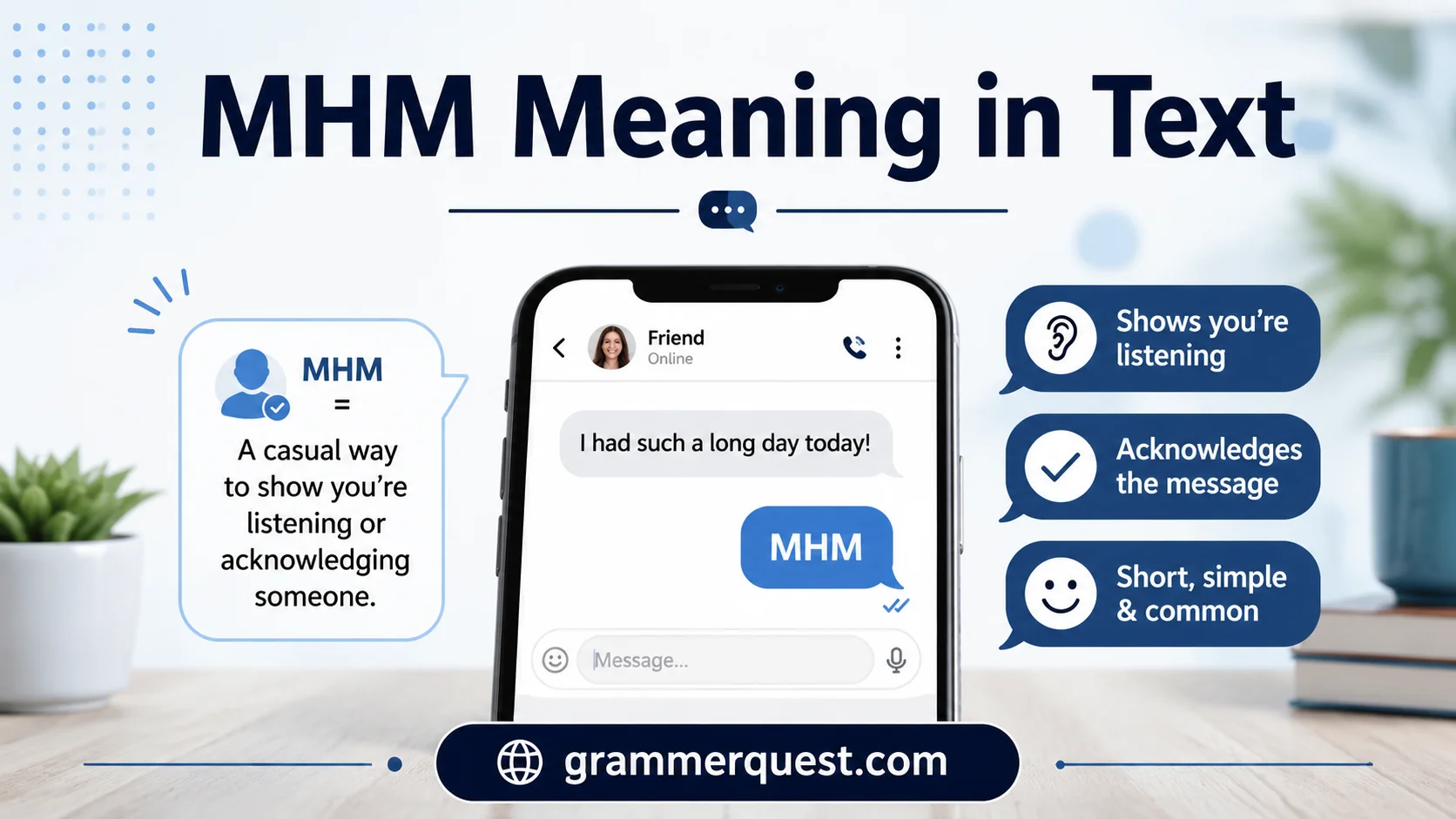
Have you ever received a text that simply says “mhm” and wondered what the person actually meant? It’s only three letters, yet the message can carry several different shades of meaning. Depending on the conversation, mhm can mean “yes,” “I agree,” “I understand,” “I’m listening,” or simply “okay.”
Unlike many texting abbreviations, MHM isn’t usually an acronym with a hidden phrase behind each letter. Instead, it represents a conversational sound commonly written as “mm-hmm.” People use it in everyday speech to acknowledge another person, show agreement, or signal that they’re following along.
That’s why understanding MHM meaning in text requires more than memorizing one definition. The words around it, punctuation, relationship between the people, and even the timing of the reply can change how it feels.
Whether you received “mhm,” “mhm,” “mhm…” or “mhm!”, this guide explains what each version can communicate and how to respond naturally.
Quick Answer: What Does MHM Mean in Text?
MHM usually means “yes,” “yeah,” “I agree,” “okay,” or “I’m listening.”
In casual texting, someone might send mhm to confirm something without writing a complete sentence. It often works like the spoken expression “mm-hmm.”
For example:
Person A: “Are you coming over tonight?”
Person B: “Mhm.”
Here, mhm most likely means “Yes, I’m coming.”
However, context matters. If someone tells you a long story and you reply:
“Mhm, go on.”
the meaning shifts toward “I’m listening” rather than simply “yes.”
So, the simplest definition is:
MHM = yes, agreement, acknowledgment, or attentive listening, depending on context.
Comparison Overview
Although mhm looks simple, it sits alongside several similar expressions. They overlap, but they don’t always create the same impression.
| Text expression | Common meaning | Typical tone | Example |
| Mhm | Yes, okay, I agree, listening | Casual | “Are you ready?” — “Mhm.” |
| Mm-hmm | Yes, agreement, acknowledgment | Conversational | “You understand?” — “Mm-hmm.” |
| Yeah | Yes or agreement | Casual and direct | “Want coffee?” — “Yeah.” |
| Hmm | Thinking, doubt, uncertainty | Reflective | “Hmm, I’m not sure.” |
| Okay | Acceptance or acknowledgment | Neutral | “I’ll call you later.” — “Okay.” |
| Yep | Yes | Informal and direct | “Did you finish?” — “Yep.” |
| Mhm… | Agreement with possible hesitation | Context-dependent | “You’re sure?” — “Mhm…” |
| Mhm!” | Agreement with stronger energy | More enthusiastic | “You like it?” — “Mhm!” |
The important distinction is that mhm often feels more like a conversational response than a formal statement.
For example, “Yes, I understand” sounds explicit. “Mhm” sounds more like a quick nod in written form.
Main Differences Between MHM Meaning in Text
The meaning of MHM meaning in text changes mainly because people use the expression for different conversational purposes.
MHM as “Yes”
The most common interpretation of mhm is yes.
Someone may use it to answer a straightforward question:
“Did you call Sarah?”
“Mhm.”
That response usually means:
“Yes, I called Sarah.”
It saves time while still providing a clear acknowledgment.
MHM as “I Agree”
Sometimes mhm expresses agreement with an opinion rather than answering a factual question.
“That restaurant has the best burgers in town.”
“Mhm.”
Here, the person likely means “I agree.”
The exact strength of that agreement depends on the conversation. A person who wants to show strong enthusiasm might write “Absolutely!” or “Definitely!” instead.
MHM as “I’m Listening”
In conversation, people often make small sounds to show they’re following what someone says. Written mhm can perform a similar job.
“So I got home, opened the door, and guess what?”
“Mhm, what happened?”
In this case, mhm doesn’t necessarily mean “yes.” It signals:
“I’m following you. Keep talking.”
This is an important distinction when interpreting MHM meaning in text.
MHM as “Okay” or “Got It”
A person can also use mhm to acknowledge information.
“The meeting starts at 9 tomorrow.”
“Mhm, got it.”
Here, the expression functions more like “Okay, I understand.”
What Does MHM Mean in a Text Message?
In a text message, mhm usually acts as a short conversational acknowledgment.
You may see it after:
- A yes-or-no question
- A suggestion
- An explanation
- A personal story
- A confirmation
- A statement someone agrees with
- Information they understand
Consider these examples:
Example 1 — Confirmation
“You’re bringing the documents, right?”
“Mhm.”
Meaning: Yes, I’m bringing them.
Example 2 — Agreement
“I think we should leave early.”
“Mhm, that’s probably better.”
Meaning: I agree.
Example 3 — Listening
“Then she told me what happened.”
“Mhm. What did she say?”
Meaning: I’m listening. Continue.
Example 4 — Acknowledgment
“I sent the file to your email.”
“Mhm, I see it.”
Meaning: Okay, I understand or received it.
The surrounding words usually reveal which interpretation makes the most sense.
Is MHM an Acronym?
No, not in its usual texting sense.
Many popular texting terms are acronyms or initialisms. For example, LOL comes from “laughing out loud,” while BRB means “be right back.”
MHM works differently.
It represents a sound commonly written as “mm-hmm.” In spoken English, people use this sound to communicate agreement, acknowledgment, or attention.
You can think of it as a written nod.
When someone says “mhm” during a conversation, they may not be adding new information. Instead, they’re showing that they heard or accepted what you said.
That explains why the expression can be so short while still serving a useful conversational purpose.
Does MHM Mean Yes or No?
Mhm generally means yes or agreement.
It doesn’t normally mean “no.” However, the exact level of agreement can vary.
Compare these responses:
“Yes.”
“Yeah.”
“Mhm.”
“Absolutely!”
All can communicate agreement, but they don’t carry exactly the same energy.
| Response | Likely interpretation |
| Yes. | Clear confirmation |
| Yeah. | Casual agreement |
| Mhm. | Brief agreement or acknowledgment |
| Absolutely! | Strong agreement |
| Mhm… | Possible hesitation |
| No. | Direct disagreement |
If someone asks:
“Do you want pizza?”
and you receive:
“Mhm.”
the natural interpretation is yes.
But if someone asks:
“You’re completely sure about this?”
and receives:
“Mhm…”
the response may feel less confident. The ellipsis introduces uncertainty or hesitation, although context remains essential.
Is MHM Rude or Dry in Texting?
Mhm isn’t automatically rude or dry.
Still, some people perceive it that way because text removes facial expressions, vocal tone, and body language.
Imagine saying “mhm” aloud while smiling and nodding. It can sound warm and encouraging.
Now imagine saying it without looking up during a serious conversation. The same sound might feel dismissive.
Texting creates the same problem.
Why MHM Can Feel Dry
A standalone “mhm” may feel dry when:
- You sent a long emotional message.
- The person repeatedly gives one-word responses.
- They don’t ask anything in return.
- The conversation suddenly becomes much shorter.
- Their normal texting style is usually more expressive.
- The topic requires a thoughtful answer.
For example:
“I’ve been really stressed about everything lately.”
“Mhm.”
That reply could feel unsympathetic.
However, don’t jump to conclusions. The sender could be busy, distracted, unsure what to say, or simply someone who naturally uses short replies.
One message rarely tells the whole story.
What Does MHM Mean From a Girl?
There isn’t a special meaning of mhm that applies to girls as a group.
A girl texting “mhm” may simply mean:
- Yes
- I agree
- I understand
- I’m listening
- Okay
- Continue
If the conversation involves flirting, relationships, conflict, or emotional topics, readers sometimes try to decode mhm as a secret signal.
That’s risky.
For example:
“You look good today.”
“Mhm 😊”
The emoji and broader conversation might suggest warmth or playful agreement.
But:
“Are you still coming at 6?”
“Mhm.”
probably means nothing more mysterious than “yes.”
Context beats stereotypes.
What Does MHM Mean From a Guy?
The same principle applies when a guy sends mhm.
It doesn’t automatically indicate attraction, annoyance, boredom, or disinterest.
He might use it because:
- He agrees with you.
- He’s confirming something.
- He’s listening.
- He’s busy.
- He prefers short replies.
- He doesn’t have anything else to add.
The surrounding conversation provides much stronger evidence than gender.
A Better Way to Interpret MHM
Instead of asking:
“What does mhm mean from a guy?”
ask:
“What was happening in the conversation when he sent it?”
That question usually gets you much closer to the intended meaning.
MHM vs. Hmm: What’s the Difference?
Mhm and hmm look almost identical, but they often perform different jobs.
Mhm usually signals agreement or acknowledgment.
Hmm more often signals thought, uncertainty, curiosity, or doubt.
Compare:
“Do you want to come with us?”
“Mhm.”
Likely meaning: Yes.
Now:
“Do you want to come with us?”
“Hmm.”
Likely meaning: I’m thinking about it.
The difference becomes even clearer with punctuation.
Mhm! → enthusiastic agreement
Mhm. → neutral acknowledgment
Mhm… → possible hesitation
Hmm… → thinking or uncertainty
These aren’t rigid rules. Text has no universal tone dictionary. Still, punctuation gives readers useful clues.
MHM vs. MM-HMM: What’s the Difference?
Mhm and mm-hmm generally represent the same spoken expression.
The main difference involves spelling and style.
“Mm-hmm” more closely resembles the conventional written representation of the spoken sound.
“Mhm” feels shorter and more natural in casual digital communication.
You might see:
“Mm-hmm, I understand.”
in writing that tries to reproduce spoken dialogue.
In a casual text conversation, someone might simply write:
“Mhm.”
Both can communicate acknowledgment or agreement.
MHM vs. Yeah: What’s the Difference?
Both mhm and yeah can mean yes. However, they can create slightly different conversational impressions.
Yeah directly states agreement.
Mhm often feels more like an acknowledgment.
Consider:
“Want to grab lunch?”
“Yeah.”
This sounds like a direct answer.
Now:
“So we’re still meeting at noon?”
“Mhm.”
This feels more like a quick confirmation.
Neither response is inherently warmer or colder. The rest of the exchange determines that.
How Context Changes the Meaning of MHM
Context is the biggest clue when decoding MHM meaning in text.
Look at the Message Before MHM
Ask what the sender is responding to.
If you asked:
“Did you finish the assignment?”
then mhm probably means yes.
If you wrote:
“I can’t believe what happened today.”
then mhm may mean “I’m listening.”
Look at What Comes After MHM
A person who writes:
“Mhm, I agree.”
clearly expresses agreement.
Someone who writes:
“Mhm, tell me more.”
signals active listening.
Someone who sends only:
“Mhm.”
leaves more room for interpretation.
Consider Their Normal Texting Style
If someone routinely responds with “mhm,” “yeah,” “yep,” and other short messages, their brief style probably isn’t personal.
On the other hand, if they normally send detailed messages and suddenly switch to “mhm,” the change may deserve attention.
The contrast matters more than the individual word.
Consider the Topic
A casual conversation can make mhm feel perfectly natural.
A serious conversation changes the stakes.
For example:
“I’m thinking about changing jobs.”
“Mhm.”
This might communicate listening, but it doesn’t tell you whether the person supports the decision.
If the answer matters, ask directly.
Also Read This: HML Meaning in Text
Case Study: Why One “MHM” Can Have Different Meanings
Consider three conversations involving the exact same response.
Case Study 1: Clear Agreement
Alex: “We’re meeting at 8, right?”
Jordan: “Mhm.”
Alex: “Great. See you then.”
Here, mhm almost certainly means yes.
Case Study 2: Active Listening
Alex: “I went to the store and ran into my old teacher.”
Jordan: “Mhm.”
Alex: “Then she asked about my new job.”
Here, mhm works like a conversational nod. Jordan is signaling that the story is being heard.
Case Study 3: Possible Emotional Distance
Alex: “I worked all weekend to finish this project.”
Jordan: “Mhm.”
Alex: “That’s all you have to say?”
Here, Alex interprets the response as dismissive.
But notice something important: the word itself didn’t change. The conversational context did.
That’s why assigning one permanent definition to mhm can lead to misunderstandings.
How to Tell What Someone Means by MHM
When you’re unsure about a text, use this simple checklist.
1. Identify What They Were Responding To
Was it a question?
A statement?
A story?
An emotional disclosure?
The message immediately before mhm often provides the strongest clue.
2. Check Their Follow-Up
A person who says:
“Mhm, and then what happened?”
is clearly engaged.
A person who sends only:
“Mhm.”
provides less information.
3. Compare Their Usual Style
Ask whether the response matches their normal texting habits.
Someone who always writes short messages probably isn’t suddenly angry because they wrote mhm.
4. Examine Punctuation
Punctuation can influence perceived tone.
- Mhm — casual
- Mhm. — potentially more final or neutral
- Mhm… — possibly hesitant
- Mhm! — stronger or more upbeat
- Mhm, yeah. — clear acknowledgment or agreement
These are tendencies, not guaranteed translations.
5. Consider Your Relationship
A close friend may use mhm naturally.
A coworker might use it as a quick acknowledgment.
A romantic partner might use it while listening to a story.
The same word can sound different because the relationship changes the expectations around communication.
How to Reply When Someone Texts MHM
Your response should match the conversation rather than the word alone.
If MHM Means Yes
You can simply continue:
“Perfect. See you at 7.”
Or:
“Great, that works.”
If MHM Means They’re Listening
Keep the story moving:
“So then you won’t believe what happened next…”
You don’t need to stop and analyze the response.
If MHM Seems Cold
Don’t immediately accuse the person of being annoyed.
Try:
“Everything okay?”
Or:
“You seem a little quiet. Is something wrong?”
That opens the door to an honest answer without turning a tiny text into a major argument.
If You Need a Clear Answer
When the issue actually matters, remove the guesswork:
“Just to confirm, is that a yes?”
That’s much more reliable than spending twenty minutes decoding three letters.
When Should You Use MHM in Texting?
Mhm works best in casual, familiar conversations.
It’s useful when you want to:
- Confirm something quickly
- Show agreement
- Acknowledge information
- Let someone know you’re listening
- Keep a relaxed conversation moving
- Respond naturally without writing a full sentence
When a Clearer Response Is Better
Avoid relying on mhm when the message involves something important or potentially confusing.
For example, instead of:
“Mhm.”
you could write:
“Yes, I’ll be there at 3.”
That small increase in clarity can prevent a scheduling mistake.
For professional communication, alternatives often work better:
- Yes, understood.
- That works for me.
- I understand.
- Got it.
- Absolutely.
- I’ll take care of it.
- Thanks, I understand.
A three-letter response has its place. It just isn’t ideal for every situation.
Examples of MHM in Text Conversations
Here are several realistic examples showing how the meaning changes with context.
Example 1: Simple Confirmation
“Are you home?”
“Mhm.”
Meaning: Yes, I’m home.
Example 2: Agreement
“We should probably leave before traffic gets bad.”
“Mhm.”
Meaning: I agree.
Example 3: Listening
“I talked to my manager about the problem.”
“Mhm, what did she say?”
Meaning: I’m listening. Continue.
Example 4: Acknowledgment
“I put the keys on the kitchen counter.”
“Mhm, thanks.”
Meaning: Okay, I understand.
Example 5: Possible Hesitation
“You’re sure you want to do this?”
“Mhm…”
Meaning: Possibly yes, but the person may feel uncertain.
Example 6: Stronger Agreement
“This is the best pizza we’ve had all year.”
“Mhm!”
Meaning: Yes, absolutely.
Again, these interpretations aren’t mathematical formulas. Tone comes from the entire exchange.
Is MHM a Good or Bad Response?
Neither.
Mhm is neutral by itself.
Its effect depends on what you’re responding to and what the other person expects.
| Situation | “Mhm” likely works? | Better alternative if clarity matters |
| Casual yes/no question | Yes | “Yes” |
| Friend telling a story | Yes | “I’m listening” |
| Confirming plans | Usually | “Yes, I’ll be there” |
| Emotional problem | Sometimes | “I understand” |
| Workplace instructions | Not ideal | “Got it” |
| Important decision | Risky | Clear statement of agreement |
| Serious relationship discussion | Often too vague | Explain how you feel |
The key issue isn’t whether mhm is good or bad. It’s whether it communicates enough for the situation.
Common Misunderstandings About MHM
Several assumptions can cause unnecessary confusion.
Myth 1: MHM Always Means “Yes”
Usually, mhm signals agreement or acknowledgment. However, it can also mean “I’m listening” without expressing strong agreement.
Myth 2: MHM Always Sounds Rude
Not true.
Some people use mhm constantly in casual conversations. Others find one-word replies cold.
Personal communication style matters.
Myth 3: MHM Has a Secret Meaning Based on Gender
There isn’t a universal male or female meaning.
A person’s wording, situation, relationship, and communication habits matter much more.
Myth 4: MHM Always Means the Person Is Bored
A short reply doesn’t prove boredom.
The person could be driving, working, multitasking, tired, or simply communicating briefly.
Myth 5: Punctuation Gives MHM One Fixed Meaning
Punctuation can suggest tone, but it doesn’t create an absolute translation.
“Mhm…” may sound hesitant in one conversation and thoughtful in another.
Interesting Facts About MHM
A few details make this tiny expression more interesting than it first appears:
- Mhm is related to the spoken expression “mm-hmm.”
- It commonly functions as a backchannel response, meaning it helps show that someone is listening or following a conversation.
- Mhm doesn’t usually represent an acronym.
- It can communicate agreement without requiring a complete sentence.
- Its meaning depends heavily on context and conversational purpose.
- Mhm, hmm, and mm-hmm can look similar while performing different conversational roles.
- Digital communication strips away vocal tone and facial expression, making short responses more open to interpretation.
- Adding words after mhm often makes the intended meaning clearer.
- A person’s typical texting habits can provide more useful information than the word itself.
- When a response matters, direct clarification is more reliable than guessing at tone.
FAQs:
1. What does MHM mean in text?
MHM usually means “yes,” “mm-hmm,” or “I agree.” It’s commonly used in texting to show acknowledgment or agreement without writing a full response.
2. Is MHM the same as “yes”?
Yes, in many conversations, MHM works like “yes” or “yeah.” However, its exact meaning can depend on the context and tone of the conversation.
3. Is MHM rude in texting?
Not necessarily. MHM is generally casual and harmless, but a very short reply can sometimes sound uninterested or dismissive, depending on the conversation.
4. Can MHM mean “I’m listening”?
Yes. Someone may use MHM to show that they’re listening, following what you’re saying, or acknowledging your message without necessarily agreeing with everything.
5. What is the difference between MHM and MMM?
MHM usually expresses acknowledgment, agreement, or “yes,” while MMM can express appreciation, pleasure, hesitation, or simply a thoughtful reaction. Context determines the intended meaning.
Conclusion:
Understanding MHM meaning in text can help you interpret casual conversations more accurately. Most often, MHM means “yes,” “mm-hmm,” “I agree,” or “I’m listening.” Its meaning can change slightly depending on the situation, punctuation, and relationship between the people texting. When you see MHM in a message, consider the surrounding conversation before deciding exactly what the sender means.

Henry Collins is a passionate grammar expert and the voice behind GrammerQuest.com. With a sharp eye for language and a love for clear communication, he simplifies complex grammar rules into easy, practical lessons.