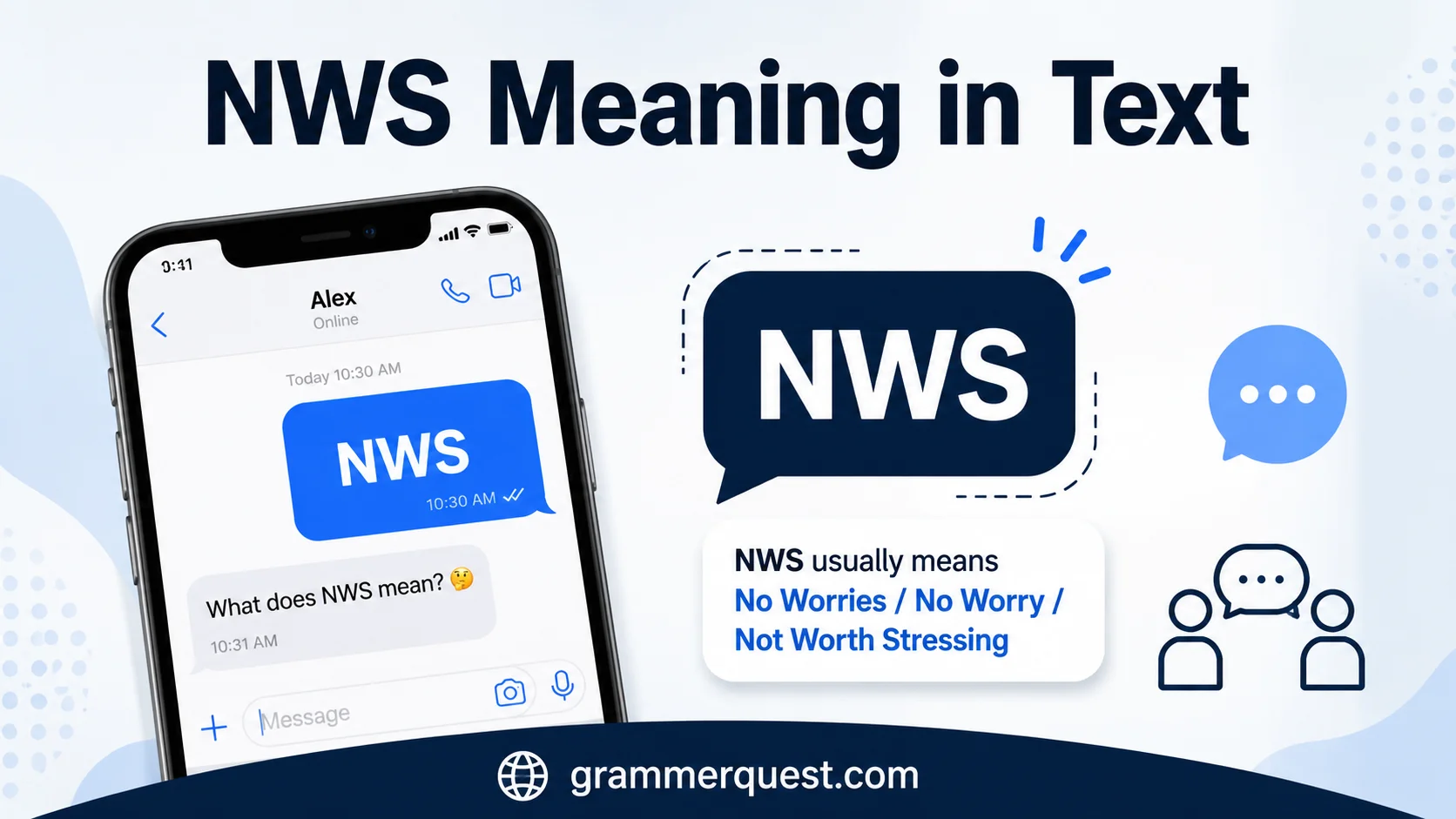
NWS Meaning in Text refers to the meaning and usage of the abbreviation NWS in text messages, chats, and online conversations. In many contexts, NWS can mean different things depending on the conversation, platform, and surrounding words. People often use abbreviations to make messages shorter and faster, especially on social media and messaging apps. Understanding the context is important because the same abbreviation may have more than one meaning in different situations or communities.
In casual texting, abbreviations like NWS can save time and make communication more convenient. However, the meaning may not always be obvious to everyone. Before interpreting NWS, look at the words around it and consider what the sender is discussing. This helps you understand the intended meaning correctly. If you’re unsure, you can simply ask the sender for clarification. Knowing common text abbreviations can make online conversations easier and prevent unnecessary misunderstandings.
Quick Answer
NWS in text can mean “no worries.” In this use, it’s an informal way to tell someone that something isn’t a problem, there’s no need to apologize, or they shouldn’t stress.
For example:
“Sorry I couldn’t call earlier.”
“nws, you’re good.”
Here, NWS = no worries.
However, NWS can also mean “not work safe” when it labels content that may be inappropriate for a workplace or other public setting. This usage overlaps with the much more established NSFW, which means “not safe for work.” Wiktionary currently lists both “no worries” as internet/text-messaging slang and “not work safe” as a computing initialism.
There is another important meaning: NWS = National Weather Service. In weather-related conversations, that is the obvious interpretation. The U.S. government describes the National Weather Service as the agency providing weather, water, and climate forecasts and data.
The easiest rule: look at what NWS is doing in the sentence. A reply usually points toward “no worries,” while a content warning points toward “not work safe.”
Comparison Overview
The meaning of NWS becomes much easier to understand when you compare its major uses side by side.
| NWS meaning | Where you may see it | What it means | Typical tone |
| No worries | Texts, DMs, chats | It’s okay; don’t worry | Casual and reassuring |
| Not work safe | Online posts, links, files, chats | Content may be unsuitable for work or public viewing | Cautionary |
| National Weather Service | Weather reports, forecasts, government information | U.S. federal weather agency | Official |
| Other specialized meanings | Technical or specialized contexts | Depends on the field | Context-dependent |
The important distinction is that these meanings don’t carry equal weight in every situation.
When NWS appears as a short reply after an apology or thank-you, “no worries” makes grammatical and conversational sense. When it appears as a label before questionable online material, “not work safe” makes more sense.
Meanwhile, NWS in a weather discussion isn’t texting slang at all. It refers to the National Weather Service. USA.gov confirms that NWS provides weather, water, and climate forecasts and data.
NWS Meaning in Text at a Glance
Think of NWS as a small sign whose meaning depends on where you find it:
- “Sorry!” → “NWS.” = No worries
- “NWS: open this later.” = Not work safe
- “NWS issued a warning.” = National Weather Service
- “NWS” in a specialized document = Check the surrounding subject
That simple context check can prevent a surprisingly awkward misunderstanding.
Main Differences Between NWS Meaning in Text
The biggest difference between the various NWS meanings in text is their purpose.
“No worries” communicates reassurance. “Not work safe” provides a warning. “National Weather Service” identifies a government agency.
Those aren’t subtle variations. They’re completely different functions.
| Feature | No worries | Not work safe | National Weather Service |
| Main purpose | Reassure someone | Warn about content | Identify an agency |
| Common setting | Texting and DMs | Internet and digital content | Weather and government information |
| Usually informal? | Yes | Yes | No |
| Often appears alone? | Yes | Sometimes | Usually within a sentence or title |
| Related to texting? | Directly | Sometimes | Usually not |
| Typical clue | Comes after thanks/apology | Appears before content | Appears with weather information |
This is why simply memorizing one NWS definition isn’t enough. You need to recognize the role the abbreviation plays.
What Does NWS Mean in Text Messages?
In a casual text conversation, NWS can mean “no worries.”
The phrase “no worries” already works as a friendly response to apologies, requests, mistakes, and expressions of thanks. The abbreviation compresses that phrase into three letters.
For example:
“Sorry, I forgot to send the file.”
“NWS. Send it whenever you can.”
The response doesn’t mean anything mysterious. It simply tells the other person that the mistake isn’t a big deal.
NWS as a Response to an Apology
This is one of the clearest contexts.
Imagine someone texts:
“Sorry I’m running ten minutes late.”
A response such as:
“nws”
can communicate:
- It’s okay.
- Don’t worry about it.
- No problem.
- That’s fine.
The exact emotional shade depends on the relationship. A close friend may use “nws 😂” casually, while another person might prefer the fuller “No worries!”
NWS as a Response to Thanks
The abbreviation can also work as a compact answer to gratitude.
For example:
“Thanks for helping me with that.”
“nws!”
In this context, the sender means that helping wasn’t a burden.
Still, don’t assume every person will recognize the abbreviation. “No worries” is much clearer because it’s a complete, familiar phrase.
Is NWS the Same as “No Problem”?
Not exactly, although the ideas overlap.
“No problem” directly says that something didn’t cause trouble. “No worries” often adds a warmer sense of reassurance.
Compare these:
- “No problem.” → The request didn’t cause difficulty.
- “No worries.” → Don’t stress about it.
- “NWS.” → A shortened, casual version of “no worries.”
The difference is small, but tone matters in texting.
NWS Meaning in Texting: How Context Changes It
Context acts like a decoder ring for abbreviations.
If you see NWS immediately after someone says “sorry,” the “no worries” meaning fits naturally. If NWS appears before a link containing mature or disturbing material, a content-warning meaning becomes more plausible.
Consider these examples:
| Message | Likely meaning |
| “Sorry I missed your call.” — “NWS” | No worries |
| “Thanks for covering for me.” — “NWS” | No worries |
| “NWS — don’t open this at work.” | Not work safe |
| “NWS issued a severe weather warning.” | National Weather Service |
The surrounding words do most of the work.
Look at What Comes Before NWS
If someone says “sorry,” “thanks,” “my bad,” or “I forgot,” a reassuring response is likely.
For example:
“My bad. I sent the wrong screenshot.”
“NWS.”
That conversational structure strongly favors “no worries.”
Look at What Comes After NWS
If NWS comes before a warning such as “don’t open this here” or “save this for later,” you’re probably dealing with a content label.
The structure gives you a clue:
NWS → warning → link/image/video
That’s very different from:
Apology/thanks → NWS
One is reassurance. The other is a caution sign.
NWS Meaning as “Not Work Safe”
Another documented use of NWS is “not work safe.”
This phrase describes digital material that may be inappropriate to view in a workplace or another public or controlled setting. It can refer to content involving explicit material, offensive language, graphic imagery, or other material that someone may not want visible on a work screen.
However, there’s an important distinction here.
NSFW is the established and much more widely recognized abbreviation for “not safe for work.” Merriam-Webster defines NSFW as “not safe for work” or “not suitable for work” and describes it as a warning that online material isn’t appropriate for viewing in many workplaces.
Cambridge Dictionary likewise defines NSFW as an abbreviation for “not safe for work” and places it within internet, email, and texting conventions.
So if someone writes NWS as a content warning, it can be understood as “not work safe.” Yet NSFW is the clearer and more standard form for most readers.
NWS vs. NSFW
| Abbreviation | Full form | Main purpose |
| NWS | Not work safe | Content warning in some online contexts |
| NSFW | Not safe for work | Widely recognized content warning |
| SFW | Safe for work | Indicates content is generally appropriate for work |
Dictionary.com notes that NSFW is used in electronic communication as a warning about content that may be unsuitable for work or public viewing.
That makes NSFW the safer choice when you want your warning to be understood immediately.
NWS Meaning on Social Media
Social media makes abbreviations especially dependent on context.
A person might use NWS in a private message as “no worries.” Someone else might use it as a warning before sharing questionable content. The platform alone doesn’t guarantee the meaning.
NWS on Instagram
In an Instagram DM, “nws” can function as a casual response.
Example:
“Sorry, I accidentally removed you from the group chat.”
“nws 😂”
Here, the tone is relaxed.
If the same letters appear before a link or image, however, the meaning may shift toward a content warning.
NWS on TikTok
TikTok comments and messages often use compressed language, slang, and abbreviations. That doesn’t mean every three-letter abbreviation has one universal definition.
A comment such as:
“nws lol”
may be intended as casual shorthand for “no worries.”
But a phrase such as:
“NWS — watch this later”
suggests a warning about what follows.
NWS on Snapchat
Snapchat’s quick, informal communication style makes short responses natural.
Someone might write:
“nws”
instead of:
“No worries.”
The shorter version saves typing while keeping the conversation relaxed.
NWS on Reddit, Discord, and Group Chats
Online communities add another layer of complexity. A community may use abbreviations that outsiders don’t immediately understand.
That means you shouldn’t treat an unfamiliar abbreviation as universal slang. Read the entire message first.
NWS Meaning in Different Contexts
The best interpretation comes from the topic surrounding the abbreviation.
NWS in Casual Texting
Likely meaning: No worries.
Typical clues include:
- Apologies
- Thank-you messages
- Small mistakes
- Requests for forgiveness
- Friendly conversations
Example:
“Sorry for replying so late.”
“NWS.”
NWS as an Online Content Warning
Possible meaning: Not work safe.
Typical clues include:
- Links
- Images
- Videos
- Memes
- Adult material
- Strong language
- Graphic or disturbing material
In this situation, the abbreviation works like a warning label.
NWS in Weather Conversations
Meaning: National Weather Service.
For example:
“The NWS issued a tornado warning.”
Here, interpreting NWS as “no worries” would obviously make no sense.
The National Weather Service is a U.S. government agency that provides weather, water, and climate forecasts and data.
NWS in Specialized Writing
NWS can also occur as an initialism in specialized fields. Wiktionary lists additional meanings such as nuclear weapons state, North-West Semitic, and New World screwworm.
Those meanings aren’t relevant to ordinary texting unless the conversation specifically concerns one of those subjects.
That’s an important lesson: an acronym’s dictionary possibilities aren’t the same as its likely meaning in every conversation.
Real-World Context Case Studies for NWS
The following examples show how the same three letters can point in completely different directions.
Case Study: An Apology From a Friend
Message:
“Sorry, I forgot to bring your charger.”
Reply:
“nws, I’ll grab it tomorrow.”
Here, NWS means “no worries.”
The response reassures the friend and closes the issue without making it sound serious.
Case Study: A Warning Before a Link
Message:
“NWS — probably don’t open this at work.”
The abbreviation now functions as a content warning.
The second sentence provides the critical clue. The sender isn’t responding to an apology or saying everything is fine. They’re telling the recipient to be careful about viewing whatever comes next.
Case Study: A Weather Discussion
Message:
“NWS says thunderstorms could become severe tonight.”
Here, NWS means National Weather Service.
The words “thunderstorms,” “severe,” and “tonight” establish a weather context. There’s no realistic reason to interpret the abbreviation as “no worries.”
Case Study: A Confusing One-Word Reply
Message:
“Can you send me the notes?”
“NWS.”
This example is ambiguous.
If the sender meant “no worries,” they may be agreeing to help. Yet some readers might not recognize NWS at all.
A clearer reply would be:
“No worries, I’ll send them.”
The extra words remove the guesswork.
Also Read This: HMU Meaning in Text: What Does HMU Mean in Texting?
How to Understand NWS in a Conversation
You don’t need a complicated system. Use these four clues.
Check the Conversation Topic
First, ask what the people are discussing.
If they’re talking about:
- Weather → National Weather Service
- Apologies or thanks → No worries
- Potentially inappropriate content → Not work safe
The subject often solves the puzzle immediately.
Check the Position of NWS
Placement matters.
At the end of a response:
“Thanks!”
“NWS.”
This points toward no worries.
Before a link or image:
“NWS — open later.”
This points toward a content warning.
Inside a weather report:
“NWS forecast…”
This points toward the National Weather Service.
Consider the Sender
A close friend may use casual shorthand without explanation. A meteorologist or weather reporter may use NWS as an official abbreviation.
The sender’s role changes the odds.
Ask When the Meaning Isn’t Clear
If none of the clues settle the meaning, simply ask:
“What does NWS mean here?”
That’s better than confidently choosing the wrong definition.
Is NWS Formal or Informal?
When NWS means “no worries” in texting, it’s clearly informal.
It works well in:
- Text messages
- DMs
- Casual chats
- Friend groups
- Informal online conversations
It’s less suitable for:
- Business proposals
- Academic papers
- Formal reports
- Job applications
- Important customer communications
- Formal workplace emails
Instead of writing:
“NWS, I’ll take care of it.”
a professional message could say:
“No problem. I’ll take care of it.”
Or, when clarity matters:
“That’s fine. I’ll handle it.”
The goal isn’t to eliminate casual language. It’s to match your language to the situation.
Common Mistakes With NWS
Short abbreviations create small communication traps.
Assuming NWS Always Means “No Worries”
That’s the biggest mistake.
If NWS appears in a weather report, National Weather Service is the obvious meaning. If it precedes questionable content, not work safe may fit better.
Assuming NWS Always Means “Not Work Safe”
The reverse mistake happens too.
If someone replies:
“Thanks for helping!”
“nws!”
they’re almost certainly using the abbreviation conversationally rather than warning you about content.
Confusing NWS With NSFW
This confusion is understandable because the letters overlap.
Still, NSFW is the established abbreviation for “not safe for work.” Major dictionaries including Merriam-Webster, Cambridge, and Dictionary.com document that usage.
Using NWS Without Considering Your Audience
Even if you understand the abbreviation, the other person might not.
For important communication, clarity beats cleverness.
NWS vs. Other Common Text Abbreviations
NWS belongs to the broader world of digital shorthand, although its meanings depend more heavily on context than some familiar abbreviations.
| Abbreviation | Meaning | Typical use |
| NWS | No worries | Reassurance |
| NSFW | Not safe for work | Content warning |
| SFW | Safe for work | Content suitability |
| LOL | Laughing out loud | Humor or amusement |
| BRB | Be right back | Temporary absence |
| IDK | I don’t know | Uncertainty |
| TMI | Too much information | Oversharing |
The difference is worth noticing. LOL, BRB, and IDK usually have relatively stable meanings in everyday texting. NWS requires more attention to the surrounding context because it has several established interpretations.
Should You Use NWS in Text Messages?
You can use NWS when you’re confident the other person understands it.
For a close friend, something like this is perfectly casual:
“nws! Don’t worry about it.”
However, if there’s any chance the recipient won’t understand the abbreviation, use “no worries” instead.
Use NWS When:
- You’re chatting with friends.
- The conversation is informal.
- The meaning is obvious from context.
- The other person already uses similar shorthand.
Avoid NWS When:
- You’re writing a formal email.
- You’re communicating an important instruction.
- You’re speaking to an unfamiliar audience.
- The abbreviation could have multiple meanings.
- A misunderstanding could cause problems.
Three letters aren’t worth creating confusion.
How to Respond When Someone Texts NWS
Your response depends on what the sender means.
If NWS means “no worries,” you don’t necessarily need to respond at all. The conversation may naturally move forward.
You could reply:
- “Thanks!”
- “Appreciate it.”
- “Got it.”
- “Cool, thanks.”
- “I appreciate that.”
If NWS appears to mean “not work safe,” treat it as a warning. Don’t open the attached content automatically if you’re in a workplace, classroom, or public setting.
If you’re still unsure, ask:
“Do you mean no worries?”
That’s especially useful when the abbreviation appears as a standalone reply.
FAQs:
1. What does NWS mean in text?
NWS can have different meanings in text depending on the context and conversation. Check the surrounding words to understand what the sender means.
2. Is NWS a common texting abbreviation?
NWS isn’t one of the most common texting abbreviations. Its meaning can vary, so the context is important when interpreting it.
3. Can NWS have multiple meanings?
Yes, NWS can have multiple meanings depending on the platform, topic, or conversation. Always consider how the abbreviation is being used.
4. How can I understand NWS in a message?
Look at the words around NWS and consider the subject of the conversation. If the meaning still isn’t clear, ask the sender for clarification.
5. Should I use NWS in professional messages?
It’s usually better to avoid unclear abbreviations like NWS in professional communication. Use complete words to make your message clear and easy to understand.
Conclusion:
Understanding the NWS meaning in text depends mainly on the context in which it appears. Since abbreviations can have different meanings, don’t assume one definition immediately. Check the surrounding conversation, consider the topic, and ask for clarification when needed. This simple approach can help you understand texting abbreviations accurately and avoid confusion in online conversations.

Henry Collins is a passionate grammar expert and the voice behind GrammerQuest.com. With a sharp eye for language and a love for clear communication, he simplifies complex grammar rules into easy, practical lessons.