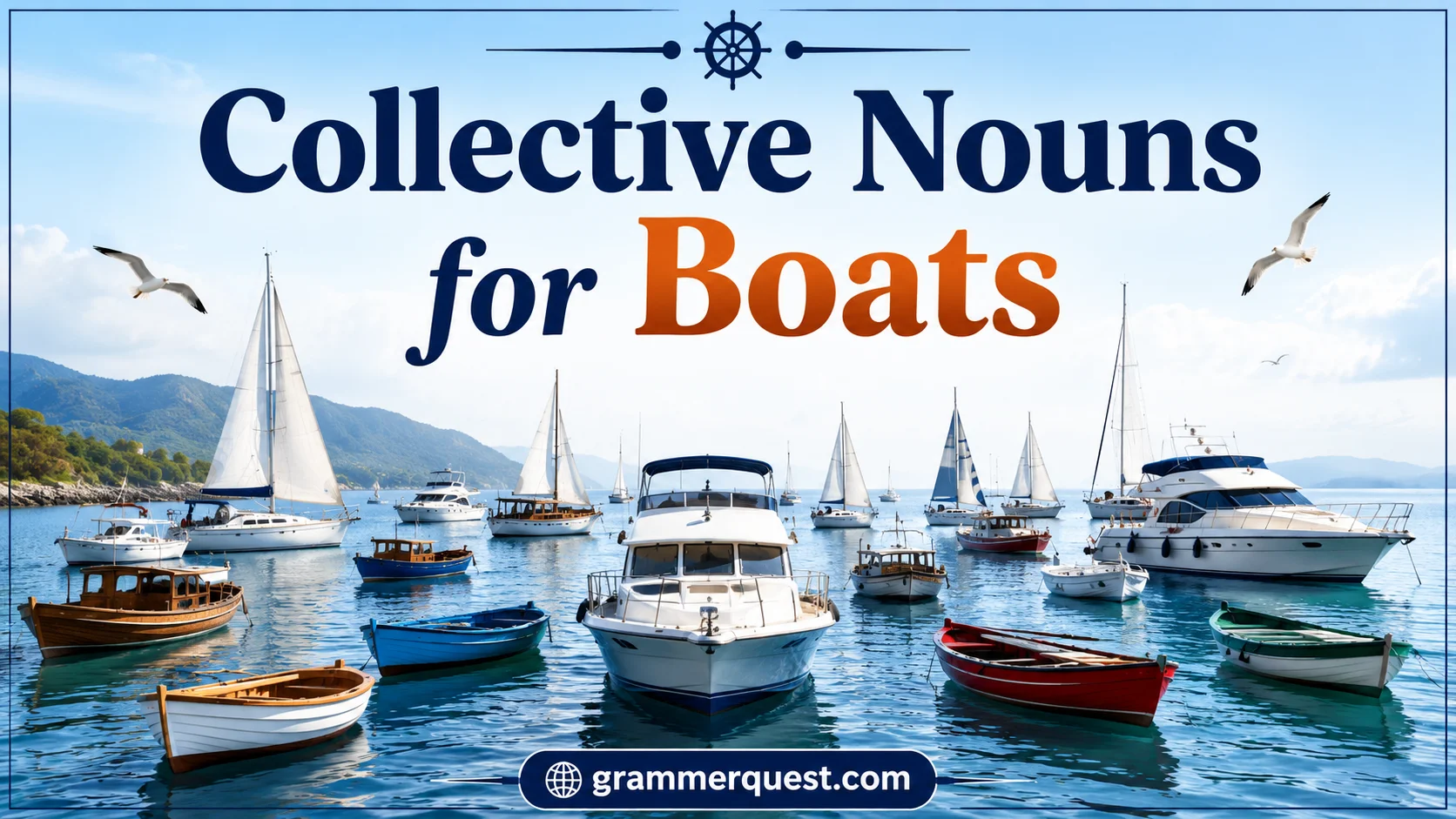
Collective Nouns for Boats are useful when we talk about groups of boats in clear English grammar. They help students, writers, and language learners choose the right collective nouns for boats, ships, and other watercraft. Using these words naturally makes sentences smoother and more professional. It also improves vocabulary, writing, and speaking skills, especially when describing sea life, travel, or marine transport in everyday English. This simple topic is especially helpful for exams, classroom practice, and confident communication everywhere today.
Learning these group nouns is also a fun way to make English more descriptive and memorable. For example, the right term can add precision when talking about a fleet, a convoy, or a collection of boats near the shore. This kind of grammar knowledge is useful for students who want stronger English skills and better confidence. It also makes reading, writing, and speaking feel more natural, especially in lessons about marine vocabulary and everyday communication for learners of all levels.
Collective Nouns for Boats Table
| Type | Simple Example |
| Fleet | A fleet of boats sailed across the bay. |
| Flotilla | A flotilla of boats participated in the festival. |
| Armada | An armada of boats crossed the harbor. |
| Convoy | A convoy of boats traveled together. |
| Squadron | A squadron of boats patrolled the coast. |
Fleet of Boats
A fleet is the most common collective noun used for a group of boats operating together.
Examples of Fleet of Boats
- A fleet of boats waited near the shore.
- The fleet of boats entered the harbor at dawn.
- We watched a fleet of boats sail away.
- The fishing fleet returned with a large catch.
- A fleet of boats lined the riverbank.
- The fleet moved smoothly across the water.
- Tourists admired the fleet of boats.
- The fleet of boats prepared for the race.
- A colorful fleet decorated the marina.
- The fleet sailed despite rough weather.
Flotilla of Boats
A flotilla refers to a small group of boats traveling or operating together.
Examples of Flotilla of Boats
- A flotilla of boats celebrated the holiday.
- The flotilla crossed the lake together.
- We spotted a flotilla near the island.
- The flotilla carried supplies downstream.
- A flotilla of boats filled the harbor.
- The flotilla moved in a straight line.
- Fishermen joined the flotilla early.
- The flotilla created a beautiful sight.
- A flotilla of boats participated in the parade.
- The flotilla anchored for the night.
Armada of Boats
An armada is a large and impressive group of boats or ships.
Examples of Armada of Boats
- An armada of boats gathered offshore.
- The armada moved toward the port.
- We watched an armada sail by.
- The armada filled the horizon.
- A grand armada entered the bay.
- The armada carried hundreds of people.
- Photographers captured the armada.
- The armada traveled through calm waters.
- An armada of boats attended the event.
- The armada created a spectacular view.
Convoy of Boats
A convoy describes boats traveling together for safety or organization.
Examples of Convoy of Boats
- A convoy of boats crossed the river.
- The convoy moved carefully through the channel.
- We followed the convoy from the dock.
- The convoy stayed together during the trip.
- A convoy of boats carried cargo.
- The convoy traveled at the same speed.
- Storm warnings delayed the convoy.
- The convoy reached the harbor safely.
- Several boats formed a convoy.
- The convoy departed before sunrise.
Squadron of Boats
A squadron is often used for a group of military or patrol boats.
Examples of Squadron of Boats
- A squadron of boats guarded the coast.
- The squadron sailed into the harbor.
- We observed the squadron during training.
- The squadron responded quickly.
- A squadron of boats patrolled the waters.
- The squadron worked as a team.
- The squadron completed its mission.
- Several vessels formed a squadron.
- The squadron moved in formation.
- The squadron returned at sunset.
Read More: Collective Nouns for Peaches
Interesting Facts About Boats
Boats have been an important part of human civilization for thousands of years. Archaeological discoveries show that some of the earliest boats were built more than 8,000 years ago, making them one of humanity’s oldest transportation technologies. Modern boats come in many forms, from small fishing vessels and sailboats to luxurious yachts and powerful rescue craft.
One of the most unique features of boats is their ability to float despite carrying heavy loads. This is possible because of buoyancy, a principle that allows a vessel to displace water equal to its weight. Boats are also designed with different hull shapes depending on their purpose, whether for speed, stability, fishing, recreation, or transportation. Unlike animals, boats do not have dietary habits, but they do require fuel, wind power, electricity, or human effort to operate.
FAQs :
1. What are Collective Nouns for Boats?
Collective Nouns for Boats are words used to describe a group of boats together. The most common collective noun is fleet.
2. What is the most common collective noun for boats?
The most widely used collective noun for boats is fleet, especially for groups of ships or boats traveling or working together.
3. Can a group of boats be called a fleet?
Yes, fleet is the standard and most accepted collective noun for a group of boats.
4. Are collective nouns for boats used in everyday English?
Yes, they are commonly used in conversations, books, news reports, and maritime writing.
5. What is the difference between a boat and a ship?
A boat is generally smaller and can often fit on a ship, while a ship is much larger and designed for long-distance travel.
6. Why should I learn collective nouns?
Learning collective nouns improves your English grammar, vocabulary, and writing skills.
7. Are there other words besides fleet for groups of boats?
Yes. Depending on the context, words like convoy, flotilla, or armada may also be used.
8. Are collective nouns important for students?
Yes, they are important for school assignments, grammar lessons, and competitive exams.
9. How can I remember collective nouns for boats?
Practice using them in sentences, read English books, and review examples regularly to improve your memory.
10. Where are collective nouns for boats commonly used?
They are commonly used in maritime studies, travel writing, history, literature, and everyday English communication.
Conclusion :
Understanding Collective Nouns for Boats helps you use English grammar more accurately and confidently. Whether you use fleet, flotilla, or convoy, knowing the correct collective nouns improves your vocabulary, writing, and speaking skills. Regular practice will make these terms easy to remember and help you communicate more clearly in both academic and everyday situations.

Emma Brooke is a passionate language enthusiast and the voice behind GrammarQuest.com. With a sharp eye for detail and a love for clear communication, she simplifies complex grammar rules into easy, practical lessons. Her goal is to help you write with confidence, clarity, and style—whether you’re a student, professional, or everyday writer.