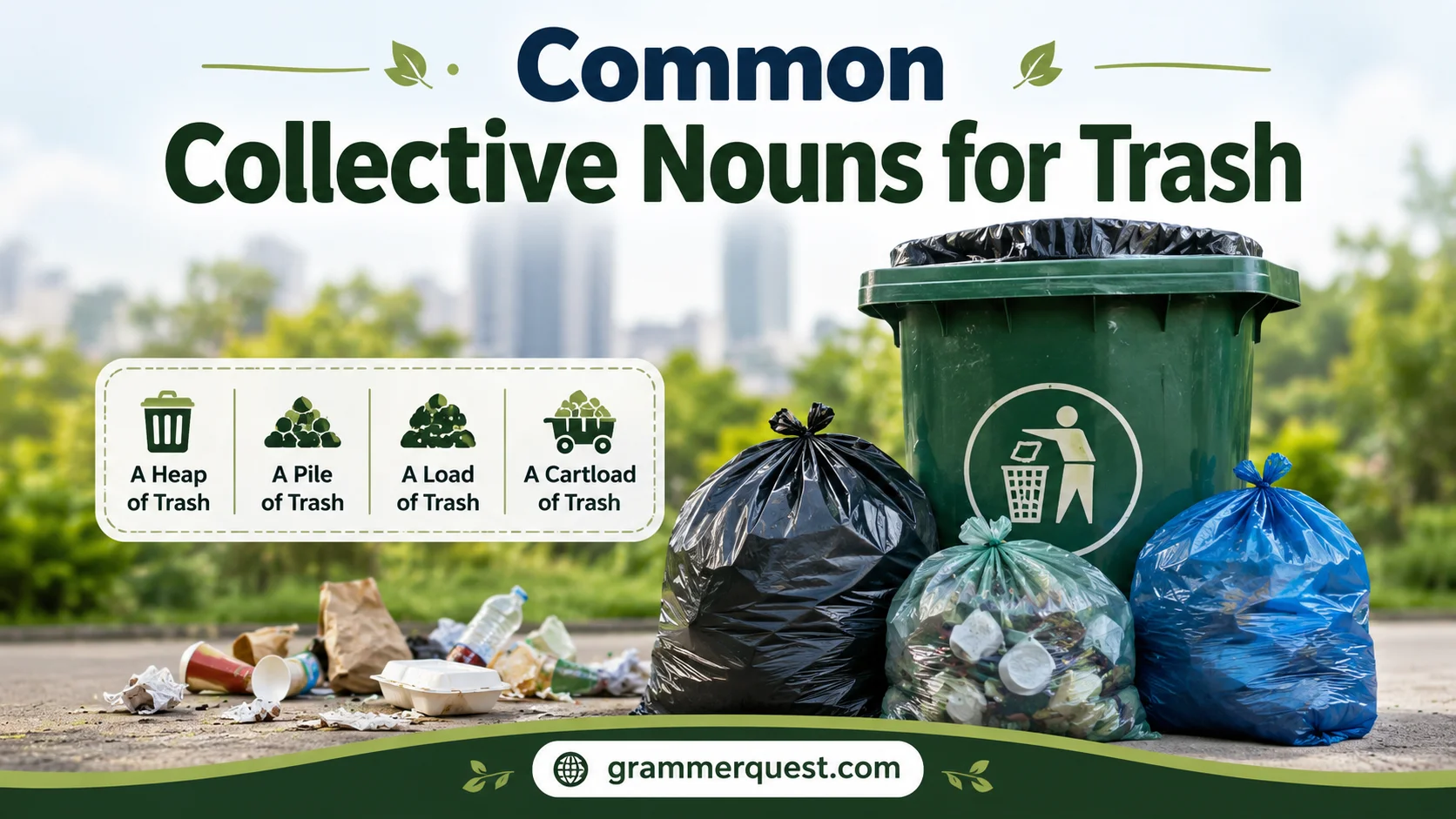
Common Collective Nouns for Trash are useful when you want to describe a group of trash, garbage, rubbish, waste, or litter in natural English. These words may seem similar, but their usage can change across American English and British English. In this guide, we will explore the most common forms, explain their meaning, and show how native speakers use them in daily conversation, school writing, and grammar lessons with easy examples that make the differences simple to understand and remember.
Knowing these collective nouns also helps you speak and write more confidently when talking about objects, cleanup, waste, or everyday language. Some words are more common in AmE, while others are preferred in BrE, so learning the difference can save confusion and make your English sound more natural. Whether you are a student, writer, or grammar learner, this topic gives you a clear way to understand how people group similar words and use them correctly in real life.
Common Collective Nouns for Trash
| Type | Simple Example |
| Heap | a heap of trash |
| Pile | a pile of trash |
| Bag | a bag of trash |
| Bin | a bin of trash |
| Truckload | a truckload of trash |
These words help describe trash in a way that is easy to picture. The right choice depends on where the trash is and how much there is.
Collective Nouns for Trash with Example Sentences
1. Heap of Trash
A heap means a large, untidy pile of trash. It often suggests that the trash is spread out or stacked carelessly.
Example Sentences:
- There was a heap of trash near the corner of the street.
- The workers cleaned up a heap of trash after the festival.
- A heap of trash had collected behind the shop.
- The rain made the heap of trash smell worse.
- Someone left a heap of trash beside the road.
- The garden looked bad because of the heap of trash.
- The cleaning team removed a heap of trash from the yard.
- We saw a heap of trash near the broken fence.
- A heap of trash blocked the narrow path.
- The children noticed a heap of trash in the empty lot.
2. Pile of Trash
A pile is a group of trash items placed on top of each other. It is a very common and natural phrase.
Example Sentences:
- There was a pile of trash outside the classroom.
- The road had a pile of trash after the market closed.
- A pile of trash waited for pickup near the gate.
- The neighbors complained about the pile of trash.
- We saw a pile of trash behind the restaurant.
- The rain soaked the pile of trash on the sidewalk.
- A pile of trash made the area look dirty.
- The janitor removed the pile of trash quickly.
- A pile of trash grew larger every day.
- They burned the pile of trash in the open field.
3. Bag of Trash
A bag is a very practical way to collect trash. It usually refers to trash packed inside a plastic or garbage bag.
Example Sentences:
- Please take the bag of trash outside.
- She tied the bag of trash before throwing it away.
- A bag of trash was left near the door.
- He carried a bag of trash to the bin.
- The dog tore open the bag of trash.
- We filled one bag of trash after cleaning the room.
- The workers lifted a heavy bag of trash into the truck.
- There was a bad smell coming from the bag of trash.
- She forgot to throw away the bag of trash yesterday.
- The cleanup team collected every bag of trash from the park.
4. Bin of Trash
A bin is a container used for holding trash. This phrase is common when talking about waste inside a trash can or garbage bin.
Example Sentences:
- The bin of trash overflowed by the end of the day.
- He emptied the bin of trash into the cart.
- The school keeps a bin of trash near each classroom.
- A bin of trash stood outside the shop.
- The fly landed on the bin of trash.
- She moved the bin of trash away from the door.
- The street cleaner checked the bin of trash every morning.
- We found an old bin of trash near the fence.
- The bin of trash was full after the party.
- Someone forgot to close the bin of trash properly.
5. Truckload of Trash
A truckload means a large amount of trash that can fill a truck. It is used when the quantity is very big.
Example Sentences:
- The city collected a truckload of trash after the event.
- A truckload of trash was removed from the construction site.
- They carried away a truckload of trash from the old house.
- The cleanup drive produced a truckload of trash.
- A truckload of trash arrived at the landfill.
- The workers sorted a truckload of trash into recycling and waste.
- We saw a truckload of trash leaving the market area.
- The storm left a truckload of trash on the roads.
- The team cleared a truckload of trash from the riverbank.
- One truckload of trash was not enough to clean the whole area.
Read More: Collective Nouns for Boats
Interesting Facts About Trash
Trash is more than just unwanted waste. It can take a very long time to break down, depending on the material. For example, some plastic items may remain in the environment for hundreds of years, while food scraps decay much faster. Trash can also release harmful gases in landfills, especially when organic waste decomposes without enough oxygen. Another important fact is that not all trash is useless. Many materials, such as paper, glass, metal, and certain plastics, can be recycled and turned into new products. Trash also affects oceans, rivers, soil, and wildlife, which is why proper disposal is so important. In short, trash may look simple, but it has a big impact on the environment and human health.
FAQs :
1. What are common collective nouns for trash?
Common collective nouns for trash include pile, heap, bag, bin, and load, depending on the situation.
2. Is trash the same as garbage?
In many cases, yes. Trash and garbage are often used for unwanted waste, but usage can vary by region and style.
3. What is the British English word for trash?
In British English, people often say rubbish instead of trash or garbage.
4. What is the difference between trash and litter?
Trash usually means general waste, while litter means waste left in a public place, like on the road or floor.
5. Can waste be used as a collective noun?
Yes, waste can describe unwanted material in a general way, especially in formal writing or environmental topics.
6. What collective noun do we use for a large amount of trash?
A pile or heap of trash is very common when talking about a large amount of waste together.
7. Are collective nouns for trash used in daily English?
Yes, words like pile, bag, and load are used often in daily English when talking about waste.
8. Why should I learn collective nouns for trash?
Learning collective nouns helps you speak and write more naturally, especially when describing groups of objects or waste.
9. Is rubbish used in American English?
It can be understood, but rubbish is more common in British English than in American English.
10. What is the easiest collective noun for trash to remember?
The easiest one is pile, because people often say a pile of trash in everyday English.
Conclusion :
Collective nouns for trash make English clearer and more natural. Words like pile, heap, bag, litter, garbage, rubbish, and waste are useful in different situations, and learning their meanings helps you understand both AmE and BrE better.

George Whitaker is the voice behind GrammarQuest, dedicated to making grammar simple, engaging, and easy to understand. He helps learners turn confusion into confidence with clear explanations and real-world examples.