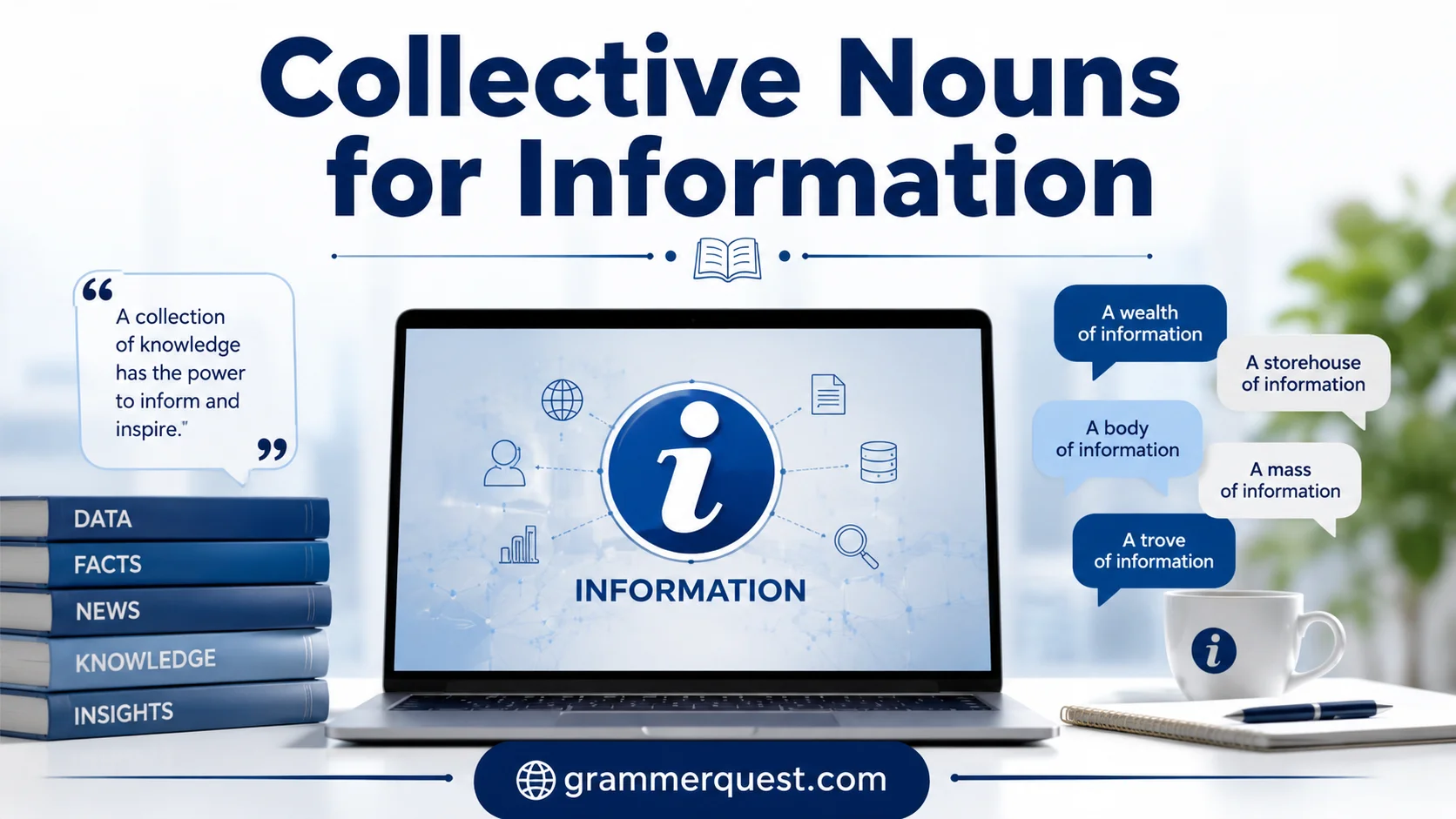
Collective Nouns for Information are useful when you want to describe a group of facts, details, or related ideas in a clear and natural way. In English, a single piece of information is easy to name, but a large set of small facts needs the right collective noun to sound smooth and correct. This is especially helpful when writing about history, learning, research, or any topic where many facts come together as one organized whole.
When you understand collective nouns, it becomes easier to speak and write about information with more confidence and precision. Some groups of facts may be described as a collection, set, batch, or another fitting term depending on the context. In this guide, you will learn the meaning of collective nouns, see simple examples, and discover how to choose the best word for a group of facts. It is a small grammar skill, but it makes your English much stronger.
Common Collective Nouns for Information
Below is a simple table to help you understand the most common collective nouns used with information.
| Type | Simple Example |
| A body of information | The report contains a body of information. |
| A wealth of information | The website offers a wealth of information. |
| A trove of information | The book is a trove of information. |
| A stream of information | We receive a stream of information online. |
| A repository of information | The library is a repository of information. |
Detailed Collective Nouns for Information
A Body of Information
A body of information means a large amount of related facts, details, or knowledge collected together.
Example Sentences:
- The teacher shared a body of information about planets.
- The article contains a body of information on health.
- Scientists studied a body of information before making the report.
- The website gives a body of information about travel.
- The manual includes a body of information for beginners.
- A body of information can help students learn faster.
- The museum has a body of information about ancient history.
- The book presents a body of information in a simple way.
- We found a body of information about local birds.
- The company keeps a body of information for research use.
A Wealth of Information
A wealth of information means a very rich or valuable amount of information.
Example Sentences:
- The library offers a wealth of information to readers.
- The internet gives a wealth of information every day.
- This guide provides a wealth of information for tourists.
- She collected a wealth of information for her project.
- The documentary includes a wealth of information about animals.
- The website is full of a wealth of information on grammar.
- The book gives a wealth of information in one place.
- We learned a wealth of information from the workshop.
- The report contains a wealth of information about climate change.
- A wealth of information is useful for students and teachers.
A Trove of Information
A trove of information means a valuable collection of useful facts, often found in one place.
Example Sentences:
- The archive is a trove of information for researchers.
- The old notebook was a trove of information.
- The website became a trove of information for learners.
- The library holds a trove of information about history.
- This app is a trove of information for travelers.
- The museum is a trove of information about the past.
- Her folder was a trove of information for the class.
- The database contains a trove of information on wildlife.
- The interview gave a trove of information to the public.
- That report is a trove of information for students.
A Stream of Information
A stream of information means a continuous flow of facts, updates, or messages.
Example Sentences:
- We get a stream of information from the news.
- The phone sends a stream of information every minute.
- Social media gives a stream of information all day.
- The radio delivers a stream of information to listeners.
- The website offers a stream of information about jobs.
- Students follow a stream of information during class.
- A stream of information can be helpful when it is clear.
- The app shows a stream of information on the screen.
- Doctors receive a stream of information about the patient.
- The newsroom handles a stream of information quickly.
A Repository of Information
A repository of information means a place where information is stored and kept for use later.
Example Sentences:
- The library is a repository of information.
- The website works as a repository of information for users.
- The school keeps a repository of information for students.
- The archive is a repository of information about old records.
- The database acts as a repository of information for the team.
- The museum is a repository of information about culture.
- The office uses a repository of information for projects.
- The cloud system is a repository of information.
- This file is a repository of information on birds.
- The research center has a repository of information for scient
Read More: Common Collective Nouns for Trash
Interesting Facts About Information
Information is not a living thing, so it does not have a body, diet, or biological traits in the real sense. Still, it has some fascinating qualities. Information can survive for a very long time when it is written down, stored digitally, or passed from person to person. It can also change form without losing its meaning, moving from speech to print, from paper to screen, and from one language to another. Another interesting fact is that information grows stronger when it is organized well, because clear structure makes it easier to understand and remember. In that way, information behaves a little like a living system in language: it spreads, adapts, and stays useful across generations.
FAQs :
1. What are Collective Nouns for Information?
Collective Nouns for Information are words used to describe a group or collection of facts, details, records, or pieces of information.
2. Is there an official collective noun for information?
No, English does not have one official collective noun for information. Common choices include collection, set, body, and bundle, depending on the context.
3. What is the best collective noun for a group of facts?
A collection of facts, set of facts, or body of facts are the most widely accepted and natural expressions.
4. Can I say a bundle of information?
Yes. Bundle of information is commonly used when referring to several related pieces of information shared together.
5. What is the difference between a set and a collection of information?
A set usually refers to a specific group with a purpose, while a collection is a broader term for gathered information.
6. Are collective nouns only used for people and animals?
No. Collective nouns can also describe groups of objects, ideas, documents, facts, and information.
7. Can body of information be used in formal writing?
Yes. Body of information is a formal and professional expression often used in academic and business writing.
8. Why are collective nouns important in English?
They make writing more organized, natural, and concise by referring to many items as a single group.
9. Can different contexts use different collective nouns for information?
Yes. The best term depends on the situation. For example, database, archive, collection, or set may all be suitable in different contexts.
10. How can I improve my use of Collective Nouns for Information?
Practice reading, writing, and using examples in everyday sentences. Learning common grammar patterns will help you choose the most appropriate collective noun.
Conclusion :
Collective Nouns for Information help make English clearer and more organized by allowing you to refer to groups of facts or details with a single term. Although there is no official collective noun for information, words like collection, set, body, and bundle are widely accepted and fit different situations. Understanding these expressions will improve your grammar, strengthen your vocabulary, and make both your writing and speaking more natural and effective.

Henry Collins is a passionate grammar expert and the voice behind GrammerQuest.com. With a sharp eye for language and a love for clear communication, he simplifies complex grammar rules into easy, practical lessons.