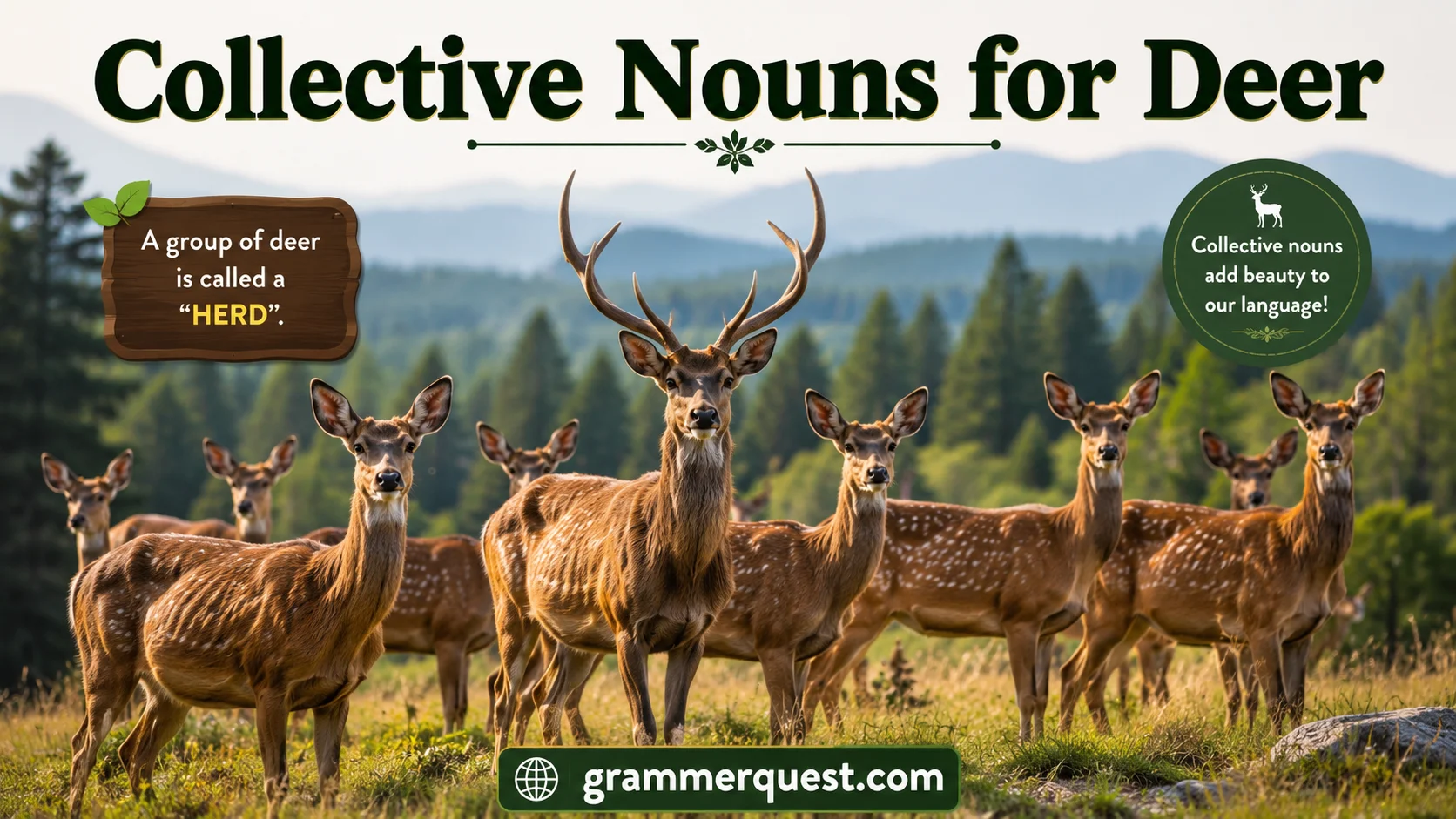
Collective Nouns for Deer help us describe a group of deer using the correct English term. The most common collective noun is a herd, which is widely used in everyday language and wildlife writing. Some historical and literary sources also mention other names, but herd remains the most accurate and accepted term. Learning these collective nouns improves your vocabulary and makes your English more natural and precise.
Deer are graceful animals that often live and travel together for protection and easier access to food. Understanding the collective nouns used for them also reveals the interesting history of the English language and old hunting traditions. Whether you are a student, writer, teacher, or wildlife enthusiast, knowing the correct collective nouns for deer will help you communicate more confidently while making your writing both informative and engaging.
Table of Collective Nouns for Deer
| Collective Noun | Type | Simple Example |
| Herd | Most common | A herd of deer crossed the road. |
| Parcel | Traditional | A parcel of deer rested in the forest. |
| Rangale | Rare | A rangale of deer moved quietly through the woods. |
| Mob | Informal | A mob of deer gathered near the lake. |
| Bevy | Literary | A bevy of deer grazed in the meadow. |
1. Herd of Deer
A herd is the most common and widely accepted collective noun for deer. It refers to a group of deer living, traveling, or feeding together.
Examples
- A herd of deer crossed the field.
- We spotted a herd of deer near the river.
- The herd of deer grazed peacefully.
- A herd of deer ran into the forest.
- The herd stayed together during winter.
- Farmers saw a herd of deer at sunrise.
- A large herd of deer wandered through the valley.
- The herd moved quietly between the trees.
- Tourists photographed a herd of deer.
- Rangers protected the herd from danger.
2. Parcel of Deer
A parcel of deer is a traditional collective noun that appears in older English literature and hunting terminology.
Examples
- A parcel of deer rested beneath the trees.
- We admired a parcel of deer in the meadow.
- The parcel of deer moved silently.
- A parcel of deer searched for fresh grass.
- Hunters once described the group as a parcel of deer.
- The parcel of deer disappeared into the woods.
- A small parcel of deer drank from the stream.
- The parcel stayed together all morning.
- Children watched the parcel of deer carefully.
- A parcel of deer avoided the noisy road.
3. Rangale of Deer
Rangale is a rare and old-fashioned collective noun for deer that is seldom used in modern English.
Examples
- A rangale of deer appeared at dawn.
- The rangale of deer crossed the open field.
- We observed a rangale of deer from a distance.
- A rangale of deer hid among the bushes.
- The rangale moved together quietly.
- A rangale of deer explored the forest.
- The rangale stopped near the pond.
- Photographers captured a rangale of deer.
- The rangale disappeared into thick trees.
- A rangale of deer looked alert.
4. Mob of Deer
A mob of deer is an informal collective noun sometimes used for a loosely gathered group.
Examples
- A mob of deer entered the meadow.
- We noticed a mob of deer near the hill.
- The mob of deer scattered after hearing a sound.
- A mob of deer grazed together.
- The mob crossed the road carefully.
- A mob of deer rested in the shade.
- Rangers monitored the mob of deer.
- The mob wandered through the forest.
- A mob of deer gathered around the water.
- The mob disappeared before sunset.
5. Bevy of Deer
A bevy is a literary collective noun that is occasionally used to describe a graceful gathering of deer.
Examples
- A bevy of deer grazed in the valley.
- We saw a bevy of deer at sunrise.
- The bevy of deer moved gracefully.
- A bevy of deer stood near the lake.
- The bevy disappeared into the woods.
- A bevy of deer searched for food.
- The bevy rested beneath tall trees.
- A bevy of deer walked across the meadow.
- Visitors admired the bevy from afar.
- The bevy of deer remained calm.
Read More: Collective Nouns for Monkeys
Why Do Deer Live in Groups?
Deer often live in groups because it increases their chances of survival. Living together helps them detect predators more quickly, protect young deer, and find food efficiently. During colder months, herds may become larger as deer gather in areas with better shelter and food sources. In the breeding season, group sizes may change as males compete for mates while females stay together with their young.
Interesting Facts About Deer
Deer are among the most adaptable mammals in the world and can be found in forests, grasslands, mountains, wetlands, and even suburban areas. Their lifespan varies depending on the species and habitat. In the wild, many deer live between 6 and 14 years, while some protected individuals can survive for 20 years or more. One of their most remarkable physiological features is their antlers, which are grown and shed annually by most male deer. Antlers are one of the fastest-growing bone structures in the animal kingdom and play an important role during the breeding season. Deer also possess excellent hearing, a powerful sense of smell, and eyes positioned on the sides of their heads, giving them a wide field of vision that helps them detect predators. As herbivores, deer primarily feed on grasses, leaves, twigs, bark, fruits, nuts, and shrubs. Their four-chambered stomach allows them to digest tough plant material efficiently, enabling them to thrive in a wide variety of environments throughout the world.
FAQs:
1. What is the most common collective noun for deer?
The most common collective noun for deer is a herd.
2. Can a group of deer be called a herd?
Yes, herd is the standard and most widely accepted name for a group of deer.
3. Are there other collective nouns for deer?
Yes, historical sources mention terms like mob, parcel, and rangale, but they are rarely used today.
4. Why do deer live in herds?
Deer stay in herds for protection, easier communication, and better chances of finding food.
5. Is “herd” used for all deer species?
Yes, herd is commonly used for most species of deer around the world.
6. Where can you usually find a herd of deer?
A herd of deer is commonly found in forests, grasslands, meadows, and woodland areas.
7. Why is it useful to learn collective nouns for deer?
Learning collective nouns for deer improves your English vocabulary and writing skills.
8. Are collective nouns for deer used in everyday English?
Yes, herd is frequently used in everyday conversations, books, and wildlife documentaries.
9. Do baby deer stay with the herd?
Yes, young deer, called fawns, usually remain with the herd under the protection of adult deer.
10. What is the difference between a herd and a pack?
A herd refers to animals like deer, while a pack is commonly used for animals such as wolves and dogs.
Conclusion:
Understanding Collective Nouns for Deer makes your English more accurate and enjoyable. While herd is the most common and accepted term, older names like mob, parcel, and rangale add historical interest to the language. Whether you’re studying English, writing about wildlife, or simply curious about nature, knowing the correct collective noun helps you communicate with confidence and appreciation for the richness of the English language.

Emma Brooke is a passionate language enthusiast and the voice behind GrammarQuest.com. With a sharp eye for detail and a love for clear communication, she simplifies complex grammar rules into easy, practical lessons. Her goal is to help you write with confidence, clarity, and style—whether you’re a student, professional, or everyday writer.