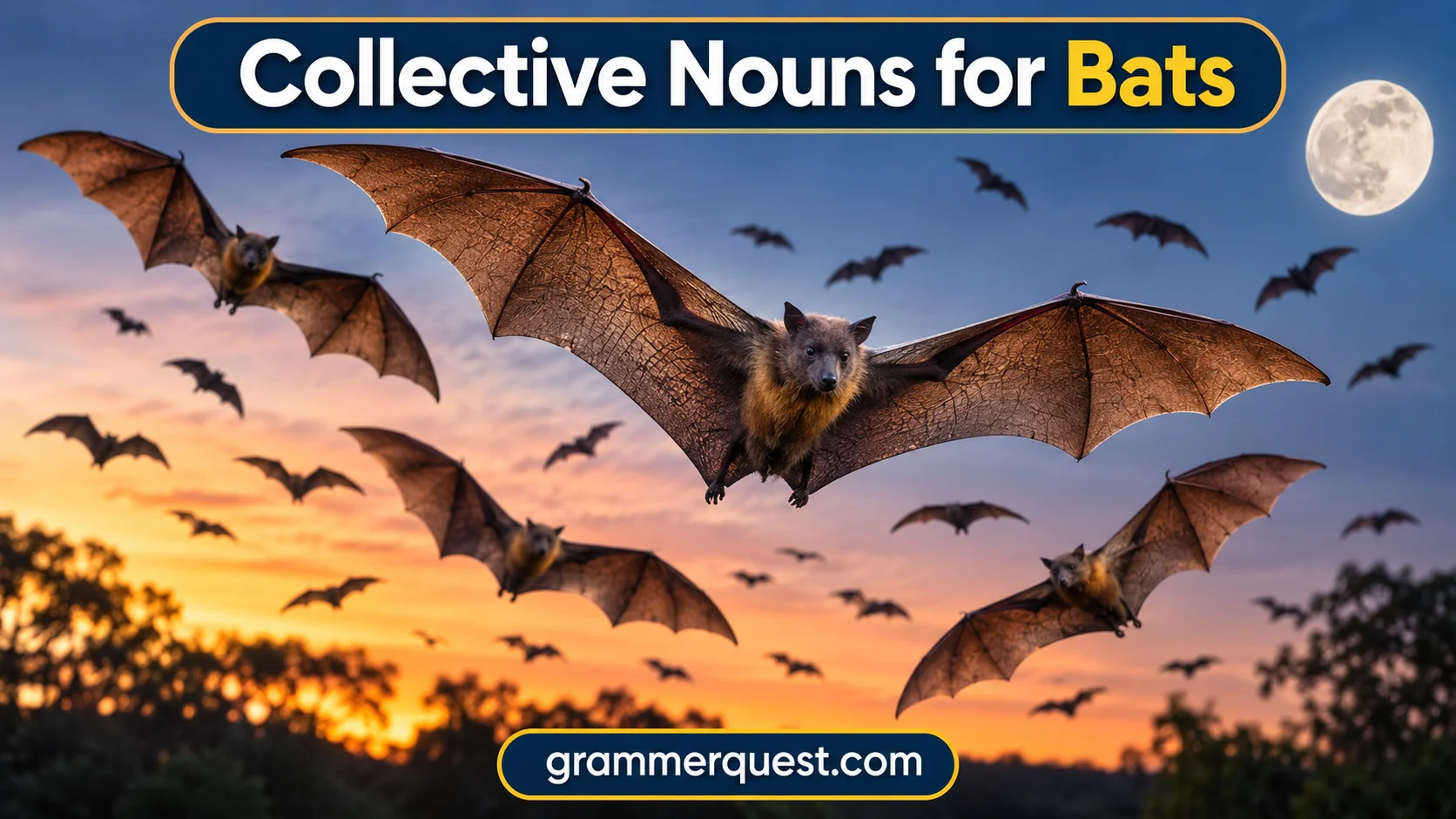
Collective Nouns for Bats help us understand the special names used for a group of bats in English. The most common collective noun is a colony, although cloud and cauldron are also recognized in some contexts. Learning these collective nouns improves your vocabulary and makes it easier to describe bats correctly in writing, education, and everyday conversations while appreciating their fascinating social behavior.
Bats are the only mammals capable of true flight and are well known for using echolocation to navigate and hunt in darkness. They often live together in large colonies, ranging from just two bats to thousands inside caves or trees. While some traditional collective nouns come from historical English, colony remains the most widely accepted and commonly used term. Understanding these unique expressions makes learning English both enjoyable and informative.
Common Collective Nouns for Bats
| Collective Noun | Type | Simple Example |
| Cauldron | Most common | A cauldron of bats flew out of the cave. |
| Colony | Scientific/Biological | A colony of bats lives in the old barn. |
| Camp | Traditional | A camp of bats rested in the trees. |
| Cloud | Descriptive | A cloud of bats filled the evening sky. |
| Swarm | Descriptive | A swarm of bats searched for insects. |
Cauldron of Bats
A cauldron is the most widely recognized collective noun for bats. It creates an image of hundreds of bats swirling through the air, especially at dusk when they leave their roosts.
Examples
- A cauldron of bats emerged from the cave at sunset.
- We watched a cauldron of bats flying overhead.
- The cauldron of bats disappeared into the dark sky.
- Tourists photographed a cauldron of bats.
- A large cauldron of bats circled above the trees.
- The cauldron of bats hunted insects all night.
- Children admired the cauldron of bats from a safe distance.
- A noisy cauldron of bats left the old tunnel.
- Rangers protected the cauldron of bats living nearby.
- Every evening, a cauldron of bats filled the air.
Colony of Bats
A colony refers to a group of bats living together in one location, such as caves, mines, hollow trees, or buildings. This is the preferred scientific term.
Examples
- A colony of bats lives inside the cave.
- Scientists studied the colony of bats.
- The colony of bats grew larger each year.
- Farmers welcomed the colony of bats.
- A healthy colony of bats helps control insects.
- The colony of bats rested during the day.
- We found a colony of bats under the bridge.
- The colony of bats returned every spring.
- The colony of bats stayed quiet until sunset.
- Wildlife experts protected the colony of bats.
Camp of Bats
The term camp is a traditional but less commonly used collective noun for bats. It usually refers to bats resting together during daylight hours.
Examples
- A camp of bats slept in the trees.
- We discovered a camp of bats nearby.
- The camp of bats remained silent all day.
- Rangers observed the camp of bats carefully.
- A camp of bats rested in the forest.
- The camp of bats woke after sunset.
- Visitors avoided disturbing the camp of bats.
- The camp of bats moved to another tree.
- A peaceful camp of bats hung upside down.
- The camp of bats left before nightfall.
Cloud of Bats
The phrase cloud of bats is descriptive and is often used when many bats fly together, creating the appearance of a moving cloud.
Examples
- A cloud of bats filled the evening sky.
- We watched a cloud of bats from the hill.
- The cloud of bats flew over the river.
- A dark cloud of bats amazed the visitors.
- The cloud of bats hunted insects together.
- A cloud of bats appeared after sunset.
- The cloud of bats disappeared into the forest.
- Everyone admired the cloud of bats.
- The cloud of bats moved quickly across the sky.
- A cloud of bats created a beautiful sight.
Swarm of Bats
A swarm of bats emphasizes a large number of bats flying closely together, especially while feeding.
Examples
- A swarm of bats chased insects.
- We saw a swarm of bats at dusk.
- The swarm of bats flew above the lake.
- A swarm of bats entered the cave.
- The swarm of bats moved silently.
- Farmers appreciated the swarm of bats.
- A swarm of bats searched for food.
- The swarm of bats returned before dawn.
- A swarm of bats circled the forest.
- The swarm of bats disappeared into the darkness.
Read More: Collective Nouns for Deer
Interesting Facts About Bats
Bats Are Surprisingly Long-Lived
Although bats are small mammals, many species live much longer than other mammals of similar size. While mice often survive only a few years, some bats can live for over 30 years, and a few species have been recorded living more than 40 years in the wild. Their long lifespan makes them unique among small mammals.
They Are the Only Mammals Capable of True Flight
Unlike flying squirrels, which glide from tree to tree, bats are the only mammals capable of sustained powered flight. Their wings are formed from thin membranes stretched over elongated finger bones, allowing them to fly with incredible agility and precision.
Echolocation Helps Them Navigate
Many bats use echolocation, producing high-frequency sounds that bounce off nearby objects. By listening to the returning echoes, bats can detect insects, avoid obstacles, and navigate even in complete darkness. This remarkable biological adaptation makes them expert nighttime hunters.
Their Diet Is Extremely Diverse
Bats have varied diets depending on the species. Most bats feed on insects, making them valuable natural pest controllers. Others eat fruit, nectar, pollen, fish, frogs, or small animals. Only three known species feed on blood, and these vampire bats are found exclusively in Central and South America. Their diverse feeding habits make bats important contributors to pollination, seed dispersal, and ecosystem balance.
Bats Benefit Both Nature and Agriculture
By consuming enormous numbers of insects each night, bats reduce agricultural pests naturally. Fruit- and nectar-feeding bats also pollinate flowers and spread seeds, helping forests regenerate and supporting biodiversity around the world.
Why Learning Collective Nouns for Bats Matters
Understanding collective nouns for bats enriches both your English vocabulary and your knowledge of wildlife. These unique expressions help writers, students, and nature enthusiasts describe groups of bats more accurately and creatively. Whether you use cauldron, colony, camp, cloud, or swarm, each term adds a different perspective on how bats gather, live, or fly together.
FAQs:
1. What is the most common collective noun for bats?
The most common collective noun for bats is a colony.
2. Can a group of only two bats be called a colony?
Yes. Even a group of two bats can be called a colony.
3. Are there other collective nouns for bats?
Yes. Besides colony, the terms cloud and cauldron are also used, although they are much less common.
4. Why is “colony” the preferred term?
Colony is widely accepted because bats naturally live and roost together in large social groups.
5. Do all bat species live in colonies?
No. While many species form colonies, some bats live alone or in very small groups.
6. Why are collective nouns for bats important?
They improve English vocabulary and help describe groups of bats more accurately.
7. Are collective nouns like “cloud” and “cauldron” commonly used?
No. These terms are mostly found in literature or historical references, while colony is used in everyday English.
8. What makes bats unique among mammals?
Bats are the only mammals capable of true flight and use echolocation to find food and navigate.
9. Where do bat colonies usually live?
Bat colonies commonly roost in caves, trees, old buildings, bridges, and other sheltered places.
10. Can learning collective nouns improve English skills?
Yes. Learning collective nouns for bats and other animals expands vocabulary and makes speaking and writing more precise.
Conclusion:
Understanding Collective Nouns for Bats helps you use English more accurately while learning interesting facts about these remarkable animals. Although colony is the most common and widely accepted term, cloud and cauldron are also recognized in certain contexts. By learning these collective nouns, you can enrich your vocabulary, communicate with greater confidence, and better appreciate the fascinating social behavior of bats.

George Whitaker is the voice behind GrammarQuest, dedicated to making grammar simple, engaging, and easy to understand. He helps learners turn confusion into confidence with clear explanations and real-world examples.