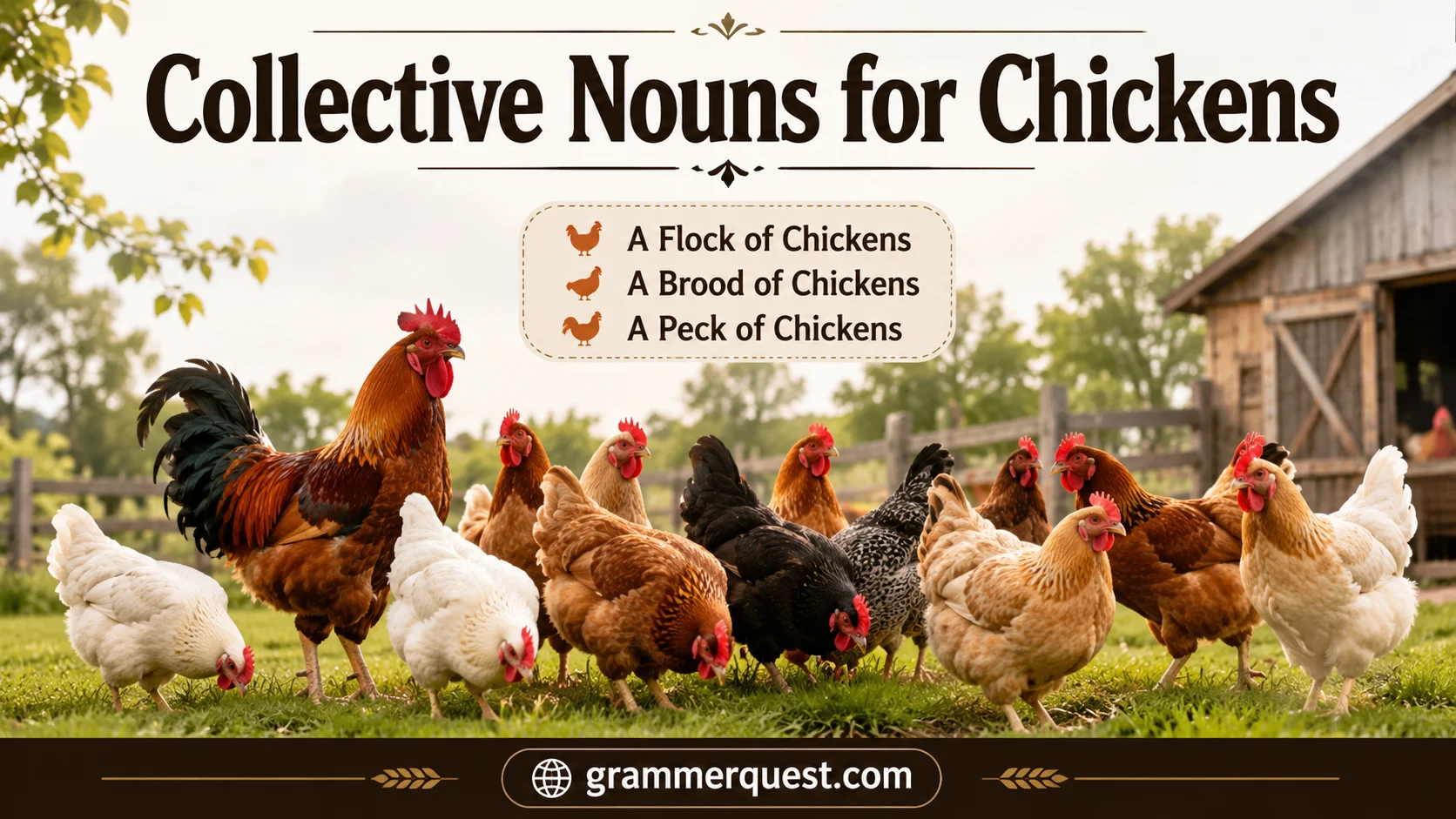
Collective Nouns for Chickens are useful terms that make your English grammar and vocabulary more accurate and engaging. The most common collective noun is flock, which describes a group of chickens gathered together. Learning these special words helps you write with confidence, improve your communication skills, and understand how animal groups are described in everyday English and educational writing.
Knowing Collective Nouns for Chickens can make your speaking and writing sound more natural and polished. Besides flock, you may also encounter words like congregation and flight in specific contexts. By exploring their meanings and using them in simple example sentences, you can strengthen your grammar, enrich your vocabulary, and gain a better understanding of how collective nouns are used correctly in different situations.
Collective Nouns for Chickens
| Collective Noun | Simple Example |
| Brood | A brood of chickens followed the hen. |
| Flock | A flock of chickens searched for food. |
| Peep | A peep of baby chickens chirped loudly. |
| Clutch | A clutch of chickens hatched this morning. |
| Run | A run of chickens wandered around the farm. |
Flock of Chickens
A flock is the most common collective noun used for chickens. It refers to a group of chickens living or moving together.
Example
- A flock of chickens wandered around the farm.
- The flock of chickens gathered near the barn.
- We watched a flock of chickens pecking at seeds.
- The farmer counted his flock every evening.
- A healthy flock of chickens produces many eggs.
- The flock stayed together during the rain.
- Children enjoyed feeding the flock of chickens.
- The flock rested under a large tree.
- Our neighbor owns a colorful flock of chickens.
- The flock quickly returned to the coop before sunset.
Brood of Chickens
A brood usually refers to a mother hen with her chicks or a group of young chickens being cared for.
Example
- A brood of chickens followed their mother.
- The brood stayed close to the hen.
- We admired the tiny brood in the yard.
- The brood chirped happily all morning.
- A brood of chickens explored the garden.
- The farmer protected the brood from predators.
- The brood rested beneath the hen’s wings.
- Everyone loved watching the playful brood.
- The brood learned to search for food.
- A healthy brood grew quickly on the farm.
Peep of Chickens
A peep refers to a group of newly hatched chicks, named after the soft “peeping” sounds they make.
Example
- A peep of chickens filled the barn with cheerful sounds.
- The peep stayed warm under the heat lamp.
- We saw a peep of chicks learning to walk.
- The peep followed the mother hen everywhere.
- A peep of chickens chirped all day.
- The farmer carefully fed the peep.
- The peep rested together after eating.
- Children smiled at the tiny peep.
- The peep explored the grassy field.
- A healthy peep quickly became stronger.
Clutch of Chickens
A clutch usually refers to a group of eggs laid by a hen or the chicks that hatch from those eggs.
Example
- The hen protected her clutch carefully.
- A clutch of chickens hatched yesterday.
- The farmer checked the clutch every morning.
- The clutch remained warm under the hen.
- We counted every egg in the clutch.
- The clutch produced healthy chicks.
- The children watched the clutch hatch.
- A clutch of young chickens stayed together.
- The clutch grew stronger each day.
- The hen proudly cared for her clutch.
Run of Chickens
A run refers to chickens kept together in a fenced outdoor area where they can roam safely.
Example
- A run of chickens enjoyed the sunshine.
- The run of chickens scratched the ground.
- The farmer cleaned the run every week.
- The run stayed secure from foxes.
- Children visited the run after school.
- The chickens happily explored the run.
- We built a larger run for the birds.
- The run contained several colorful chickens.
- The chickens rested inside the run.
- A clean run keeps chickens healthy.
Read More: Collective Nouns for Bats
Interesting Facts About Chickens
Chickens Can Live for Many Years
Although many domestic chickens are raised for eggs or meat, a well-cared-for pet chicken can live between 5 and 10 years, with some reaching 12 years or more. Their lifespan depends on breed, nutrition, health care, and living conditions. Heritage breeds often live longer than commercial egg-laying breeds.
Chickens Have Amazing Physiological Features
Chickens possess several fascinating biological traits. They have excellent color vision and can see ultraviolet light, allowing them to notice details invisible to humans. Their comb and wattles help regulate body temperature, especially during hot weather. Chickens also have lightweight bones and a highly efficient digestive system designed for constant foraging. Despite popular myths, they have surprisingly good memories and can recognize dozens of individual chickens and even familiar human faces.
Chickens Are Omnivores
Chickens eat a wide variety of foods. Their diet includes grains, seeds, grasses, insects, worms, fruits, vegetables, and small animals such as lizards or frogs when available. This omnivorous diet provides the protein, vitamins, and minerals they need to stay healthy and produce eggs. On farms, chickens are usually fed balanced poultry feed along with natural foods they find while scratching the ground.
Chickens Have Complex Social Lives
Chickens establish a well-known social hierarchy called the pecking order. Every bird knows its place within the group, which helps reduce conflict and organize access to food, nesting areas, and resting spots. This social structure makes collective nouns like flock especially meaningful because chickens naturally thrive in organized groups.
Chickens Communicate in Many Ways
Chickens use more than two dozen different vocalizations to communicate. They produce distinct sounds to warn of predators, call chicks to food, announce egg-laying, or alert the flock to danger. Their communication is supported by body language such as feather displays, wing movements, and head positions.
FAQs:
1. What is the most common collective noun for chickens?
The most common collective noun for chickens is flock, which refers to a group of chickens together.
2. Can “flock” be used for all types of chickens?
Yes, flock is the standard term for both domestic and free-range chickens.
3. Are there other collective nouns for chickens?
Yes. Besides flock, words like congregation and flight may be used in certain contexts.
4. Why are collective nouns important in English?
Collective nouns make writing and speaking more precise, descriptive, and grammatically correct.
5. Is “flock” used only for chickens?
No. Flock is also commonly used for birds such as sheep, ducks, geese, and other birds depending on the context.
6. What does the word “flock” mean?
A flock means a group of birds or animals gathered or moving together.
7. How can I learn collective nouns more easily?
Practice using them in sentences, read grammar guides, and memorize common examples.
8. Are collective nouns used in everyday English?
Yes, many collective nouns are used regularly in conversations, books, and educational materials.
9. Can collective nouns improve my vocabulary?
Yes, learning collective nouns expands your English vocabulary and improves your writing skills.
10. What is an example sentence using “flock”?
A flock of chickens wandered around the farm searching for food.
Conclusion:
Understanding Collective Nouns for Chickens helps improve your English grammar, vocabulary, and writing style. While flock is the most widely accepted term, words like congregation and flight may appear in specific situations. By learning these collective nouns and practicing them in everyday sentences, you can communicate more clearly and confidently while making your English richer and more descriptive.

Henry Collins is a passionate grammar expert and the voice behind GrammerQuest.com. With a sharp eye for language and a love for clear communication, he simplifies complex grammar rules into easy, practical lessons.