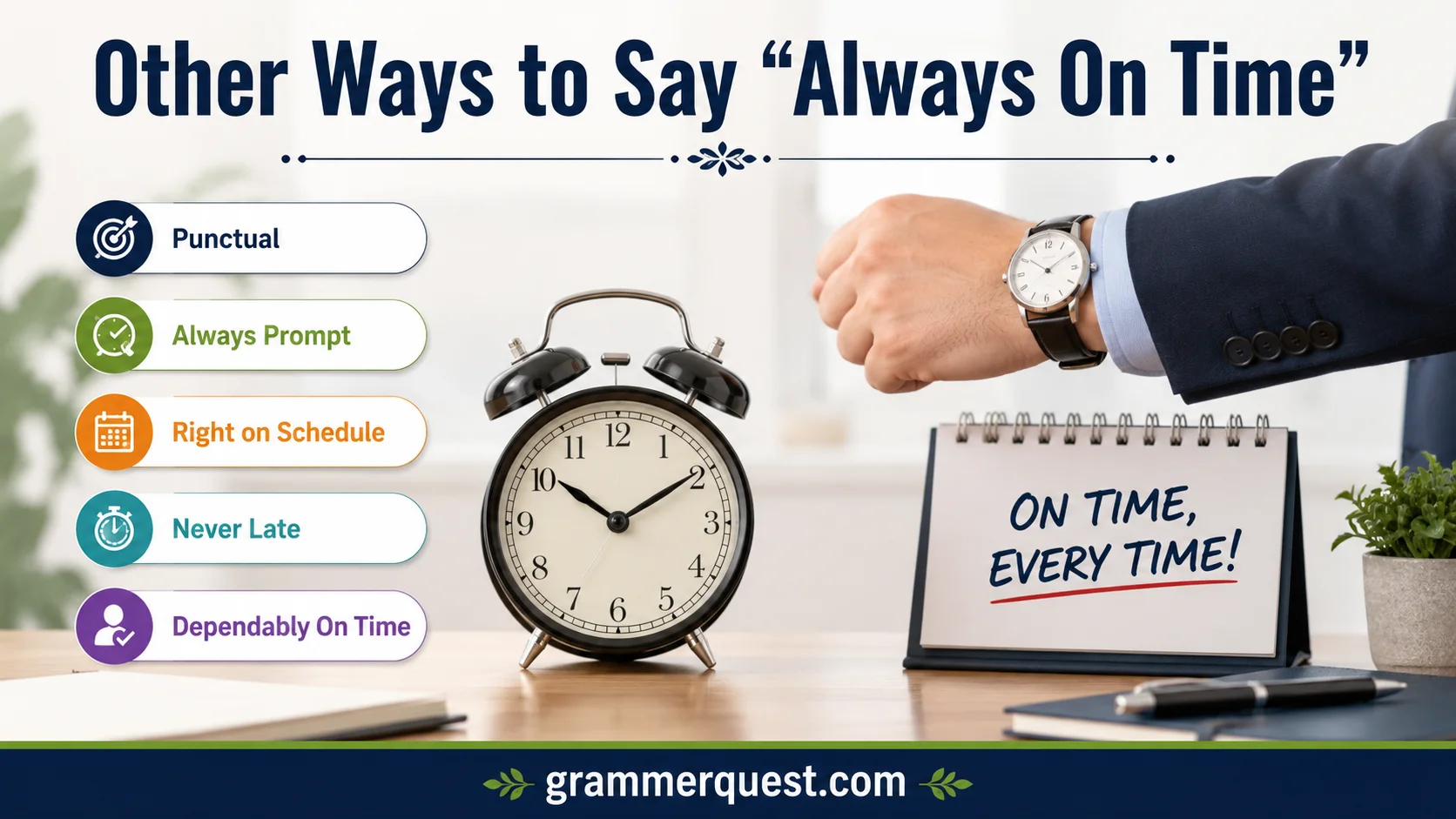
Other Ways to Say “Always On Time” (With Examples) helps you improve your vocabulary by using professional, natural, and polished alternatives instead of repeating always on time. Words like punctual, prompt, timely, time-conscious, dependable, and reliable make your communication stronger. Choosing the right expression also creates a better professional image in writing, emails, interviews, and everyday conversations.
Using the right words shows professionalism, reliability, and good time management in every situation. A punctual person who meets every deadline and follows a proper schedule leaves a strong first impression. These synonyms, expressions, and examples help you sound more professional, improve communication skills, increase communication confidence, and boost productivity while making your language more clear and effective.
Did You Know About Always on Time?
Punctuality is valued in many cultures because it reflects reliability and consideration. In professional settings, being always on time can improve your reputation, build confidence, and make people more comfortable depending on you.
The phrase also goes beyond clocks and schedules. It can describe someone who is consistent, dependable, and predictable in a good way. That is why writers, teachers, managers, and everyday speakers often look for different ways to express the same idea with more style and accuracy.
What does “Always on Time” mean?
“Always on time” means arriving, responding, or completing tasks exactly when expected, or very close to the expected time. It is a simple phrase, but it carries a strong message about discipline and respect for others.
In broader use, it can also mean being consistently dependable. For example, a person may always arrive on time for meetings, or a service may always deliver on time. In both cases, the phrase suggests trust, order, and reliability.
Professional or Political Way to Say Always on Time
In professional writing, you may want to sound more refined than simply saying always on time. Good alternatives include punctual, timely, dependable, consistently reliable, and prompt in delivery.
In political or public-facing language, softer and more formal expressions work better. Phrases like shows strong discipline, meets commitments reliably, or demonstrates consistent punctuality sound polished, respectful, and suitable for speeches, reports, or official statements.
“Always On Time” Synonyms
1. Punctual
2. Prompt
3. Timely
4. Reliable
5. Dependable
6. On Schedule
7. On Time
8. Right on Time
9. Exact
10. Consistent
11. Reliable with Time
12. Well-Timed
13. Prepared and Punctual
14. Never Late
15. Strictly on Time
16. Dead on Time
17. Prompt and Professional
18. Time-Conscious
19. Highly Dependable
20. Always Reliable
21. Never Misses a Beat
22. Always Prepared
23. Faithful to Time
24. Clockwork Reliable
25. Always There When Needed
1. Punctual
Definition: Being punctual means arriving or completing something at the expected time. It is one of the most direct and professional alternatives to always on time.
Meanings: It shows discipline, reliability, and respect for schedules. It is often used in formal, academic, and workplace settings.
Example: She is punctual for every meeting and never keeps the team waiting.
Detailed Explanation: Punctual is a classic word that works in almost any formal situation. It is simple, clear, and widely understood. People use it when they want to emphasize good timing without sounding too emotional or casual. It is especially useful in resumes, reports, and workplace conversations. If you want to describe someone who respects time, punctual is one of the strongest choices.
Tone: Formal, professional, respectful.
Best use: Workplaces, school, business communication, evaluations.
2. Prompt
Definition: Prompt means quick and on time in action or response. It focuses on speed and timely behavior.
Meanings: It suggests that someone does not delay and responds exactly when needed.
Example: His prompt arrival helped the meeting begin smoothly.
Detailed Explanation: Prompt is often used when timing matters in both action and response. It can describe a person, a reply, a payment, or a service. Compared to punctual, prompt feels a little more active and efficient. It is a great word when you want to highlight speed plus reliability. In customer service and business writing, it sounds especially strong.
Tone: Professional, efficient, clear.
Best use: Emails, service descriptions, formal writing.
3. Timely
Definition: Timely means happening at the right time. It does not only mean punctual arrival, but also good timing.
Meanings: It suggests something is useful because it happens when it is most needed.
Example: Her timely support made a difficult situation much easier.
Detailed Explanation: Timely is a flexible word that works well in both personal and professional contexts. It can describe help, advice, delivery, decisions, or arrivals. It gives a sense of good judgment and perfect timing. Unlike some other words, timely can suggest that something is not just on schedule, but also appropriate for the moment. That makes it valuable in writing, speeches, and formal communication.
Tone: Balanced, professional, thoughtful.
Best use: Reports, speeches, business writing, advice.
4. Reliable
Definition: Reliable means consistently trustworthy and dependable. A reliable person or service can be counted on to show up or perform as expected.
Meanings: It suggests steady behavior, strong character, and consistency.
Example: He is reliable and always arrives when he says he will.
Detailed Explanation: Reliable is broader than punctual, but it often includes punctual behavior. It is ideal when you want to talk about trust over time, not just one moment. A reliable person usually keeps promises, meets deadlines, and handles responsibilities well. This word is excellent for describing coworkers, friends, drivers, service providers, or anyone whose consistency matters. It sounds honest and strong without being too formal.
Tone: Trustworthy, warm, professional.
Best use: References, recommendations, personal profiles.
5. Dependable
Definition: Dependable means someone can be counted on to do what is expected. It includes punctuality, but also consistency and responsibility.
Meanings: It shows that a person is steady, responsible, and safe to rely on.
Example: She is dependable and never misses an important appointment.
Detailed Explanation: Dependable is a very human word because it focuses on trust and consistency. It works well when describing people who are emotionally or practically reliable. In workplace language, it suggests strong work habits. In personal writing, it can show deep appreciation for someone who keeps showing up. It is one of the best alternatives when you want to sound sincere rather than overly formal.
Tone: Warm, respectful, dependable.
Best use: Personal descriptions, reviews, references, relationships.
6. On schedule
Definition: On schedule means something is happening according to the planned time. It is a practical and neutral phrase.
Meanings: It suggests progress is controlled, organized, and not delayed.
Example: The project is on schedule and moving exactly as planned.
Detailed Explanation: This phrase is especially useful for projects, events, and deliveries. It sounds organized and clear, and it works well in reports or updates. While it is not as personal as punctual, it is very effective in business communication. It tells people that things are moving according to plan without unnecessary detail. This makes it a clean and professional option.
Tone: Neutral, organized, professional.
Best use: Project updates, logistics, schedules, planning.
7. On time
Definition: On time means arriving or finishing at the expected time. It is the simplest and most common way to express punctuality.
Meanings: It shows respect for the schedule and for other people’s time.
Example: He is always on time for class and meetings.
Detailed Explanation: Even though it is simple, on time remains one of the most effective expressions in English. It is easy to understand and works in nearly every situation. You can use it in casual speech, formal writing, or everyday conversation. Sometimes the best choice is the most direct one. This phrase is especially useful when clarity matters more than style.
Tone: Plain, natural, versatile.
Best use: Everyday speech, basic writing, casual conversation.
8. Right on time
Definition: Right on time means arriving exactly when expected. It adds a little emphasis to the idea of punctuality.
Meanings: It gives the sense of precision and perfect timing.
Example: You arrived right on time for dinner.
Detailed Explanation: This phrase sounds a bit warmer and more conversational than simply saying on time. It is often used in personal conversations, friendly messages, and casual writing. It can also express pleasant surprise when someone arrives exactly when needed. The phrase feels natural and a little more expressive. It works well when you want to sound friendly and appreciative.
Tone: Casual, warm, friendly.
Best use: Informal speech, messages, personal conversations.
9. Exact
Definition: Exact means precise and perfectly correct in timing. It focuses on accuracy.
Meanings: It suggests there is no delay and no guesswork.
Example: Her exact arrival time was recorded in the system.
Detailed Explanation: Exact is not always used alone to mean always on time, but it can support the idea of precise timing. It works well when you want to sound factual and specific. In technical or official writing, exact timing is often important. This word gives a strong sense of precision and control. It is useful in contexts where details matter more than emotion.
Tone: Precise, formal, factual.
Best use: Records, logistics, technical writing.
10. Consistent
Definition: Consistent means happening in the same good way over and over again. It is about steady behavior and dependable habits.
Meanings: It suggests regularity, discipline, and reliability.
Example: She is consistent and always arrives before the meeting starts.
Detailed Explanation: Consistent is a great word when punctuality is part of a larger pattern of good behavior. It can describe a person who is not only on time once, but on time repeatedly. That makes it especially useful in performance reviews, personal growth discussions, and professional feedback. It sounds stable and mature. People often respect consistency because it builds confidence.
Tone: Professional, steady, dependable.
Best use: Performance reviews, business communication, self-improvement.
11. Reliable with time
Definition: Reliable with time means a person manages time well and can be counted on to respect schedules. It is a descriptive phrase rather than a single-word synonym.
Meanings: It suggests punctual habits and careful time management.
Example: He is reliable with time and never makes others wait.
Detailed Explanation: This phrase is especially useful when you want to sound natural and specific. It is softer than a strict professional label and works well in conversation or character descriptions. It communicates more than just arrival time because it hints at time awareness in general. This makes it useful for social, work, or personal contexts. It is a practical alternative when you want a fuller description.
Tone: Natural, friendly, descriptive.
Best use: Character descriptions, informal writing, recommendations.
12. Well-timed
Definition: Well-timed means happening at a perfect or useful moment. It focuses on good timing more than strict punctuality.
Meanings: It suggests an action or arrival happened exactly when needed.
Example: Her well-timed call solved the problem before it got worse.
Detailed Explanation: Well-timed is ideal when you want to describe an event or action that fits the moment beautifully. It is slightly more elegant than simple punctuality. While it does not always mean “arriving on schedule,” it does carry the idea of being exactly where and when needed. This phrase works well in both creative writing and thoughtful conversation. It can sound graceful, smart, and intentional.
Tone: Elegant, thoughtful, balanced.
Best use: Writing, storytelling, appreciative remarks.
13. Prepared and punctual
Definition: Prepared and punctual means ready in advance and arriving on time. It combines readiness with timely behavior.
Meanings: It shows responsibility, discipline, and professionalism.
Example: The team was prepared and punctual for the client presentation.
Detailed Explanation: This phrase is useful when punctuality is part of a larger picture of readiness. It tells people not only that you arrived on time, but also that you came organized and ready to work. That makes it especially effective in business or formal settings. It sounds strong because it reflects both mindset and action. This is a great phrase when you want to sound polished and dependable.
Tone: Formal, professional, disciplined.
Best use: Interviews, presentations, workplace communication.
Read More: Collective Nouns for Chickens
14. Never late
Definition: Never late means a person does not arrive after the expected time. It is direct and easy to understand.
Meanings: It suggests strong habit, discipline, and respect.
Example: My grandmother is never late for family gatherings.
Detailed Explanation: This phrase is simple, clear, and personal. It works especially well in casual speech and storytelling because it feels relatable. It does not sound as formal as punctual, but it is very strong in meaning. You can use it to describe someone’s habit in an easy, memorable way. It is a practical choice when you want to sound natural.
Tone: Casual, simple, direct.
Best use: Everyday speech, storytelling, personal comments.
15. Strictly on time
Definition: Strictly on time means arriving exactly as scheduled, with no delay at all. It is precise and firm.
Meanings: It suggests discipline, seriousness, and respect for rules.
Example: The train runs strictly on time during the morning route.
Detailed Explanation: This phrase sounds stronger than ordinary on time because it adds a sense of precision and discipline. It is often used for transport, formal systems, or people with strict routines. It can also imply high standards. Because of that, it is useful in business, operations, and scheduling. It gives the impression of order and professionalism.
Tone: Strict, formal, disciplined.
Best use: Transport, operations, formal schedules.
16. Dead on time
Definition: Dead on time means exactly on time. It is informal and emphasizes precision.
Meanings: It suggests something happened at the exact expected moment.
Example: He showed up dead on time for the interview.
Detailed Explanation: This phrase sounds more conversational and slightly more emphatic than plain on time. It is common in casual speech and informal writing. Because of the word dead, it carries a strong sense of exactness. It should be used carefully in professional or polite settings. In the right context, it sounds confident and natural.
Tone: Informal, emphatic, casual.
Best use: Friendly conversation, casual writing, spoken English.
17. Prompt and professional
Definition: Prompt and professional means quick, timely, and handled in a polished way. It combines time awareness with good conduct.
Meanings: It suggests a person is efficient, respectful, and organized.
Example: Her prompt and professional response impressed the entire team.
Detailed Explanation: This phrase is ideal for business communication because it adds quality to timing. It does not only say the person was on time, but also that they acted with maturity and care. That makes it useful in reviews, recommendations, and client-facing language. It sounds strong without being too rigid. If you want to praise both behavior and timing, this is a useful option.
Tone: Professional, polished, respectful.
Best use: Work reviews, business praise, formal compliments.
18. Time-conscious
Definition: Time-conscious means aware of time and careful about using it well. It reflects respect for schedules and efficiency.
Meanings: It suggests the person values time and avoids wasting it.
Example: She is time-conscious and plans her day very carefully.
Detailed Explanation: Time-conscious is a modern and practical phrase. It can describe someone who is punctual, organized, and mindful of deadlines. It is especially useful in workplace or productivity writing. The phrase can also suggest a respectful attitude toward other people’s time. It sounds smart and thoughtful, which makes it useful in both formal and semi-formal settings.
Tone: Modern, practical, thoughtful.
Best use: Productivity writing, professional profiles, lifestyle content.
19. Highly dependable
Definition: Highly dependable means very trustworthy and consistent. It shows strong reliability in timing and action.
Meanings: It suggests someone can be trusted to show up and follow through.
Example: He is highly dependable and always keeps his commitments.
Detailed Explanation: This phrase is excellent when you want to strongly praise someone. It feels more detailed than simply dependable, and it carries a positive tone. It is useful for references, employee evaluations, and personal recommendations. The word highly adds emphasis without sounding dramatic. It is a strong choice when punctuality is part of a larger pattern of trustworthiness.
Tone: Warm, respectful, formal.
Best use: Recommendations, evaluations, reference letters.
20. Always reliable
Definition: Always reliable means a person can be counted on every time. It suggests dependable behavior without inconsistency.
Meanings: It shows steady performance, trust, and punctual habits.
Example: My assistant is always reliable and ready when needed.
Detailed Explanation: This phrase is simple but powerful. It combines the idea of consistency with trust, which makes it useful in both personal and professional settings. It works well when you want to praise someone’s character or service. The phrase feels natural and positive. It is especially effective in testimonials, everyday speech, and workplace feedback.
Tone: Positive, stable, appreciative.
Best use: Testimonials, personal praise, workplace appreciation.
21. Never misses a beat
Definition: Never misses a beat means someone stays perfectly in sync and does not fall behind. It can describe punctuality, readiness, and smooth performance.
Meanings: It suggests excellent timing, attention, and consistency.
Example: She never misses a beat and is always ready before the event begins.
Detailed Explanation: This phrase is lively and expressive. It is more figurative than literal, so it is best used in casual or creative writing. It can describe someone who is on time, alert, and effective. Because it sounds vivid, it adds personality to your writing. It is a great choice when you want to sound natural and engaging.
Tone: Creative, casual, lively.
Best use: Storytelling, informal speech, expressive writing.
22. Always prepared
Definition: Always prepared means ready in advance and capable of acting on time. It often includes punctuality as part of readiness.
Meanings: It suggests discipline, organization, and responsibility.
Example: He is always prepared and never arrives empty-handed or late.
Detailed Explanation: Preparedness often goes hand in hand with punctuality. A person who prepares well is more likely to arrive on time, stay calm, and perform well. That makes this phrase useful in education, work, and personal development. It sounds mature and responsible. It is especially good when you want to show that the person is not only on time but also ready for action.
Tone: Responsible, professional, steady.
Best use: School, work, planning, personal character descriptions.
23. Faithful to time
Definition: Faithful to time means loyal to schedules, commitments, and timing. It is a softer, more poetic way to describe punctuality.
Meanings: It suggests respect, consistency, and devotion to order.
Example: She is faithful to time and never breaks her routine.
Detailed Explanation: This phrase feels more literary and graceful than ordinary punctuality. It can work well in spiritual, reflective, or elegant writing. The phrase suggests that the person treats time with respect and care. It can also imply a strong personal value system. Because it sounds thoughtful, it works well in writing that aims to be warm and expressive.
Tone: Poetic, respectful, reflective.
Best use: Literary writing, speeches, spiritual contexts.
24. Clockwork reliable
Definition: Clockwork reliable means dependable in a very regular, precise way. It suggests timing that works like a clock.
Meanings: It shows strong consistency and exactness.
Example: His morning routine is clockwork reliable, down to the minute.
Detailed Explanation: This phrase is vivid and memorable. It is not as common as punctual, but it gives strong image-based meaning. It works well when describing routines, machines, services, or people with strict habits. Because it sounds descriptive, it can make your writing feel more alive. It is a smart choice when you want to sound a little more creative.
Tone: Imagery-rich, neat, dependable.
Best use: Creative writing, descriptions, routines.
25. Always there when needed
Definition: Always there when needed means someone shows up at the right time and can be counted on. It is warm and personal.
Meanings: It suggests emotional reliability, support, and timely presence.
Example: He is always there when needed, whether for a meeting or a crisis.
Detailed Explanation: This phrase goes beyond strict punctuality and adds heart. It is perfect when you want to describe a supportive friend, partner, family member, or colleague. It shows that timing matters, but care matters too. The phrase feels sincere and human, which makes it powerful in personal writing. It is one of the best choices when you want to sound warm and meaningful.
Tone: Warm, emotional, caring.
Best use: Relationships, appreciation messages, heartfelt writing.
FAQs:
1. What is another way to say “always on time”?
You can use words like punctual, prompt, timely, dependable, or reliable instead of saying always on time.
2. Why is punctuality important in professional life?
Punctuality shows professionalism, reliability, and respect for other people’s time, helping create a positive impression.
3. Can I use these alternatives on a resume?
Yes, terms such as reliable, dependable, time-conscious, and punctual work well in resumes and professional profiles.
4. Which synonym sounds the most professional?
Reliable, dependable, and punctual are among the most professional words for workplace and business communication.
5. How can better vocabulary improve communication?
Using a wider vocabulary helps you express ideas clearly, sound more professional, and improve your overall communication skills.
Conclusion:
Learning Other Ways to Say “Always On Time” (With Examples) can make your language more engaging and professional. Instead of repeating the same phrase, you can use words like punctual, prompt, timely, dependable, and reliable to describe good timekeeping. These alternatives improve your communication, strengthen your professional image, and help you leave a positive first impression in both personal and professional situations.

Emma Brooke is a passionate language enthusiast and the voice behind GrammarQuest.com. With a sharp eye for detail and a love for clear communication, she simplifies complex grammar rules into easy, practical lessons. Her goal is to help you write with confidence, clarity, and style—whether you’re a student, professional, or everyday writer.