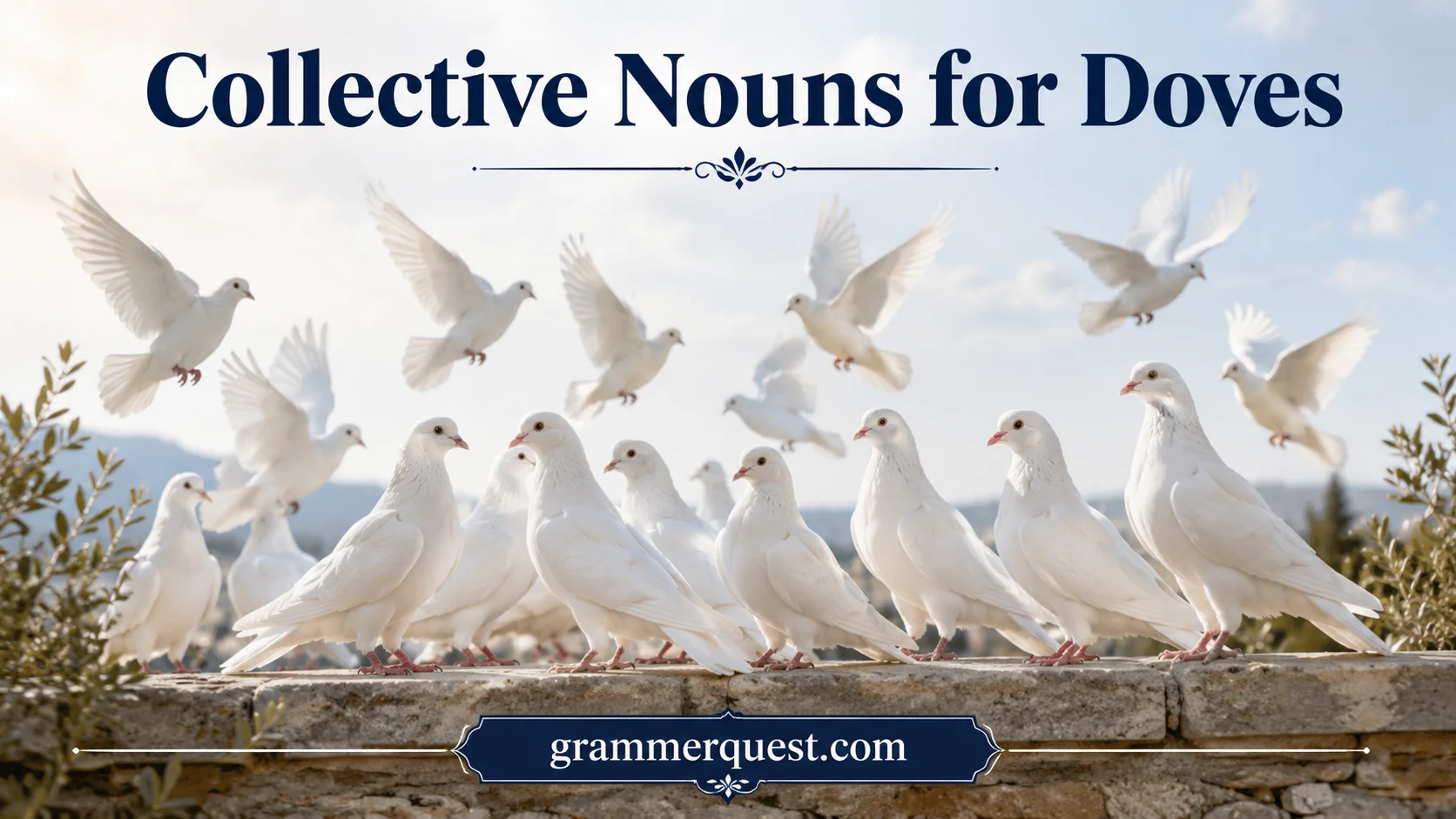
Collective Nouns for Doves are interesting because they show how language and nature connect in creative ways. Many people see doves flying together but never think about the special name given to their group. Learning these collective nouns helps improve your vocabulary while making bird facts more enjoyable. These gentle birds are often linked with peace, making their group names even more fascinating to discover and remember in everyday learning.
Doves are known for their calm behavior, soft sounds, and beautiful appearance, which is why they attract bird lovers worldwide. Understanding bird group names can make conversations, writing, and learning more engaging. From classrooms to casual discussions, knowing unique animal collective nouns adds extra knowledge and fun. Exploring these terms also reveals how creative the English language can be when describing groups of animals and birds.
Table: Common Collective Nouns for Doves
| Collective Noun | Simple Example |
| Bevy | A bevy of doves resting in the garden |
| Flight | A flight of doves crossing the sky |
| Cote | A cote of doves nesting on the roof |
| Dule | A dule of doves gathered near water |
| Flock | A flock of doves feeding in the field |
Bevy of Doves
A bevy of doves usually refers to a group of doves resting or gathered closely together, often on the ground or in trees.
Examples
- A bevy of doves gathered peacefully in the park.
- We saw a bevy of doves near the fountain.
- A bevy of doves rested under the shade of a tree.
- The bevy of doves scattered when we approached.
- A bevy of doves cooed softly in the morning.
- The garden attracted a bevy of doves daily.
- A bevy of doves fed on scattered grains.
- Children watched a bevy of doves in amazement.
- A bevy of doves formed a calm circle on the ground.
- The farmer noticed a bevy of doves near his crops.
Flight of Doves
A flight of doves describes doves while they are flying together in the sky, often in a graceful and coordinated movement.
Examples
- A flight of doves crossed the orange sunset sky.
- We admired a flight of doves above the hills.
- A flight of doves moved in perfect harmony.
- The sky filled with a flight of doves at dawn.
- A flight of doves circled the old tower.
- The children watched a flight of doves in wonder.
- A flight of doves disappeared into the clouds.
- A sudden flight of doves startled the villagers.
- The festival began with a flight of doves released.
- A flight of doves glided smoothly over the river.
Cote of Doves
A cote of doves refers to doves living or nesting together, often in a sheltered place like a barn, loft, or roof space.
Examples
- A cote of doves nested in the old barn.
- The roof had a cote of doves living peacefully.
- A cote of doves cooed softly at dusk.
- Farmers often notice a cote of doves in sheds.
- A cote of doves built nests in the corners.
- The abandoned house became home to a cote of doves.
- A cote of doves stayed warm during winter nights.
- We found a cote of doves under the bridge.
- A cote of doves raised their young in safety.
- The attic sheltered a cote of doves quietly.
Dule of Doves
A dule of doves is an older and less commonly used term, often referring to a mournful or peaceful gathering of doves.
Examples
- A dule of doves gathered near the lake.
- The quiet field held a dule of doves.
- A dule of doves rested under the gray sky.
- We spotted a dule of doves at sunrise.
- A dule of doves flew slowly over the valley.
- The garden attracted a dule of doves daily.
- A dule of doves sat calmly on the fence.
- The silence was broken by a dule of doves.
- A dule of doves moved gently through the mist.
- The forest echoed with a dule of doves.
Flock of Doves
A flock of doves is the most commonly used collective noun and refers to any large group of doves together, whether feeding, flying, or resting.
Examples: Flock of Doves
- A flock of doves gathered in the open field.
- The farmer saw a flock of doves eating grains.
- A flock of doves flew across the blue sky.
- Children chased a flock of doves in the park.
- A flock of doves rested on the telephone wires.
- The city square attracted a flock of doves.
- A flock of doves took off suddenly at noise.
- The garden was filled with a flock of doves.
- A flock of doves migrated during the season.
- The sunset highlighted a flock of doves flying home.
Read More: Collective Nouns for Mallards
Interesting Facts About Doves
Doves are remarkable birds known for their peaceful symbolism and strong adaptability. They can live in both urban and rural environments and are often seen forming lifelong pair bonds. One of their most fascinating traits is their ability to navigate long distances using Earth’s magnetic field and the position of the sun.
Physiologically, doves have strong wings built for sustained flight, allowing them to migrate or travel long distances with ease. Their soft cooing sounds are produced by specialized muscles in their vocal system. Doves are also highly social birds, preferring to live and move in groups, which helps protect them from predators.
In terms of diet, doves are mainly granivorous, meaning they feed on seeds, grains, and small plant materials. They play an important role in seed dispersion, helping maintain ecological balance in their habitats.
FAQs :
1. What is a group of doves called?
A group of doves is commonly called a dule, flight, or pitying of doves.
2. Why do doves have collective nouns?
Like many animals and birds, doves have collective nouns to describe groups in a unique and creative way.
3. Are doves and pigeons the same birds?
Doves and pigeons belong to the same bird family, but they may differ in size and appearance.
4. Why are doves associated with peace?
Doves are often symbols of peace, love, and harmony because of their gentle nature.
5. Do all bird species have collective nouns?
Many bird species have special collective nouns, although some are more popular than others.
6. What does a flight of doves mean?
A flight of doves refers to a group of doves flying together.
7. Where are doves commonly found?
Doves live in many habitats worldwide, including forests, cities, and gardens.
8. Why should I learn collective nouns for birds?
Learning collective nouns improves vocabulary and makes writing and speaking more interesting.
9. Are collective nouns important in English grammar?
Yes, collective nouns are an important part of English because they describe groups as a single unit.
10. What makes doves unique among birds?
Doves are known for their calm behavior, soft cooing sounds, and symbolic meaning.
Conclusion :
Learning Collective Nouns for Doves helps you understand both the beauty of language and the uniqueness of birds. These special group names make learning more enjoyable while expanding your vocabulary. Whether you are studying grammar, writing content, or simply exploring bird facts, knowing collective nouns adds extra knowledge and m

Emma Brooke is a passionate language enthusiast and the voice behind GrammarQuest.com. With a sharp eye for detail and a love for clear communication, she simplifies complex grammar rules into easy, practical lessons. Her goal is to help you write with confidence, clarity, and style—whether you’re a student, professional, or everyday writer.