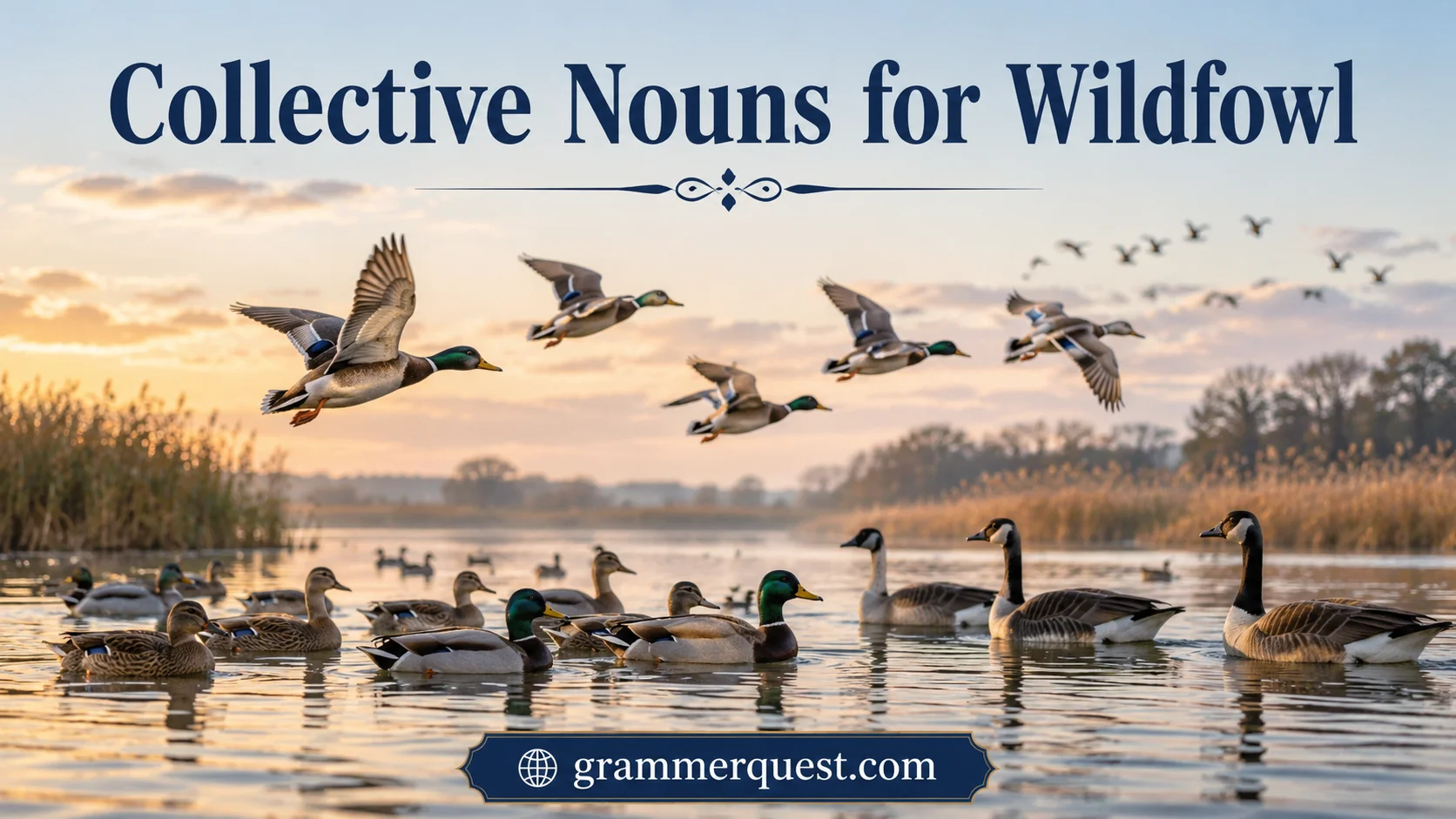
Collective Nouns for Wildfowl refer to the special words we use for birds such as ducks, geese, and swans when they gather in groups. In daily speech, flock is the most familiar term, but the English language also offers richer names like raft, paddling, skein, sord, and badling. These expressions often describe how the birds move on water, fly in the air, or walk on land, making them both useful and memorable for bird lovers and grammar learners alike today.
Many of these collective nouns began as terms of venery, a playful part of older English that hunters and writers once used to sound precise and stylish. Some, like flock and pride, became everyday words, while others survived as charming curiosities. For birdwatchers and language lovers, these names add color, history, and personality to simple descriptions. They also show how one group of wildfowl can be described in several ways, depending on context and movement in natural, everyday English usage.
Table: Common Collective Nouns for Wildfowl
| Type of Wildfowl Group | Collective Noun | Simple Example |
| Geese on the ground | Gaggle | A gaggle of geese |
| Geese in flight | Skein | A skein of geese flying |
| Ducks on water | Raft | A raft of ducks |
| Ducklings | Paddling | A paddling of ducklings |
| Ducks (general group) | Badling | A badling of ducks |
Gaggle of Geese
What is a Gaggle?
A gaggle refers to a group of geese when they are on land or water but not flying. It is one of the most commonly used collective nouns for wildfowl.
Example
- A gaggle of geese was walking across the field.
- We saw a gaggle of geese near the pond.
- The gaggle of geese made loud honking sounds.
- A gaggle of geese blocked the country road.
- Children watched a gaggle of geese at the farm.
- A gaggle of geese gathered around the lake shore.
- The farmer shooed away a gaggle of geese.
- A gaggle of geese rested under the trees.
- Tourists photographed a gaggle of geese in the park.
- A gaggle of geese slowly moved toward the water.
Skein of Geese
What is a Skein?
A skein is used to describe geese flying together in a V-shaped formation during migration.
Example
- A skein of geese flew across the sunset sky.
- We spotted a skein of geese heading south.
- The skein of geese moved in perfect formation.
- A skein of geese crossed the mountains.
- The sky was filled with a skein of geese.
- A skein of geese migrated during winter.
- The skein of geese looked like a moving arrow.
- A skein of geese flew over the river.
- The hunter watched a skein of geese pass by.
- A skein of geese disappeared into the clouds.
Raft of Ducks
What is a Raft?
A raft describes ducks floating together on water, often appearing like a floating group.
Example
- A raft of ducks floated peacefully on the lake.
- We saw a raft of ducks near the riverbank.
- The raft of ducks moved slowly with the current.
- A raft of ducks gathered in the pond.
- Children fed a raft of ducks bread crumbs.
- A raft of ducks rested under the bridge.
- The raft of ducks looked calm and relaxed.
- A raft of ducks swam together in harmony.
- The morning sun shone on a raft of ducks.
- A raft of ducks glided across the water surface.
Paddling of Ducklings
What is a Paddling?
A paddling refers to a group of young ducks (ducklings) swimming together, usually under the care of their mother.
Example
- A paddling of ducklings followed their mother.
- The paddling of ducklings crossed the pond safely.
- We saw a paddling of ducklings near the shore.
- A paddling of ducklings swam in a straight line.
- The paddling of ducklings looked very cute.
- A paddling of ducklings stayed close together.
- The farmer watched a paddling of ducklings.
- A paddling of ducklings explored the water.
- The paddling of ducklings rested near the reeds.
- A paddling of ducklings learned to swim.
Badling of Ducks
What is a Badling?
A badling is a less commonly used term for a group of ducks, often seen together on land or water.
Example
- A badling of ducks gathered near the barn.
- We spotted a badling of ducks in the field.
- The badling of ducks moved toward the pond.
- A badling of ducks rested under the trees.
- The badling of ducks quacked loudly together.
- A badling of ducks searched for food.
- Tourists watched a badling of ducks at sunrise.
- The badling of ducks crossed the muddy path.
- A badling of ducks swam across the canal.
- The badling of ducks stayed close to each other.
Read More: Collective Nouns for Doves
Interesting Facts About Wildfowl
Wildfowl are fascinating birds known for their strong social behavior, long migration patterns, and adaptability to different environments. Many species, such as ducks and geese, can live for over 10 to 25 years depending on their habitat and protection from predators. Their long lifespan allows them to form strong social bonds within their groups.
Physiologically, wildfowl have waterproof feathers due to a special oil gland near their tails, which helps them stay dry while swimming. Their webbed feet make them excellent swimmers, while their lightweight bones support long-distance flight. These adaptations make them highly efficient in both water and air environments.
In terms of diet, wildfowl are generally omnivorous. They feed on aquatic plants, small insects, seeds, and sometimes small fish or invertebrates. Their feeding habits often depend on the season and availability of food, which is why they migrate to different regions throughout the year.
FAQs:
1. What is the collective noun for wildfowl?
The most common collective noun for wildfowl is flock, but other words can also be used depending on the bird and situation.
2. What is the collective noun for ducks?
A group of ducks is often called a flock, raft, or paddling.
3. What is the collective noun for geese?
A group of geese is usually called a gaggle on land and a skein when flying.
4. What is the collective noun for swans?
A group of swans is called a bevy on water and a wedge in flight.
5. Why do wildfowl have different collective nouns?
Different collective nouns describe how the birds move, where they are, or how they behave together.
6. Is “flock” the correct word for all birds?
Yes, flock is widely accepted for many birds, including wildfowl, but more specific terms can also be used.
7. What does “raft” mean for ducks?
Raft describes ducks floating closely together on water.
8. What does “paddling” mean for ducks?
Paddling is a group of ducks swimming or moving together in water.
9. What are terms of venery?
Terms of venery are old and often playful collective nouns for groups of animals.
10. Are these collective nouns used in everyday English?
Some are common, like flock and gaggle, while others are more traditional or poetic.
Conclusion:
Collective nouns for wildfowl make English more vivid, interesting, and fun to learn. Words like flock, raft, paddling, gaggle, and skein help us describe birds in a more exact and creative way. Whether you are a birdwatcher, student, or language lover, these special terms add color and charm to everyday speech.

George Whitaker is the voice behind GrammarQuest, dedicated to making grammar simple, engaging, and easy to understand. He helps learners turn confusion into confidence with clear explanations and real-world examples.