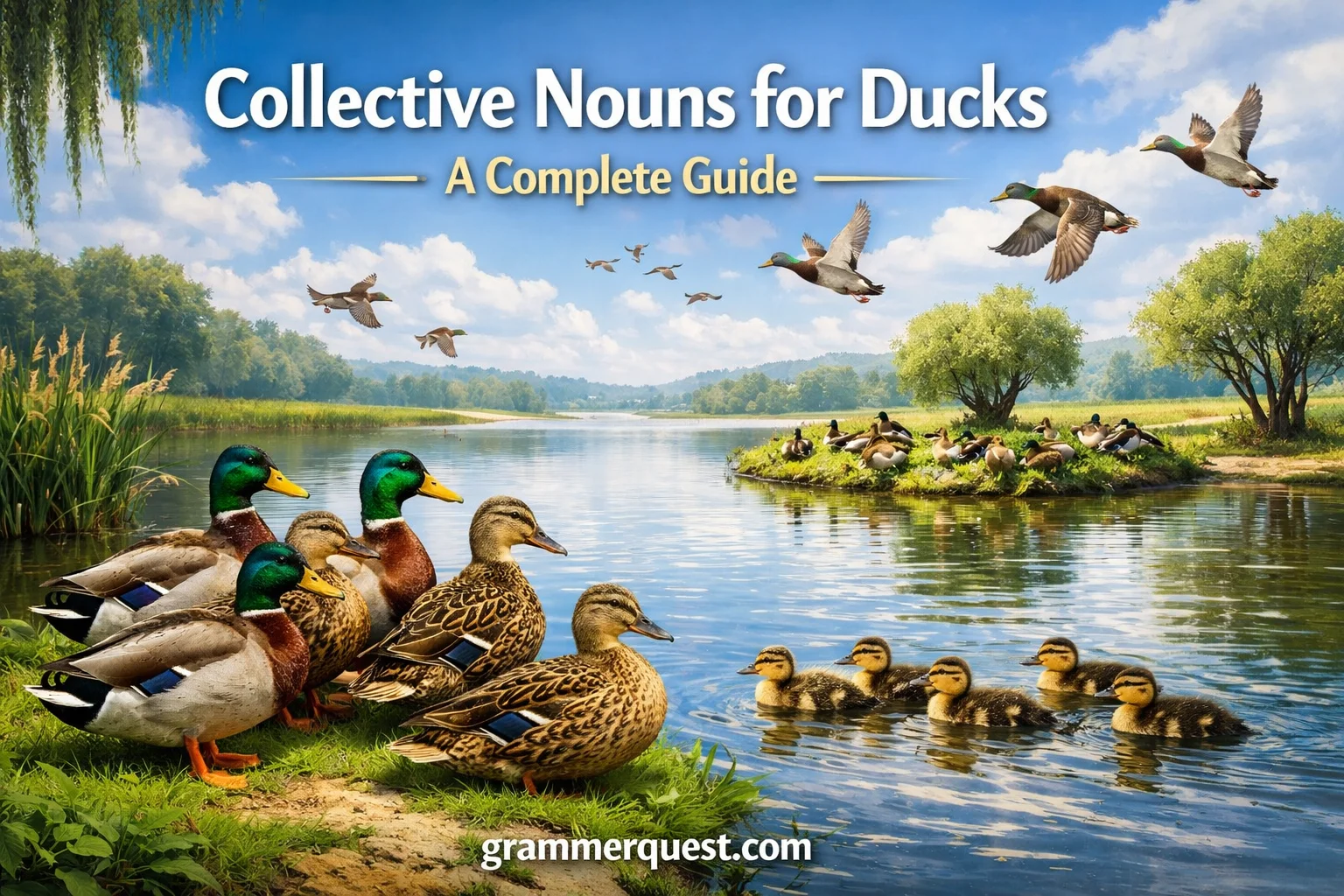
Collective Nouns for Ducks: A Complete Guide shows how ducks are social, noisy birds living in groups, often seen swimming, waddling, and floating together on water.
From my time on a small farm, I observed how ducks move in close-knit groups with a strong family bond. You can see babies trailing behind their mothers, creating a calm and beautiful sight. On an average day, a group may look small, but in the wild, they gather in hundreds or thousands, often floating on a pond. I once kept a motley assortment in my backyard, calling them a herd, which felt natural but was actually wrong.
When investigating the correct name, the collective noun varies based on activity. A flock is the most widely known term, but others like raft, paddling, flight, skein, sord, badling, and team are also used. These terms come from terms of venery, a funny language style invented by medieval hunters. Some became obsolete, but a few like pride of lions stayed in everyday speech, while others remain curiosities in our lexicon.
Common Collective Nouns for Ducks
Below is a simple table to help you understand the most common collective nouns used for ducks:
| Collective Noun | Type/Usage | Example |
|---|---|---|
| Flock | General group of ducks, especially when flying or gathered together | A flock of ducks flew overhead. |
| Raft | Ducks floating together on water | A raft of ducks rested on the lake. |
| Team | Ducks moving together on land | A team of ducks waddled across the field. |
| Paddling | Ducks swimming together | A paddling of ducks moved quietly across the pond. |
| Brace | A pair of ducks, often used in hunting terminology | He saw a brace of ducks near the reeds. |
Detailed Examples of Collective Nouns for Ducks
Flock of Ducks
Examples:
- A flock of ducks flew across the sunset sky.
- We watched a flock of ducks land gracefully on the pond.
- The farmer fed a flock of ducks every morning.
- A flock of ducks gathered near the riverbank.
- Children pointed at a flock of ducks passing overhead.
Raft of Ducks
Examples:
- A raft of ducks floated peacefully on the lake.
- We spotted a raft of ducks drifting with the current.
- The calm water held a raft of ducks near the shore.
- A raft of ducks rested quietly at dawn.
- Tourists admired a raft of ducks in the park pond.
Team of Ducks
Examples:
- A team of ducks crossed the road together.
- The team of ducks searched for food near the grass.
- A team of ducks moved in perfect harmony.
- We saw a team of ducks walking beside the lake.
- A team of ducks followed the leader closely.
Paddling of Ducks
Examples:
- A paddling of ducks swam across the river.
- The paddling of ducks created ripples in the water.
- We enjoyed watching a paddling of ducks at the park.
- A paddling of ducks gathered near the dock.
- The paddling of ducks moved slowly in the pond.
Brace of Ducks
Examples:
- He observed a brace of ducks near the wetland.
- A brace of ducks flew low over the water.
- The hunter spotted a brace of ducks in the distance.
- A brace of ducks rested among the reeds.
- We saw a brace of ducks swimming together.
Read More: Collective Nouns for Curs
Interesting Facts About Ducks
- Ducks are highly social birds and often live in groups for safety and companionship.
- They have waterproof feathers due to a special oil they spread while grooming.
- Ducks can sleep with one eye open to stay alert for predators.
- Some species of ducks migrate thousands of miles every year.
- Ducks communicate using a variety of sounds, including quacks and whistles.
- Baby ducks, called ducklings, can swim almost immediately after hatching.
- Ducks play an important role in ecosystems by helping control insects and spreading plant seeds.
FAQs:
1. What is the most common collective noun for ducks?
The most common term is a flock, and it is widely used in everyday speech.
2. What do you call ducks on water?
When ducks are on water, they are often called a raft or a paddling.
3. What is a group of ducks in the air called?
A group of ducks flying is known as a flight or a skein.
4. Are there unusual names for duck groups?
Yes, rare terms like sord, badling, and team are also used.
5. Why are there different names for duck groups?
The names change based on their behavior, such as swimming, flying, or waddling.
6. What are terms of venery?
These are old naming traditions created by medieval hunters for animal groups.
7. Are these collective nouns still used today?
Some like flock are common, while others are mostly curiosities.
8. Can ducks live in large groups?
Yes, ducks can gather in hundreds or even thousands in the wild.
9. Is it wrong to call ducks a herd?
Yes, herd is incorrect, though people sometimes use it casually.
10. Why are collective nouns interesting?
They add fun and depth to language, especially for a logophile or nature lover.
Conclusion:
Understanding collective nouns for ducks helps us see how language connects with nature. Whether it’s a flock, raft, or paddling, each term reflects how ducks behave together, making learning both simple and enjoyable.

George Whitaker is the voice behind GrammarQuest, dedicated to making grammar simple, engaging, and easy to understand. He helps learners turn confusion into confidence with clear explanations and real-world examples.