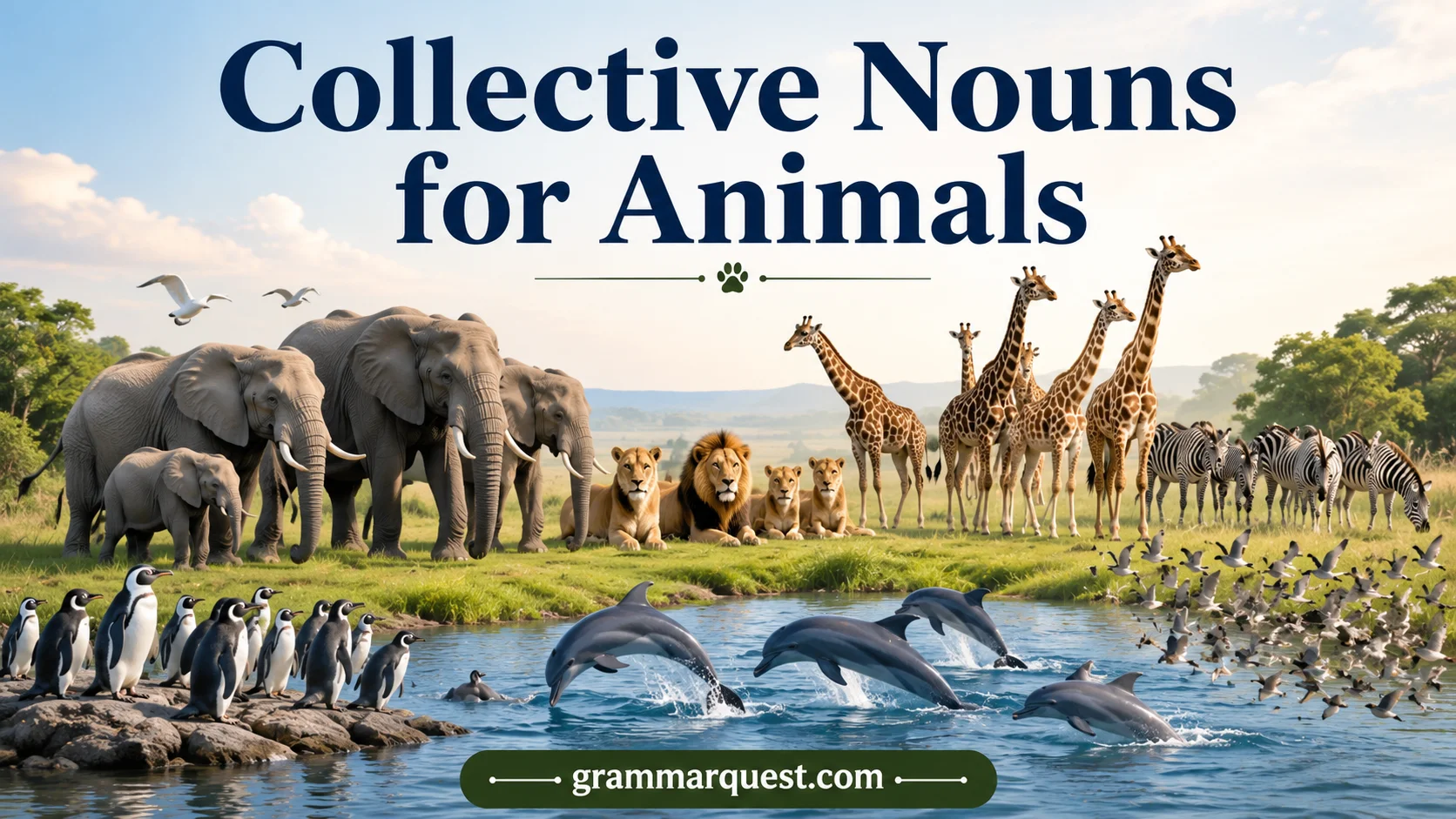
Collective Nouns for Animals are special words used for a group of living things. In daily English, we often say a pack of dogs, a pride of lions, or a herd of buffalo. These animal group names make language more interesting and easy to remember. Some names come from old English vocabulary, while others were used in medieval sources and technical hunting terms. They are part of common usage and help us describe animals in a clearer way.
Many collective nouns sound unusual, but they are still fun to learn. A flock of birds, a pod of whales, a clowder of cats, and a gathering of flamingos are good examples. Some words are very quirky, yet they are widely known in written English and spoken English. These proper terms also appear in lists, examples, and group terminology, making them useful for anyone who wants to understand animal names better.
Collective Nouns for Animals Table
| Animal Type | Collective Noun | Simple Example |
| Lions | Pride | A pride of lions rested near the trees. |
| Wolves | Pack | A pack of wolves ran through the forest. |
| Fish | School | A school of fish swam together. |
| Birds | Flock | A flock of birds flew across the sky. |
| Elephants | Herd | A herd of elephants crossed the river. |
| Monkeys | Troop | A troop of monkeys climbed the branches. |
| Crows | Murder | A murder of crows sat on the fence. |
| Bees | Swarm | A swarm of bees surrounded the flowers. |
| Dolphins | Pod | A pod of dolphins jumped in the sea. |
| Cattle | Herd | A herd of cattle grazed in the field. |
Common Collective Nouns for Animals
Herd of Animals
A herd is commonly used for large grazing animals such as elephants, cattle, deer, and sheep. These animals usually travel together for protection and food.
Examples
- A herd of elephants walked slowly across the plains.
- The herd of cattle rested near the barn.
- We saw a herd of deer in the forest.
- A herd of sheep followed the farmer.
- The herd moved together during the storm.
- A herd of buffalo crossed the river.
- The herd searched for fresh grass.
- The herd stayed close for safety.
- A herd of goats climbed the rocky hill.
- The herd gathered near the waterhole.
Pack of Animals
A pack is often used for animals that hunt or travel together, especially wolves and wild dogs.
Examples
- A pack of wolves howled at night.
- The pack hunted together in the snow.
- A pack of wild dogs chased the prey.
- The pack rested after hunting.
- We heard a pack moving through the forest.
- The pack protected its young members.
- A pack of foxes ran quickly.
- The pack stayed close during winter.
- Hunters spotted a pack near the hills.
- The pack searched for food together.
Flock of Animals
A flock usually describes groups of birds, but it can also refer to sheep and goats.
Examples
- A flock of birds flew over the lake.
- The flock landed on the tree branches.
- We watched a flock of ducks swim together.
- A flock of sheep moved across the field.
- The flock circled in the sky.
- Farmers guided the flock into the barn.
- A flock of geese migrated south.
- The flock rested near the riverbank.
- A flock of pigeons gathered in the park.
- The flock scattered after hearing a loud sound.
School of Animals
A school is used for fish and other sea creatures swimming together in large groups.
Examples
- A school of fish swam near the coral reef.
- The school moved quickly through the water.
- Divers saw a school of tuna underwater.
- A school of fish avoided the shark.
- The school glittered in the sunlight.
- Fishermen followed the school across the sea.
- A school of sardines swam together.
- The school changed direction suddenly.
- Children watched the school in the aquarium.
- A large school passed near the boat.
Pride of Animals
A pride is the collective noun mainly used for lions living together in groups.
Examples
- A pride of lions rested under the tree.
- The pride protected its cubs carefully.
- We saw a pride near the watering hole.
- The pride hunted during the night.
- A strong lion led the pride.
- The pride moved across the grasslands.
- Tourists photographed the pride from a jeep.
- The pride slept during the hot afternoon.
- A pride of lions roared loudly.
- The pride worked together while hunting.
Read More: Collective Nouns for Goslings
Interesting Facts About Animals
Animals Have Incredible Longevity
Many animals can live for surprisingly long periods. Giant tortoises are famous for living more than 100 years, while some whales can survive for over two centuries. Parrots are also known for their long lives, with certain species living for several decades. Longevity often depends on habitat, diet, and protection from predators. Animals that live longer usually develop slower growth patterns and strong survival instincts that help them adapt to changing environments.
Animals Have Unique Physiological Features
Animals possess remarkable body features that help them survive in nature. Camels can store fat in their humps to survive harsh deserts, while polar bears have thick fur and layers of fat to stay warm in icy climates. Birds have hollow bones that make flying easier, and chameleons can change colors for protection and communication. Some fish produce light in the deep ocean through a process called bioluminescence, helping them attract food or escape danger.
Animals Have Diverse Dietary Habits
Different animals follow different diets depending on their environment and body structure. Herbivores like cows and deer eat plants and grass, while carnivores such as lions and tigers survive by hunting meat. Omnivores like bears and humans eat both plants and animals. Some animals have highly specialized diets; for example, pandas mainly eat bamboo, and anteaters feed mostly on ants and termites. These dietary habits help maintain balance in ecosystems around the world.
Why Collective Nouns Matter
Collective nouns are important because they make language more expressive and descriptive. Instead of repeatedly saying “many animals,” people can use specific terms like herd, pack, or flock to create clearer images in the reader’s mind. These words also reveal how animals behave socially in nature.
Understanding collective nouns helps students, writers, and wildlife lovers appreciate the richness of the English language and the fascinating lifestyles of animals. It also encourages curiosity about how animals live, communicate, travel, and protect one another in groups.
FAQs :
1. What are collective nouns for animals?
Collective nouns are special words used to describe a group of animals like a pack of dogs or a pride of lions.
2. Why do animals have group names?
They help describe animals in a more interesting and specific way in English.
3. What is a group of lions called?
A group of lions is called a pride.
4. What is a group of dogs called?
A group of dogs is called a pack.
5. What is a group of birds called?
A group of birds is often called a flock.
6. What is a group of whales called?
A group of whales is called a pod.
7. Are collective nouns still used today?
Yes, many are used in spoken and written English every day.
8. Are all animal group names official?
No, some come from old or medieval sources and are rarely used.
9. What is a group of cats called?
A group of cats is called a clowder.
10. Why are collective nouns interesting?
Because many of them are creative, unique, and sometimes very quirky.
Conclusion
Collective nouns for animals make the English language more expressive and fun. They help us describe animal groups like lions, birds, whales, and cats in a simple and meaningful way. While some terms come from old history and are rarely used, others are still common in everyday communication.

Henry Collins is a passionate grammar expert and the voice behind GrammerQuest.com. With a sharp eye for language and a love for clear communication, he simplifies complex grammar rules into easy, practical lessons.